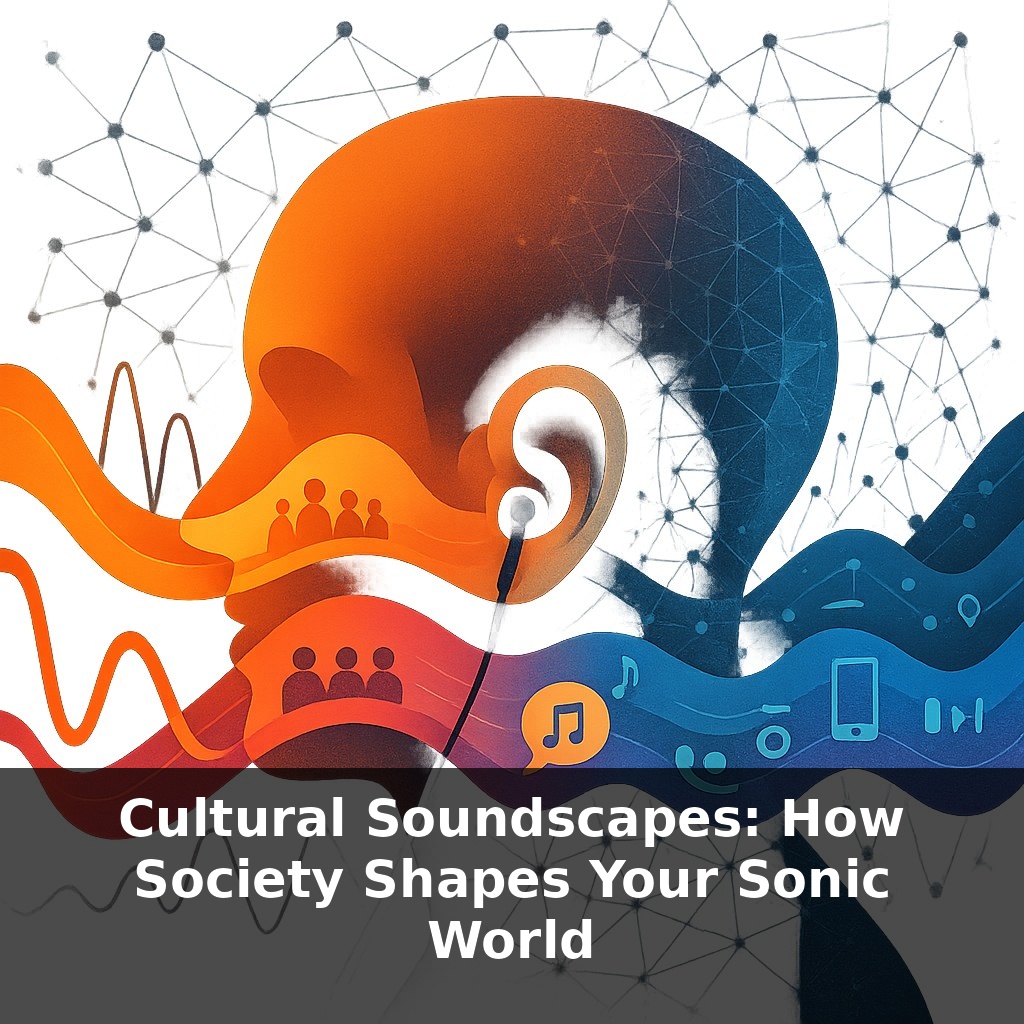
Right now, your favorite song is probably less “you” than you think. Before you ever pressed play, your culture, your friends, and a few invisible algorithms were already tuning your ears. This episode asks a simple question: whose taste are you really hearing?
By now, we’ve seen how your emotions, memories, and even pain levels can be tuned by sound. Today we’re zooming out: not into your brain, but into the world that decides which sounds ever reach it.
Think about the last time you walked through a mall, scrolled TikTok, or sat in a café. None of those playlists were random. They were chosen to keep you browsing, lingering, or scrolling just a bit longer. That constant background soundtrack quietly narrows what feels “normal” to your ears.
Research shows this starts shockingly early: by six months old, babies are already locking onto the rhythmic patterns common in their local music. Later, school assemblies, sports chants, protest songs, movie scores, and even national anthems keep reinforcing a shared sonic “accent.”
In this episode, we’ll unpack how those everyday soundscapes train your taste—often without you ever hitting play.
Take a second and rewind your day by sound alone: the notification pings, the hum of traffic, the theme music before your favorite show, the neighbor’s playlist bleeding through the wall. Most of this noise wasn’t “chosen” by you, yet it still sneaks into your mental archive of what music feels current, dated, classy, or trashy. Even silence has a social shape—compare the hush of a library to the murmur of a bar. These layers of everyday audio work like a city’s zoning laws, quietly deciding which kinds of music feel at home in which parts of your life. You’re not just hearing music; you’re hearing social rules.
Walk into a stadium during a home game and listen with your eyes closed. The drums, chants, and call‑and‑response songs aren’t just “background hype”—they’re scripts for who belongs. Sociologists call this *sonic branding of identity*: the way groups use particular sounds to mark insiders and outsiders as clearly as a uniform does.
This shows up everywhere. Subcultures carve out their own audio flags: punk scenes with distorted guitars in tiny venues, lo‑fi beats in study corners, gospel chords in churches, hyper‑processed pop in shopping districts. The sound itself matters less than the badge it becomes. When you hit play, you’re often signaling “my people” as much as seeking pleasure.
Crucially, these badges shift over time. Genres that started as rebellion—jazz, rock, hip‑hop—were once coded as dangerous or low‑status in many places. As they get absorbed into ads, movies, and official events, the same sounds can flip to “classic,” “heritage,” or “family‑friendly.” Your sense that something is “timeless” is often just a sign that it won a long, noisy status battle.
Technology accelerates those battles. Radio once filtered everything through a handful of gatekeepers; today, streaming platforms slice listeners into micro‑markets: “mood,” “era,” “vibe,” “productivity.” That reshapes how you think about music’s purpose. A track becomes less a singular artwork and more a tool: for working out, concentrating, crying, flirting, or “aestheticizing” a commute.
There’s also what you *don’t* hear. Noise ordinances, licensing fees, and even architecture decide which sounds are allowed to leak into shared space. Street performers pushed out of city centers, buskers limited to certain hours, religious calls to prayer restricted or defended by law—these choices curate whose music is treated as culture and whose is treated as nuisance.
Think of it like a financial portfolio you didn’t realize someone else diversified for you: mainstream hits, nostalgic throwbacks, a few “discoveries,” maybe one or two global genres. You feel like you built it from scratch, but most of the options were pre‑selected. The more you notice those invisible curators—institutions, platforms, neighbors—the more deliberately you can rebalance what you let into your ears.
Step into a wedding, a protest, and a luxury store in the same week and listen for the “instructions” baked into the sound. At the wedding, the DJ’s slow‑dance picks tell you when to cling close, when to form a circle, when to shout‑sing the chorus with cousins you barely know. At the protest, drums and chant‑ready phrases organize bodies as much as placards do, turning strangers into a moving unit. In the boutique, sparse, polished tracks signal you’re supposed to move gently, touch carefully, maybe spend a bit more.
Notice how some sounds act like passports. Knowing the lyrics at a underground rap show gets you approving nods; singing along to a niche indie track at a house party can spark instant friendship. Other sounds work like velvet ropes: a harsh “NO MUSIC” sign in a park, or a cafe that swaps local bands for curated “international chill” to seem more upscale.
Your playlist isn’t just private taste—it’s a map of where you’ve been allowed to belong, and where you’re still sonically “checking in” as a tourist.
Soon, you might carry parallel sonic identities: one for work calls in AR, another for fandom spaces in VR, each with its own theme songs, in‑jokes, and “inside” sounds. AI will both remix archives and fabricate artists, raising questions about who owns a tradition when a model can imitate it in seconds. Your challenge this week: audit one day of your listening and tag each moment as local ritual, global trend, or algorithmic wildcard—then ask which category you want more of.
As you start noticing these patterns, try gently breaking them. Swap your usual workout mix for a genre you’ve never touched, or trade playlists with someone from a different generation or city. Treat it like taking the “scenic route” home: a small detour that reveals side streets, hidden landmarks, and futures your ears weren’t planning on.
Here’s your challenge this week: for three days in a row, spend 10 minutes in a different “cultural soundscape” you normally ignore—one day in a busy café, one on public transit or a street corner, and one in a quiet space like a library or park—and record a 30-second audio clip from each. Each time, label the clip with where you are, the dominant sounds (voices, machines, nature, music, etc.), and one way those sounds are shaping how people behave in that space. At the end of the three days, pick the one soundscape that made you feel most different from your “usual” self and deliberately recreate a piece of it at home (background café chatter, street noise, or silence) while doing something you care about, then note how your mood or focus changes.