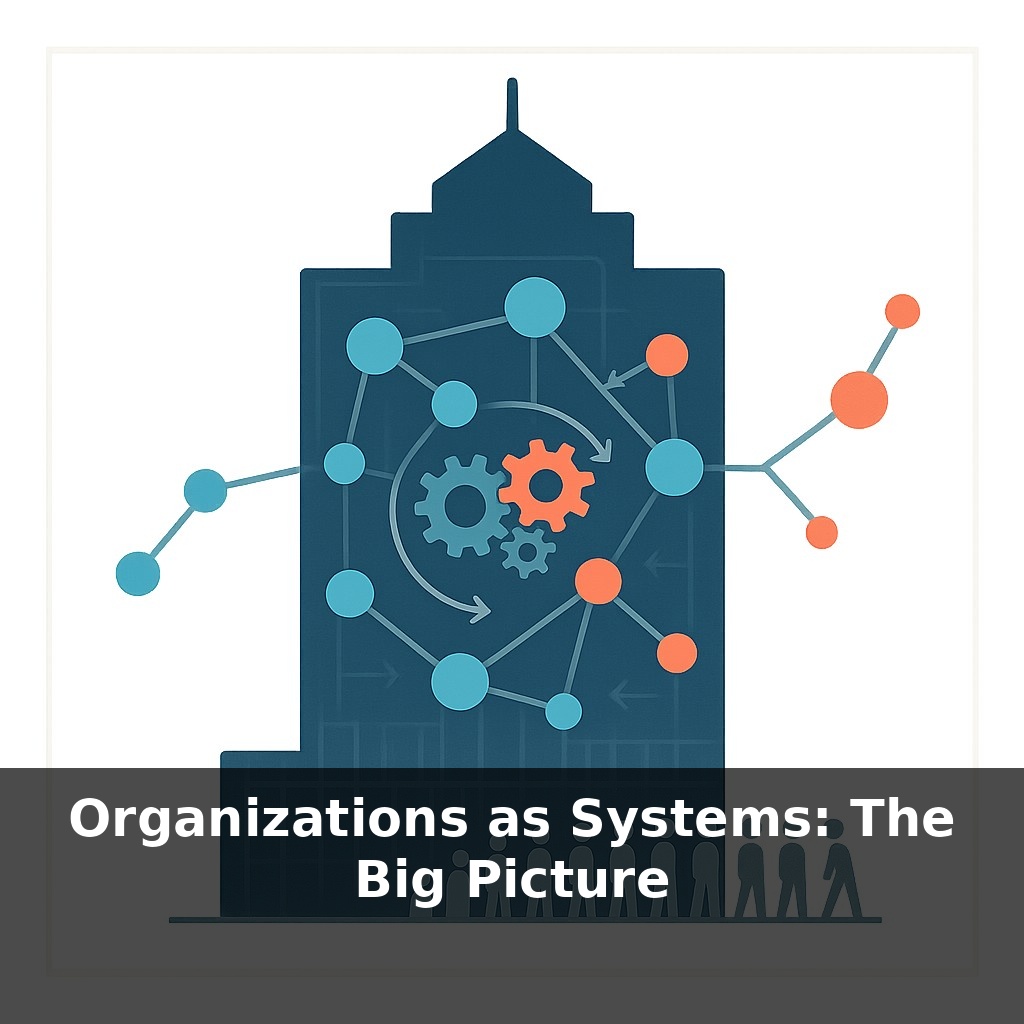
Organizations as Systems: The Big Picture
📝 Transcript
A global bank spent millions on a “transformation” that made customer wait times longer. The paradox? Every department hit its targets. This episode asks: how can an organization do everything “right” in the parts, and still fail spectacularly as a whole?
Most careers are built inside organizations that quietly work against themselves. Not because people are lazy or leaders are clueless, but because the “wiring” of the system nudges everyone toward local wins and global losses. Think of a kitchen where the appetizer chef, grill cook, and dessert station each run perfectly—but plates still reach guests cold and out of order. In many companies, that’s normal.
Here’s the twist: you experience these systemic effects every day, you’re just trained to explain them as “communication issues” or “resistance to change.” In this episode, we’ll zoom out from individual performance and team dynamics to see how structure, incentives, information flows, and feedback loops quietly shape behavior. The goal isn’t to blame “the system,” but to notice it—so you can navigate it, influence it, and eventually help redesign it.
Careers often stall not from lack of talent, but from treating organizations as if they were simple cause-and-effect machines. You push harder on effort, and expect output to rise in a straight line. But in real companies, moves reverberate: a small policy tweak in procurement shows up months later as developer burnout; a sales promotion quietly warps product roadmaps. What looks like “random chaos” is usually the system expressing its design. Once you start asking, “If this keeps happening, what loop might be driving it?” you shift from firefighting to pattern-hunting—and your leverage changes.
Most organizations still use mental models that belong to the factory era: draw a hierarchy, assign responsibilities, track outputs, and assume the rest will sort itself out. But once work became digital, collaborative, and fast-moving, those neat charts stopped matching reality. People now sit in one box on the org chart but participate in dozens of invisible systems: product launches, incident response, hiring pipelines, partner integrations, internal tooling.
This is why cross-functional efforts struggle. Harvard Business Review’s finding—that 75% of cross-functional teams are dysfunctional without systemic governance—isn’t about “bad teamwork.” It’s a sign that the underlying system isn’t being consciously designed. Different parts of the organization are pulling on shared constraints (time, talent, budget, attention, infrastructure) without a shared picture of how their moves interact.
Three shifts distinguish people who navigate this well:
First, they look for patterns over events. A single outage, missed deadline, or botched launch is noise. But when similar issues recur across quarters or teams, they start asking, “What recurring loop could be producing this?” They stop treating each incident as a fresh crisis and start treating it as a symptom.
Second, they get curious about delays. In dynamic systems, cause and effect rarely sit next to each other in time. A decision in Q1 might not “speak back” until Q3. Leaders who grasp this become skeptical of quick wins that quietly accumulate long-term costs—like overloading a star team to hit a launch date and then losing key people six months later.
Third, they think in flows rather than functions. Instead of fixating on who owns what, they track how work, information, and decisions actually move end-to-end. Toyota’s just-in-time approach didn’t succeed because one department was brilliant; it succeeded because production, suppliers, and logistics were tuned as a single, coherent flow that could sense strain and adjust.
Your challenge this week: Pick one recurring frustration in your work—missed handoffs, rework, surprise escalations. For seven days, each time it appears, quickly note: (1) Who was involved just before the problem surfaced, (2) What information or decision moved—or failed to move—right before it, and (3) How long the delay was between “upstream” action and “downstream” pain. At the end of the week, line up your notes chronologically. Don’t look for a villain; look for a loop. You’re starting to see your organization as a system.
Think about moments when the system “fights back.” A team automates a tedious report and celebrates the time savings—until leadership realizes those reports were their only window into a brewing risk, and suddenly new checks, reviews, and dashboards appear. Nobody reversed the change; the system just re-stabilized around a different bottleneck.
You’ll see this in hiring too. A company speeds up offers to “win talent,” but months later discovers misaligned expectations, churn, and more performance management. The original fix “worked,” yet overall friction increased. That’s often a clue you changed a visible symptom without touching the pattern underneath.
Or take pricing. A discount campaign boosts quarterly revenue, but pulls demand forward, clogs operations, and trains customers to wait for deals. Short-term metrics improve while long-term options narrow. When you notice improvements that quietly generate new constraints, you’re getting closer to seeing the real system—where every gain comes with a reshaped landscape, not a clean win.
Careers will tilt toward people who can “read” systems the way good traders read markets. As AI simulations and digital twins mature, meetings may revolve less around opinion and more around running small “what happens if…” experiments. Your value won’t just be delivering in your lane, but spotting where tiny adjustments upstream save massive downstream effort—like seasoning a dish early instead of masking it with sauce at the end. Over time, promotions will favor those who can host these systemic conversations.
As you start spotting loops, you may notice your own habits shift. Meetings feel less like battles over whose plan wins, more like joint debugging of a sprawling codebase. You’ll ask, “Where does this really start?” and “Who reacts next?” Over time, that curiosity becomes an edge: you’re not just doing tasks, you’re quietly rewriting the game.
Here’s your challenge this week: Pick one recurring cross-team problem in your organization (for example: product requirements bouncing between product and engineering, or customer complaints getting “lost” between support and operations) and map its full system flow on a single page—every handoff, decision point, and feedback loop. Then, before Friday, talk to at least three people from different parts of that flow and ask them one specific question: “What do you do *right before* and *right after* this step?” to correct your map. Finally, circle exactly two leverage points (places where a small change could prevent rework, delay, or confusion) and commit to testing one concrete tweak in that spot within the next seven days.
From this course
How Organizations Work: Systems, Power, and Culture
7 episodesUnlock all episodes
Full access to 7 episodes and everything on OwlUp.
Subscribe — $1.99/monthLess than a coffee ☕ · Cancel anytime