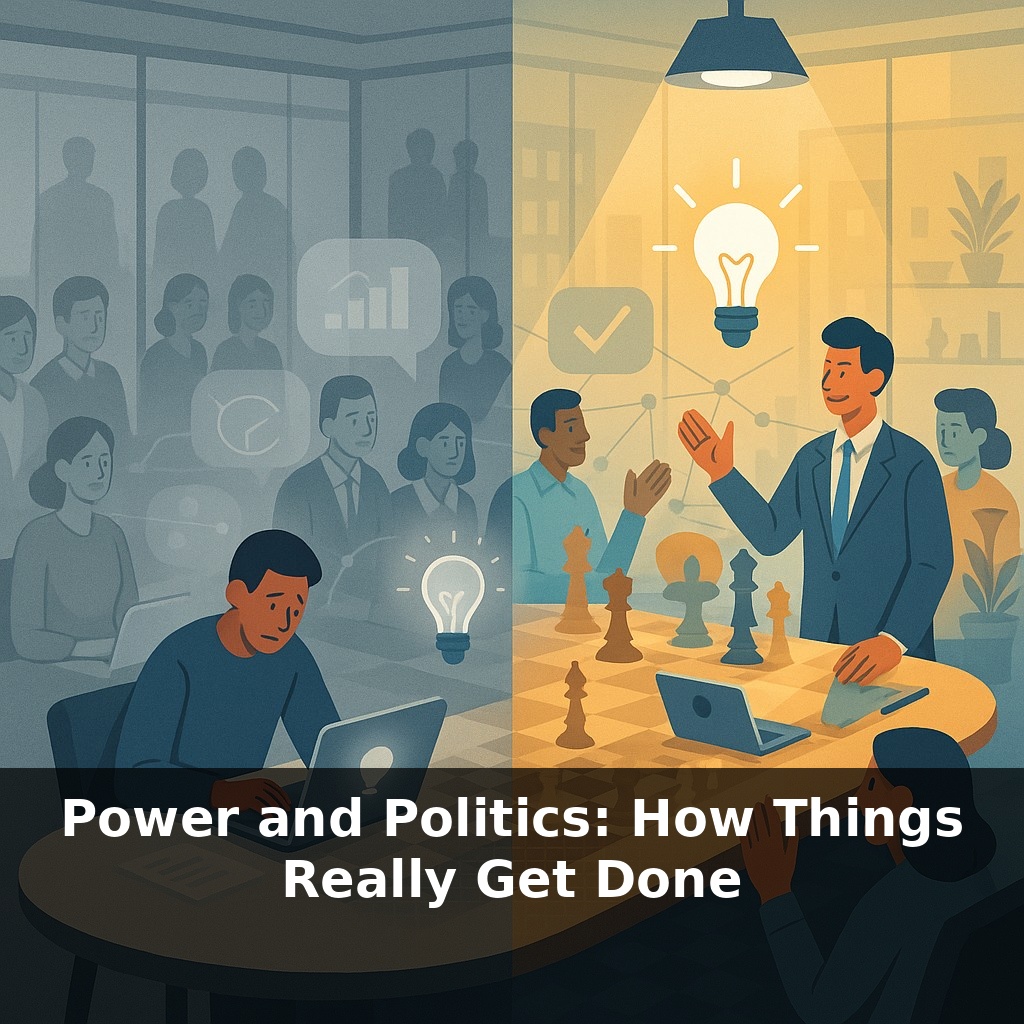
Roughly a fifth of a manager’s week goes to office politics—yet almost no one puts “politician” on their résumé. You’re in a meeting: your idea gets polite nods, then quietly dies. Later, a similar idea wins budget fast. Same logic, same data—so what really changed?
That quiet gap between a good idea and a green‑lit idea is rarely about merit alone. Under the surface, three forces are doing most of the work: the power of the role you sit in, the relationships you’ve built, and how deftly you read and move people. Think less “who had the smartest slide deck” and more “who could align the right people at the right time.”
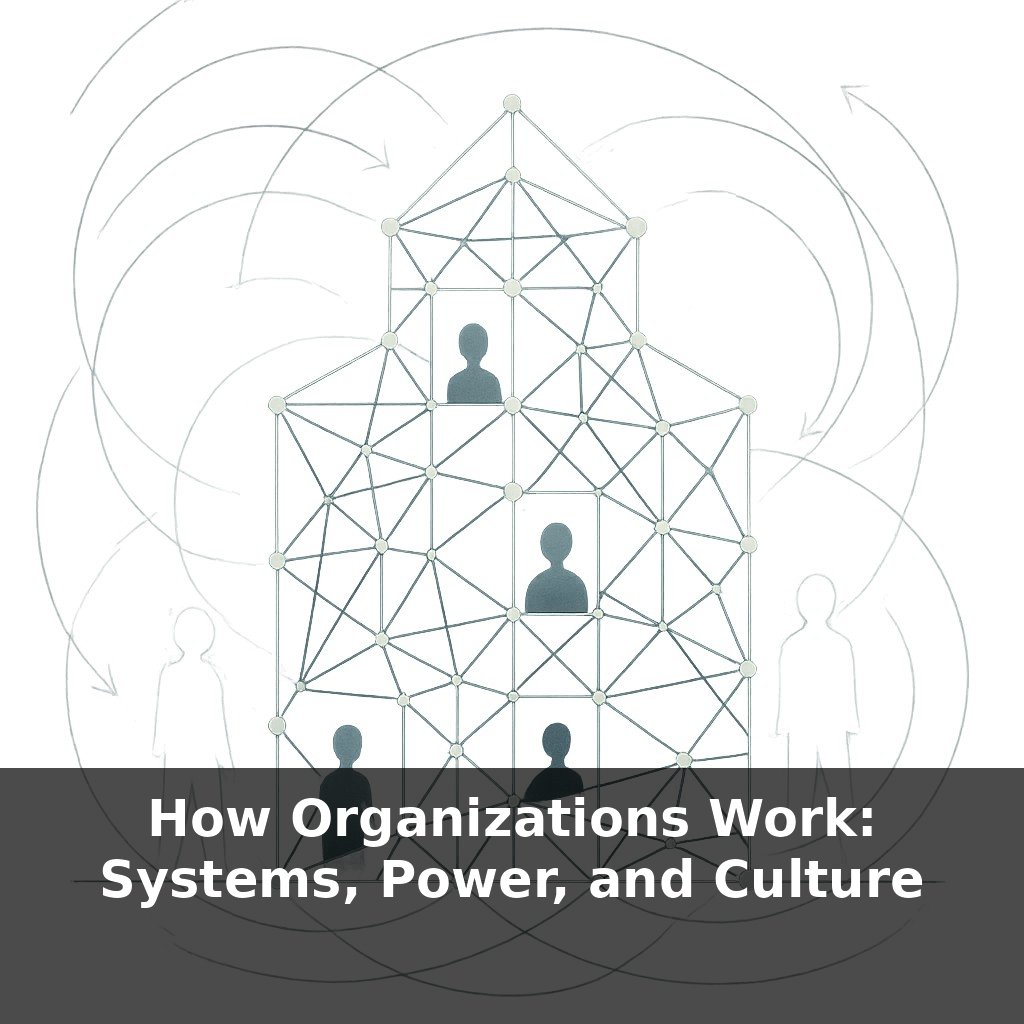
Formal org charts tell you where decisions *should* get made; informal power maps reveal where they *actually* get made. The people who move work forward fastest usually aren’t the loudest or the most senior—they’re the ones others naturally route information, favors, and early warnings through, the way side streets carry traffic when the main road jams up.
In this episode, we’ll unpack what those power maps look like, why “brokers” rise faster, and how to play this game without becoming manipulative.
Think about the last big win in your organization—a product launch, a key hire, a sudden shift in priorities. On paper, it may look like a linear story: proposal, approval, execution. In reality, it likely moved through side conversations, quiet vetoes, and a few “let me talk to them” favors that never hit email. Structural power, relationships, and political skill don’t just influence outcomes; they shape *when* issues surface, *who* gets consulted, and *which* options appear “reasonable.” It’s less a straight line and more a branching tree that gets pruned backstage long before the meeting.
Power and politics show up in three very different—but tightly linked—ways: where you sit, who you connect, and how you move in the gray areas between people.
First, consider resources and veto points. Every meaningful initiative touches at least one person who can either unlock or quietly stall it: legal, finance, security, a key country leader, a senior engineer who “blesses” architecture. They don’t have to love your idea; they just have to not block it. People with real pull often control one of three levers: money (budgets, headcount), rules (policies, risk gates), or reputation (whose name makes others relax). Trace those levers, and you start to see why some projects sail through while others get “parked for later.”
Second, look at where information actually flows. Network research shows that the people who sit between groups—engineering and sales, HQ and field, ops and product—see problems earlier and opportunities sooner. They hear the “we’d love to, but…” from multiple sides and can translate. That translation is power: it lets them frame issues so they sound reasonable to each audience, and it makes them the person others ping when something sensitive is brewing.
This is where political skill comes in. It isn’t about flattery; it’s about timing, framing, and coalition‑building. High‑skill people do a few things differently: - They surface disagreements privately before they explode publicly. - They attach their ideas to priorities that already have momentum. - They offer others a visible win, not just more work. - They adjust the story: the same proposal becomes “cost control” in one room and “growth” in another.
Notice how this changes risk. Projects don’t just fail at launch; they fail in the weeks when someone important quietly stops returning emails. The people who navigate politics well spend disproportionate time *before* the big meeting mapping stakeholders, trading small favors, and testing objections in low‑stakes conversations.
This isn’t optional soft stuff. With most change efforts still missing the mark, the real scarce resource isn’t vision or data; it’s aligned, emotionally committed stakeholders who will spend their political capital when things get hard.
A product manager once mapped every person who could quietly stall her launch. Instead of starting with her own VP, she went sideways: lunch with the finance analyst who built the cost models, a quick screen‑share with the security architect, a “can I sanity‑check this?” ping to a skeptical sales lead. By the time she walked into the formal approval meeting, three potential blockers were already saying, “Yeah, this looks reasonable.” The decision felt effortless because the real work had happened in those small, early moves.
Think of it like configuring a cloud system before go‑live. If you connect the right APIs, set permissions, and test failure paths in sandbox, the production rollout looks mundane. Skip that back‑end wiring and the same rollout turns into a crisis. Political skill is that back‑end wiring: quiet configuration of expectations, alliances, and escape hatches long before anyone hits “deploy” on a big, visible decision.
Algorithms are becoming quiet players in this game: performance scores, routing systems, even who sees which dashboard can tilt whose priorities “matter.” Those who learn to question inputs, spot hidden incentives, and co‑design metrics will shape outcomes, not just comply. Your influence may hinge less on who you convince in a room and more on which data story you help code into the system that feeds everyone else’s judgments.
Real leverage starts when you treat power like a skill you can practice, not a trait you were born (or not born) with. Notice who quietly steers priorities, how they time conversations, where data gets shaped before it’s shared. Follow those currents the way a good hiker studies streams: not to fight the flow, but to choose smarter paths through the terrain.
Try this experiment: For the next week, pick one initiative you care about at work and deliberately map the “real” power around it by watching who people defer to in meetings, who gets looped on emails late, and whose opinions quietly change the plan. Then, instead of going through the official org chart, ask one of those informal power brokers for 10 minutes and pitch your idea in a way that clearly helps *their* priorities. Notice how quickly (or not) your idea suddenly shows up in agendas, gets referenced by others, or gains resources. After a few days, compare how far this route moved your idea versus when you tried to push it through formal channels.