In one of the world’s biggest companies, a junior engineer can’t just email the CEO for approval—yet that same company ships products to millions, on time. Here’s the paradox: the very structure that blocks you from the top might be the reason the whole machine works at all.
You don’t need a giant company to feel hierarchy; you see it every time your manager “has to check with their boss,” or when a decision stalls because three directors all want a say. It’s easy to label this as politics or pointless bureaucracy. But underneath the frustrating parts, hierarchy is doing some quiet, essential work: deciding who talks to whom, about what, and when.
Think about all the projects, deadlines, and crises flying around your workplace like orders in a busy restaurant kitchen. If everyone could jump on everything, chaos would win fast. Hierarchy is one of the ways organizations narrow the firehose into focused streams of attention, so that not every issue lands on your desk—or your CEO’s.
In this episode, we’ll dig into why hierarchy keeps showing up, even in companies that claim to be “flat,” and how understanding it can actually make your work life easier.
So instead of asking “Is hierarchy good or bad?”, it’s more useful to ask, “What problems is this structure quietly solving—and where does it overreach?” Modern organizations aren’t choosing between hierarchy and freedom; they’re constantly trading off coordination, speed, and autonomy. Digital tools changed how fast information moves, but they didn’t change the limits of people’s time, attention, or cognitive bandwidth. That’s why you see firms cut layers, but not abandon them: they’re trying to keep just enough structure to keep work legible, without smothering initiative.
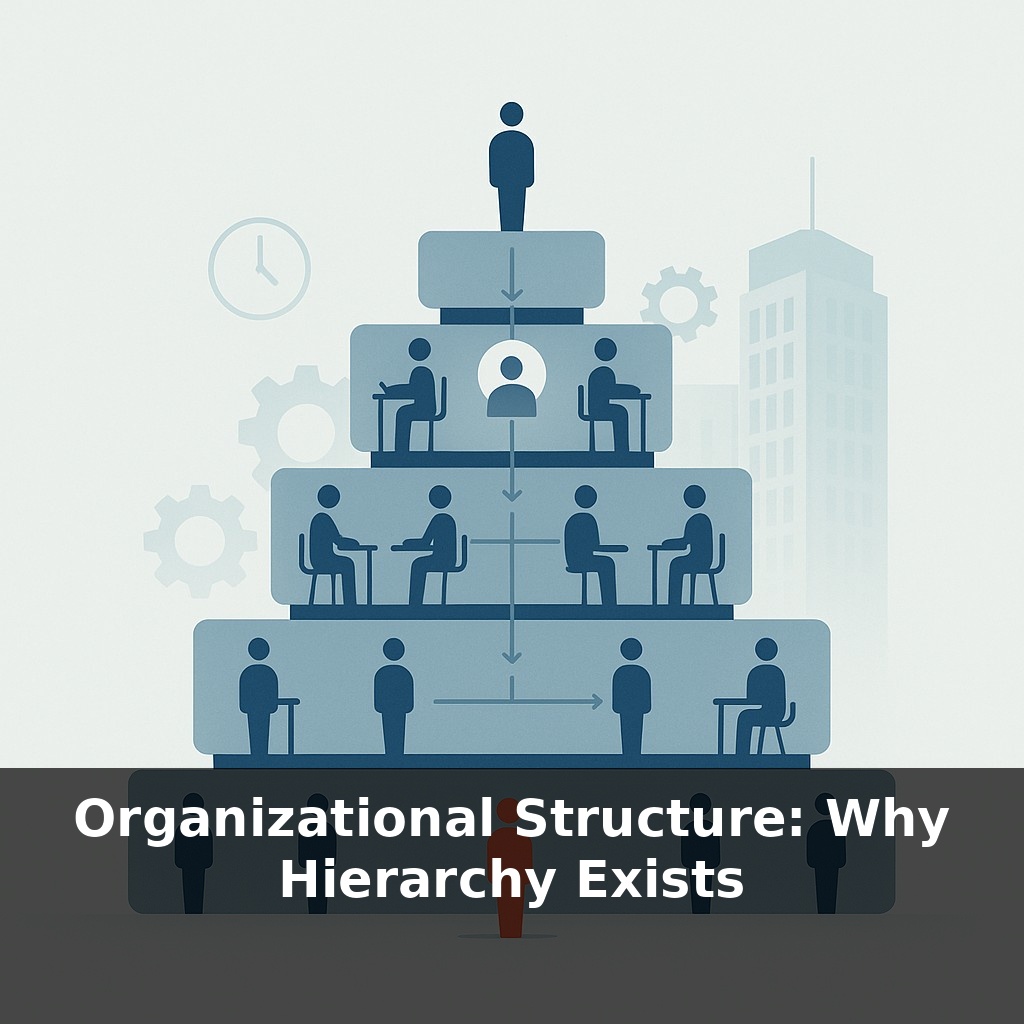
When you strip away titles and org charts, hierarchy is mostly an answer to one brutal constraint: you can’t be in 500 conversations at once. As headcount grows, the number of potential interactions explodes. With 10 people, it’s easy to “just talk.” With 1,000, trying to keep everyone equally informed and involved in every choice would paralyze the place. So organizations quietly sort people into clusters: who you check with, who you escalate to, who you mostly ignore unless there’s a fire.
This isn’t just about control; it’s about legibility. Someone has to be able to say, “If this specific kind of problem appears, here’s the person on the hook.” That’s what Gallup picked up when they linked clear roles to big jumps in productivity. When you know which lane is yours, you stop burning energy re-deciding it every week—or fighting with three peers over who owns the same decision.
You can see the same logic in how large companies slim down. Fortune 500 firms cut layers over decades not because hierarchy “died,” but because too many rungs turned simple calls into relay races. GE’s aggressive pruning under Jack Welch worked precisely because it kept a chain of command while shortening the path signals had to travel. The aim wasn’t liberation from bosses; it was fewer handoffs, faster loops.
Efforts to erase formal lines often rediscover this the hard way. Zappos’ holacracy experiment, for example, tried to replace managers with self-organizing roles and circles. On paper, it sounded empowering. In practice, people still needed to know whose “yes” actually counted when money, risk, or reputation were involved. Without visible authority, they had to infer it socially—which can feel even more political. The turnover spike wasn’t just resistance to change; it was a reaction to losing a clear map of who decides what.
That’s why “flat” usually means “flatter.” You can compress layers, push more power to the edges, and give teams more say—but you rarely escape the need for some ladder that says, in moments of conflict, whose call ends the debate.
A helpful way to see this is to drop down a level and watch how it plays out in real teams. Take a fast-growing startup that just hit 60 people. At 10 people, the founders sat in every meeting. At 60, they quietly create “leads” for sales, product, and engineering—not because they crave titles, but because deals start slipping when no one feels fully on the hook for quoting prices, shaping the roadmap, or approving launches. The new leads act like local routers: they decide which issues they’ll absorb, which to push up, and which to settle with peers.
Or look at a hospital adding a new surgical wing. They don’t just hire more surgeons and nurses; they designate a charge nurse per shift, a medical director for the unit, a coordinator for beds and schedules. Each added role is a bet that slightly slower access to “the top” is worth fewer crossed wires when lives and lawsuits are on the line.
Expect “liquid” hierarchies to emerge: roles that thicken around tough problems and thin out once patterns are stable, like dough firming in the oven and softening again with heat. Algorithms will quietly become middle managers—surfacing anomalies, nudging priorities, reallocating work. Your edge won’t be knowing where you sit in the chart, but how quickly you can read shifting power lines and plug your expertise into the right temporary ladder.
As your career unfolds, the real question isn’t “how do I escape hierarchy?” but “how do I navigate and quietly reshape it?” Start noticing where informal influence lives, where work actually gets unblocked, and where decisions repeatedly stall. Those fault lines are signals: places you can redesign workflows, build alliances, and make yourself indispensable.
Start with this tiny habit: When you open your calendar each morning, say out loud one decision you’ll delegate up the hierarchy and one you’ll keep at your level (for example, “I’ll decide how we run the team meeting, but I’ll escalate the budget trade-off to my manager”). Then, send a one-sentence message to the person above or below you explaining just that single decision and why it fits their place or yours in the structure. Do this every workday for just one decision, and notice how it slowly clarifies who owns what in your part of the organization.