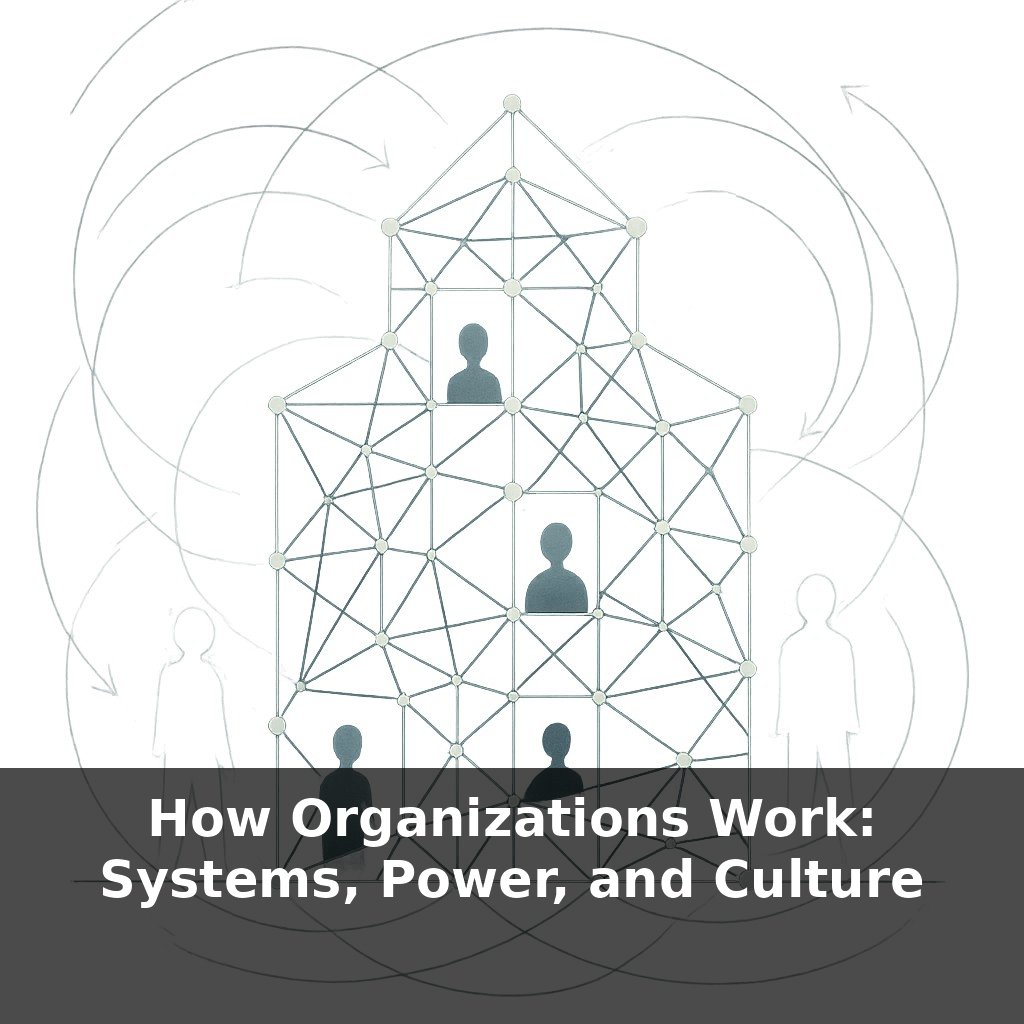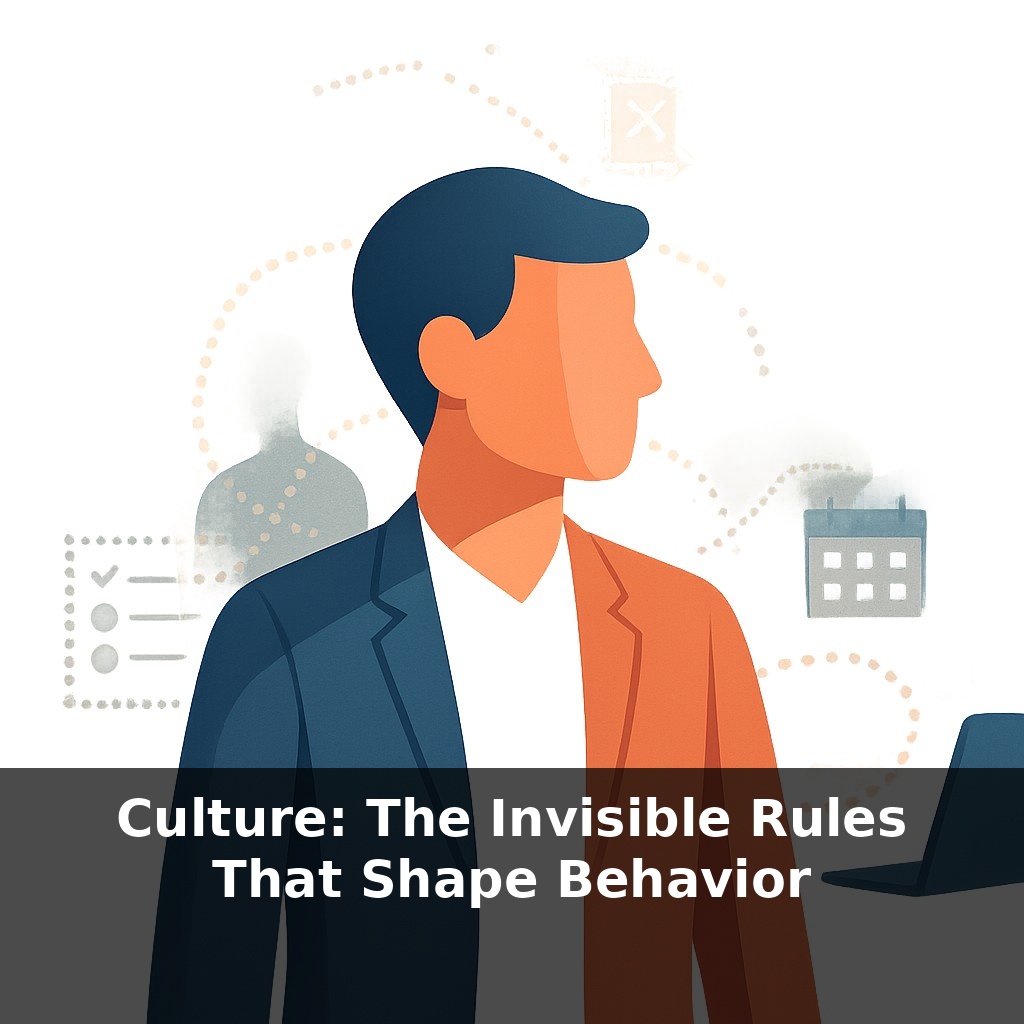
Right now, in most offices, people follow rules no one ever wrote down. A joke you can’t make. A question you’re not “supposed” to ask. Here’s the twist: those invisible rules are doing more to drive performance than almost any official strategy document.
Some of those unwritten rules feel harmless, even helpful. Everyone knows you don’t book meetings after 4 p.m. on Fridays. New hires learn quickly that “we’re direct here” actually means “soften bad news.” But beneath those day‑to‑day habits sit deeper signals: who gets promoted faster, whose ideas get airtime, which mistakes are forgiven, which are quietly career‑limiting. Culture shows up in who speaks first in a tense meeting, how leaders react when revenue is at risk, whether people share bad news early or bury it. Think of how a seasoned traveler reads an airport: they can tell, in five minutes, whether this place runs on strict order, quiet flexibility, or barely controlled chaos. You can develop that same radar for your organization—and once you do, you stop taking the “way things are” as natural and start seeing them as choices.
Those “this is just how it is” patterns don’t come from nowhere. Culture is shaped, mostly unintentionally, by what leaders reward, tolerate, and repeat. Over time, each decision—who gets the tough assignment, which metric gets wall space, whose calendar always wins—lays another brick. Some bricks are obvious, like a new bonus plan. Others are subtle, like who gets copied on urgent emails. Together they form the walls people navigate every day. You can’t see the blueprint, but you can trace it by asking: what actually gets someone trusted, protected, or sidelined here?
Culture becomes easier to see when you stop listening to what people say and start watching what actually happens at key moments. Three moments, especially, act like high‑contrast dye in an MRI: who gets resources, how conflict is handled, and what happens under pressure.
First, follow the money, time, and attention. In one company, leaders talked endlessly about “innovation,” but every budget review cut experimental projects first and fully funded anything that protected existing revenue. No one ever announced, “We’re risk‑averse now.” People just watched where approvals flowed. Within a year, the boldest product managers had either left or learned to present every new idea as a minor tweak to something proven.
Second, watch conflict. In some teams, disagreement is framed as disloyalty: people say “I’m just playing devil’s advocate” in a lowered voice, and the room gets tense. In others, pushing back is a sign that you care. The same words—“I don’t think this will work”—can either earn you a reputation as “difficult” or mark you as a critical thinker. That difference doesn’t live in value statements; it lives in what happens to the last person who challenged a senior leader in public. Did their arguments get integrated, or did their next performance review suddenly include vague feedback about “tone”?
Third, look at behavior when the stakes spike: a missed quarter, a public mistake, a major outage. Under strain, the real priorities surface. One retailer facing a crisis quietly instructed store managers to override return policies and eat short‑term losses to protect trust; another, in a similar crunch, doubled down on strict rules and approved more customer‑hostile fees. Both claimed to be “customer‑centric.” Only one acted that way when it hurt.
These patterns aren’t random; they’re the accumulated outcome of many small, consistent choices. Leaders often underestimate how loudly those choices speak. Promoting a brilliant jerk after months of promising “respect for all” says, unequivocally: results outrank how you get them. Free snacks and wellness apps can’t compete with that signal.
Your role, regardless of level, is to become a sharper observer. Once you can name the real rules—who gets air cover, who gets blamed, what’s non‑negotiable—you can start testing which parts enable great work and which quietly tax performance, trust, and integrity.
Think about how different restaurants “feel” before you even taste the food. In one place, the staff quietly covers for each other when things get busy; in another, you catch sharp whispers when an order is missed. Same menu complexity, same Saturday rush—very different invisible agreements about what matters. Organizations are like that. A fintech startup I worked with claimed to prize “learning,” but engineers were quietly moved off projects after failed experiments. No memo announced a policy; people just noticed who disappeared from the ambitious work. Within months, demos became heavily scripted and “stretch ideas” dried up. Contrast that with a manufacturing firm that held short, blameless debriefs after quality issues. The person who surfaced a problem first often got asked to present fixes to senior leaders. Over time, spotting risk early became a status move. The process documents barely changed, but the social rewards did—and performance followed.
Culture will get harder to fake. As tools quietly map who actually talks to whom, which teams share credit, and where cynicism clusters, leaders will see patterns they used to feel only anecdotally. Think of it like turning on the kitchen lights after years of cooking in dimness: you’ll notice spills, but also discover which habits reliably produce great dishes. The edge will belong to organizations that treat this visibility not as surveillance, but as a mirror to refine how they truly work.
The uncomfortable part is realizing you’re not just living in this system—you’re helping write it. Every hiring decision, offhand joke, and rushed email is like adjusting a shared playlist: skip certain “songs” often enough and people stop suggesting them. Culture shifts when enough individuals quietly choose different tracks, then see who turns up the volume.
Here’s your challenge this week: Pick one “invisible rule” in your team or family culture (for example: how disagreements are handled, who speaks first in meetings, or how mistakes are reacted to) and run a 3-day experiment to gently break it in a positive way. For the next three days, start one interaction by explicitly surfacing that rule out loud (e.g., “We usually avoid disagreeing in this group, but I’d like to try openly debating this idea for the next 10 minutes”). After each experiment, ask at least one person, “How did that feel compared to how we usually do things?” and jot down their exact words in a single place. By the end of the week, choose whether to keep, tweak, or drop that old rule based on the reactions you collected.