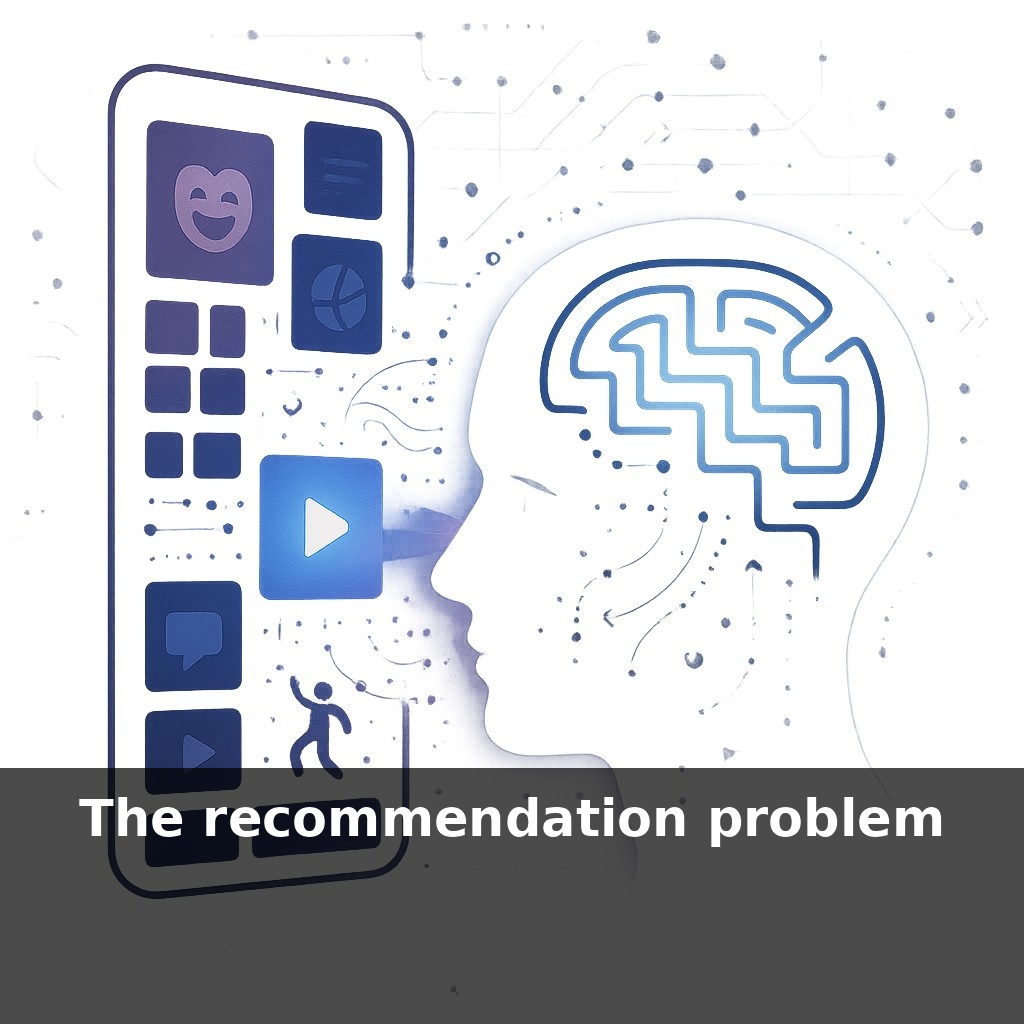
TikTok’s algorithm decides what millions see before breakfast—yet it never asks what you want. One swipe, a laugh; the next, a rant; then a rabbit hole you didn’t mean to enter. Somewhere between chaos and control, your feed is quietly solving its favorite puzzle: you.
That puzzle doesn’t start with your personality; it starts with your traces. Every pause, rewind, like, and skip is a tiny vote about what should appear next. Add those votes up across billions of people and you get the central dilemma behind every major platform: from countless possible posts, which five or ten should rise to the top, right now, for you?
This is the “recommendation problem,” and it’s bigger than taste. Get it right, and people stay, creators grow, and advertising feels oddly well-timed. Get it wrong, and feeds feel stale, extreme, or just exhausting. YouTube, Instagram, and others pour enormous effort into that invisible decision process—balancing what you’ll click, what you’ll tolerate, and what they’re willing to promote. Underneath your casual scrolling, industrial-scale math is constantly betting on your next second of attention.
Beneath that betting lies a different struggle: platforms don’t just guess what you’ll like, they must decide what *should* count as “good.” Is it pure watch time? Comments? Shares that start conversations—or fights? The choice of metric quietly steers everything else. Optimize only for clicks and outrage rises; optimize only for safety and feeds go flat. Real systems juggle dozens of goals at once—satisfaction surveys, long-term return rates, even “did this make you close the app?” Each tiny adjustment can tilt whole communities toward discovery, comfort, or polarization.
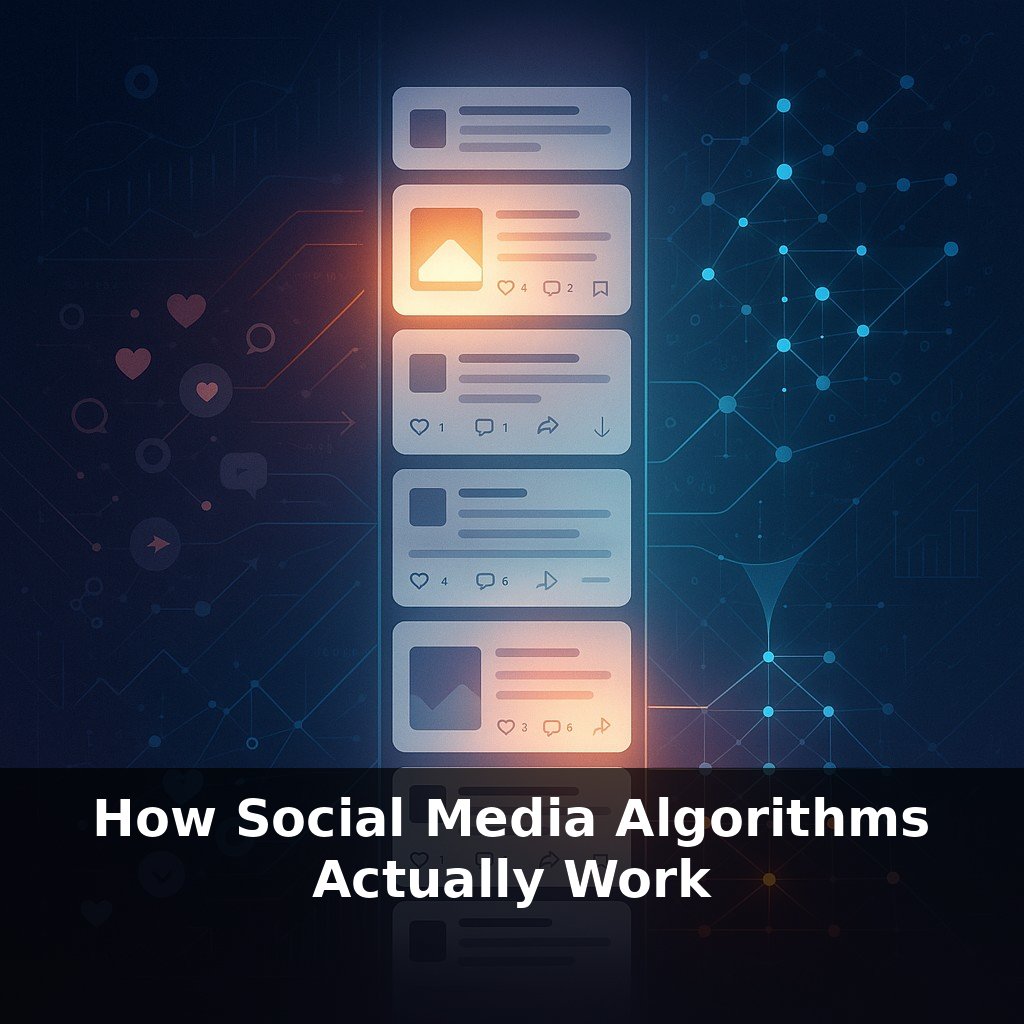
Under the hood, that “what should count as good” question turns into a pipeline of decisions that runs every time you open an app. First, the system has to *collect signals* about you without stopping the experience dead. Some are explicit—likes, follows, hides, “not interested.” Others are implicit: how quickly you scroll past, whether you turn sound on, whether you watch the same creator late at night but never at lunch. These traces are messy and often contradictory, so platforms spend huge effort just cleaning and weighting them before any fancy modeling begins.
Next comes *matching*: finding candidates out of the chaos. Here, algorithms lean on two broad recipes. One looks at relationships between people: “users who engaged like you did also tend to stick with these posts.” That drives things like YouTube’s “Up next,” where behavior patterns across viewers matter more than what the video is “about.” The other recipe starts from the content itself—captions, hashtags, audio tracks, visual features—to guess what a post is and who might care, even if it’s brand new and no one has clicked it yet.
Because reality isn’t static, these systems can’t just lock in one answer and coast. They constantly face a tension between *exploit* (show what’s almost guaranteed to work) and *explore* (try something weird that might reveal a new interest). That’s where reinforcement-learning style approaches sneak in: the algorithm treats each recommendation as a tiny bet, updates its beliefs when you respond, and nudges future bets accordingly.
Scale makes everything stranger. YouTube’s torrent of uploads and Facebook’s trillions of daily predictions force platforms to compress people into abstract “embeddings”: dense numerical fingerprints of your behavior and of each post. These sit in huge vector spaces where “nearby” means “likely relevant.” Two users who don’t share language, age, or geography might still end up close together there, purely because their late-night scrolling habits rhyme.
Yet technical sophistication doesn’t erase social trade-offs. If the system leans too hard on what’s already popular, it snowballs fame and buries niche voices. If it over-emphasizes similarity, it risks tightening social circles into ideological loops. That’s why newer approaches experiment with diversity boosts and even “serendipity budgets”—reserving part of your feed for things you didn’t know to ask for.
Open Twitter, YouTube, or TikTok with a fresh account and you’ll see the recommendation machinery at its most experimental: clips in different languages, hobbies you’ve never tried, news from places you’ve never been. In those first minutes, the system is probing—tossing out wild guesses just to see what sticks. Once you start reacting, it narrows fast, but engineers now fight to *slow* that narrowing, because a too-precise feed can become a tunnel.
Like a touring doctor in a remote village, the system doesn’t just treat one patient; it tracks how its “medicine” affects the whole population. Promote sensational health myths and you get more clicks today, but worse “health” for the network tomorrow—misinformation, fatigue, distrust. That’s why some teams simulate thousands of parallel futures: “If we nudge toward calmer content, do people return more next month? Do smaller creators survive?”
Your feed, then, is partly about you—and partly about how the platform wants its entire ecosystem to evolve over time.
As these systems mature, the power balance can shift subtly toward users. You might tune feeds like a graphic equalizer—more local news, less celebrity drama—while third‑party “nutrition labels” rate how risky or narrow a stream feels. Regulation could introduce civic “quiet hours,” where outrage is down‑ranked like late‑night ads. And as on‑device models grow, your preferences travel with you, yet stay locked in your pocket, not a distant server.
Algorithms will keep evolving, but the open question is who gets to steer them. Maybe you’ll one day flip feed “modes” like changing lenses on a camera: depth over drama, breadth over speed. Your challenge this week: notice three posts that changed your plans, mood, or views—and ask, “Who benefited most from me seeing this?”