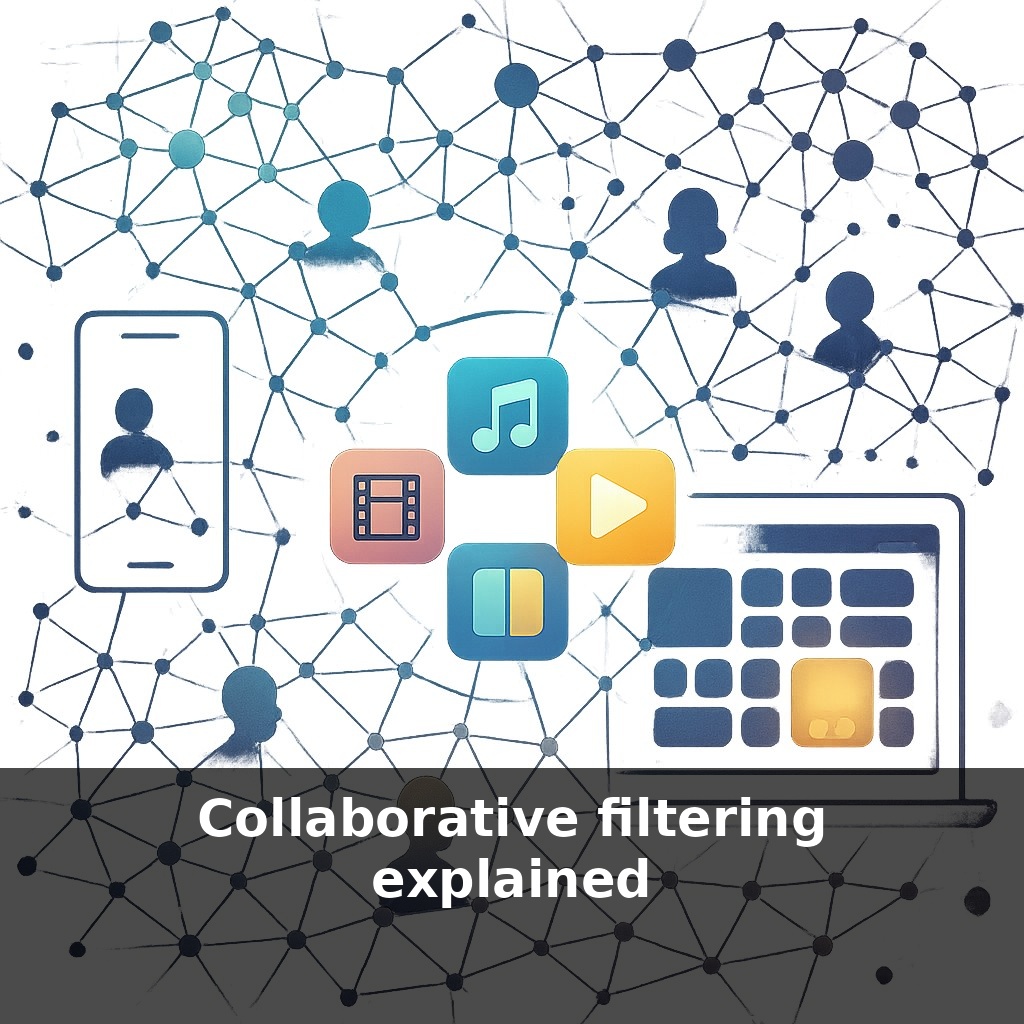
Right now, an algorithm you’ve never met knows your taste in music or movies better than some of your friends. Netflix once ran a global contest just to squeeze a tiny bit more accuracy from it. Today we’ll pull back the curtain on how those “you might like this” guesses really work.
Some of the most powerful systems behind your screen don’t start with “Who are you?” but with “Who behaves like you?” That’s the core twist behind collaborative filtering: it learns from crowds, not from your biography. Instead of asking your age, job, or hometown, it quietly watches patterns: which shows cluster together across millions of people, which products tend to land in the same carts, which songs are often replayed after a certain artist. Over time, dense constellations of co‑choices emerge—tight little neighborhoods of items and people that “move together.” You might never rate anything, but your pauses, replays, and scroll-bys still leave tiny footprints. Stacked across millions of users, those traces become strong signals. In this episode, we’ll unpack how those signals are combined, why scale matters so much, and where this pattern-sharing approach starts to break down.
At web scale, this pattern-spotting becomes less like guessing and more like running a massive social experiment. Every click, skip, and binge subtly reshapes invisible “crowds” you belong to—people who happen to move through catalogs in vaguely similar ways. That’s why a niche documentary you watched at 2 a.m. might quietly boost a foreign series into your row a week later: others who watched that doc drifted there too. Crucially, the system doesn’t care *why* you made those choices. It just tracks the rhythm of your decisions and continuously re-groups you as new behavior flows in.
When engineers implement this in practice, they usually start with a giant table: rows are people, columns are items, and each cell is an interaction—maybe a rating, a click, a watch, or a purchase. In theory, you could compare every row to every other row and say, “Whose pattern most closely lines up with yours?” That “who is near whom?” idea is called a neighborhood method. User‑based versions look sideways across rows; item‑based versions look down columns and ask, “Which products, movies, or songs tend to show up together across many people?”
That brute‑force matching collapses once the table gets big. A typical platform has millions of users, millions of things, and the table is almost entirely empty. Most people touch only a tiny fraction of what exists. To cope, companies either approximate (using tricks like approximate nearest neighbors that skip unlikely comparisons) or change the representation entirely.
That’s where matrix factorization comes in. Instead of storing you as a gigantic row of mostly empty cells, the system learns a compact “profile” in a much smaller space—often just a few dozen or hundred numbers. The same happens for items. Now the table is roughly rebuilt as “user profile · item profile ≈ interaction strength.” Those profiles are learned directly from historical data: tweak them until the predicted interactions match the real ones as closely as possible. This is the family of methods that dominated the Netflix Prize era.
The moment platforms move to streams of clicks, watch‑time, and skips, the scale jumps again. Explicit ratings are relatively rare; implicit traces can be hundreds of times more abundant. Modern systems treat them differently—rewarding long, repeated engagement more than a single casual tap, and down‑weighting noisy signals like accidental plays. Deep‑learning hybrids push this further: they mix those compact profiles with text, images, audio, and social signals so they can recommend even when the table cell is empty—crucial for fresh songs, brand‑new creators, or long‑tail products that almost no one has touched.
Underneath all of this is a constant tug‑of‑war: lean too hard on what’s already popular and the system just recycles blockbusters; lean too hard on obscurities and people feel lost. Real‑world recommenders continuously rebalance between “you’ll almost certainly like this” and “this is a calculated stretch,” and that balance can quietly shape entire cultures.
On Netflix, two people might never watch the same hit show, yet still be “neighbors” because they both drift toward slow‑burn crime series and bleak European dramas. Collaborative filtering notices that hidden kinship and quietly surfaces a Danish noir to both, even if it’s buried deep in the catalog. On Amazon, item‑to‑item methods link things you’d never tag together: people who buy a budget microphone and an HDMI capture card often end up with the same mid‑range ring light. The system learns that bundle long before marketing teams give it a name. Spotify leans heavily on similar tricks for “Discover Weekly,” but with a twist: it can fold in audio features (tempo, timbre, energy) so that a seven‑minute jazz track and a three‑minute lo‑fi beat end up in the same late‑night focus cluster. In medicine, researchers adapt these ideas to find “patients like this one” across huge records, then surface treatments that worked best for that tiny, relevant group.
Billions of micro‑choices will soon link across apps, devices, even cities, so a late‑night reading binge might quietly sway the cafés or events you sBuilding on this idea of uncharted paths, tuning that web will feel less like fixing a single playlist and more like adjusting the lighting in a whole house—bright in some rooms, dim in others. Your challenge this week: notice three moments when a suggestion nudges you somewhere unexpected, and ask: “Who else’s trail might I be following right now?”
As these systems spread, their quiet suggestions can feel like a gentle river current: stay in the main flow or swim sideways into smaller, stranger streams. Over time, those tiny course changes add up, shaping which voices are amplified and which stay unheard. Noticing that drift is the first step toward steering your own path through the feed.
Before next week, ask yourself: 1) “If I had to design a super-basic ‘people who liked X also liked Y’ recommender for just 10 friends today, what concrete data about their behavior (ratings, clicks, watch time, skips) would I actually collect, and why those signals over others?” 2) “Looking at one app I use daily that recommends things (Netflix, Spotify, Amazon, YouTube), where do I see user–user collaborative filtering signals (similar people) versus item–item signals (similar content), and how might each one be failing me in a specific example?” 3) “If my own tastes have changed over the last year, how would I want a collaborative filtering system to notice and adapt—what behaviors of mine today should ‘count more’ than my history, and what would I deliberately do this week to help it relearn my preferences?”