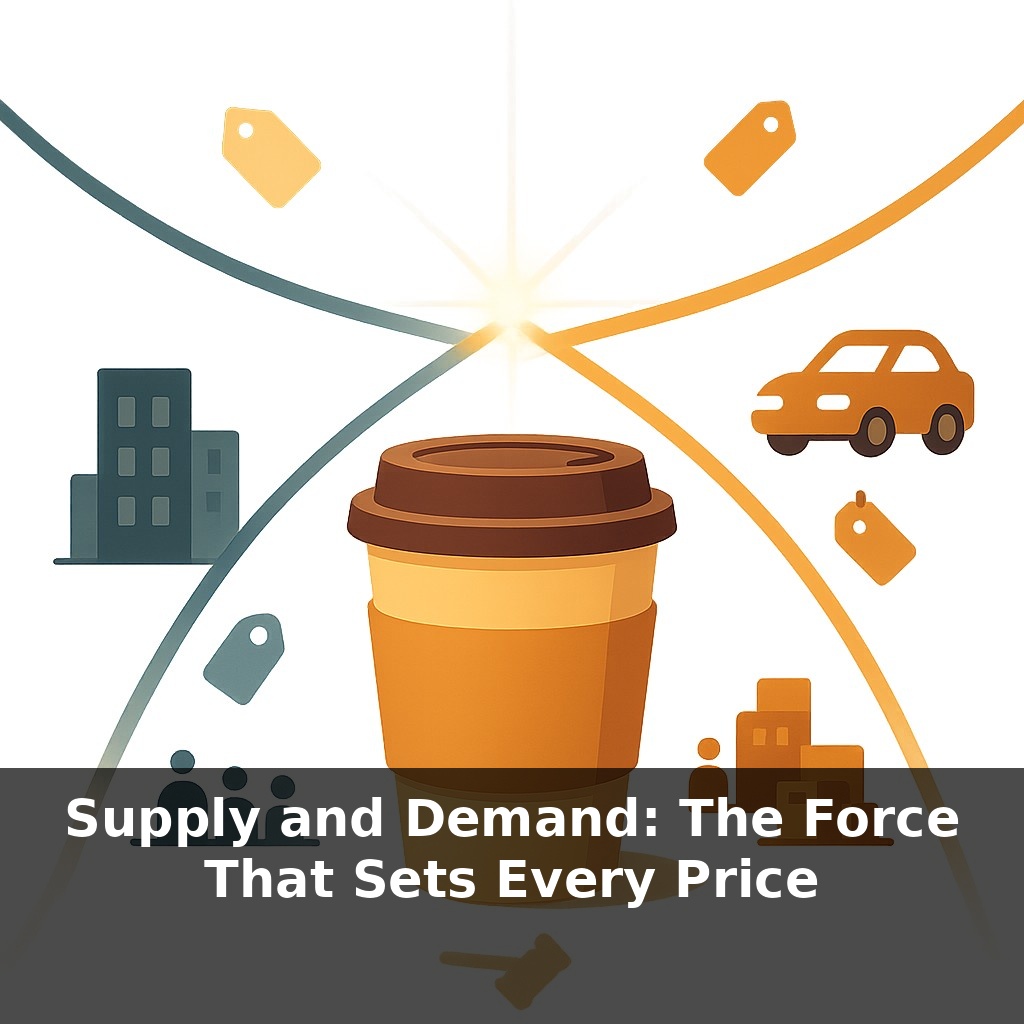
Supply and Demand: The Force That Sets Every Price
📝 Transcript
Right now, as you listen, an invisible auction is setting the price of your next coffee, your rent, and the ride home. In one year, U.S. used-car prices jumped nearly half. Today we’ll peel back the curtain on the quiet tug-of-war that decides what everything costs.
Every price you see is really a truce in a constant negotiation. On one side: all the people who might want the thing. On the other: all the people who might make or sell it. Most of the time, that truce feels ordinary—a $4 loaf of bread, a $12 movie ticket. But when something shifts beneath the surface, those truces can snap fast.
Think of a concert where the crowd suddenly rushes one food stall—lines explode, portions shrink, and the vendor quietly raises prices. Nothing “mystical” happened; the balance just moved. In the wider economy, the same story plays out with far more moving parts: incomes rise, a new technology cuts costs, a drought hits crops, a government subsidy appears.
Now we’ll zoom in on those shifts—who moves first, how the other side reacts, and why scarcity keeps pulling the strings.
Markets don’t just react to big shocks like chip shortages or droughts; they’re constantly adjusting beneath the surface. A new app makes it easier to compare prices, and suddenly weak sellers lose customers overnight. A viral video boosts a niche brand, and demand jumps before factories can catch up. Even rumors—of a bad harvest, a policy change, a strike—can move today’s prices based on tomorrow’s guesses. In the background, firms test how far they can nudge prices without losing you, while you quietly decide what’s “too much” and switch, delay, or downgrade. Those tiny choices, multiplied, reshape the whole landscape.
A coffee shop doesn’t raise prices just because it “feels like it.” It moves when the trade-off changes: higher bean costs, more foot traffic, a competitor closing, or a new crowd willing to pay for oat milk and Wi‑Fi seats. That’s supply and demand in motion: not a static graph, but a stream of decisions bumping into each other.
On the demand side, what you want isn’t fixed. Higher income can turn a once-a-month treat into a daily habit. A trend can pull people toward one product and away from another—streaming over DVDs, plant-based burgers over beef. Expectations matter too: if people expect prices to rise, they often buy early, which can push prices up sooner.
On the supply side, producers constantly ask: “Can we make more at this price and still cover our costs?” New technology might let a factory double output with the same workers. Cheaper inputs—say, a drop in global shipping rates—can suddenly make low-margin products worth expanding. But constraints bite: limited machine time, scarce skilled labor, or a key part stuck in transit can cap how far supply can stretch.
Sometimes these shifts are dramatic. A sudden drop in oil supply, even a few percent, can send prices jumping because drivers and airlines can’t instantly cut usage; their demand is inelastic in the short run. Other times, the movements are quieter: a slow rise in incomes nudging families toward larger homes, better appliances, more travel.
Policy and platforms weave through this. A subsidy can tilt the numbers so solar panels flood the market. A ride-hailing app can tweak its pay formula and watch driver “supply” swell or shrink within an hour. When one side moves faster than the other—for instance, demand spiking more quickly than firms can add capacity—prices swing until behavior adjusts.
A useful way to see it is like a weather system in your city: warm fronts (rising demand), cold fronts (shifting supply), and high-pressure zones (regulation, contracts) colliding. Today’s price is just the current temperature, reflecting countless forces you rarely see—but feel every time you tap your card.
Walk down a supermarket aisle during a heatwave and watch the shelves: ice cream thins out, but canned soup looks untouched. Same store, same day—totally different pressures. The “temperature” of demand is higher for things that cool you down, so small changes in weather can move their prices or at least how fast they’re restocked. Now think about a limited-edition sneaker drop. Thousands of people click “buy” at once, but supply is locked in. Resale prices shoot up, not because the shoes changed, but because the crowd’s urgency did.
On the flip side, when farmers have a bumper crop of strawberries, they race the clock before fruit spoils. You might see discounts, bundle deals, “buy one, get one free” offers—not charity, just sellers trying to move a sudden surge of supply. Even your own time works this way: when your evenings are scarce, your “price” for going out rises, and only the most valued invitations make the cut.
A shock you’ll feel more often: as climate extremes hit crops, power grids, and ports, supply jolts will collide with always‑on demand from apps and subscriptions. AI matching buyers and sellers could smooth some bumps, like a skilled traffic cop rerouting cars before jams form. But if income support or price caps ignore how fast supply can react, queues, blackouts, or empty shelves follow. Your rent, wages, and even streaming fees will increasingly reflect how well societies navigate those frictions.
Next time a “random” price jump hits your bill, treat it like a plot twist, not a glitch. Ask: who suddenly wants more, who can’t deliver as much, and who’s quietly exiting or entering the scene? Just as a cook adjusts salt, heat, and time, societies can tweak taxes, rules, and safety nets—changing not just what things cost, but who gets left hungry.
To go deeper, here are 3 next steps: (1) Open up the free database at FRED (Federal Reserve Economic Data) and pull up historical data for a product mentioned in the episode (like gasoline or housing); spend 15 minutes comparing price charts with volume or inventory data to literally see supply and demand in action. (2) Go to your favorite online marketplace (Amazon, Walmart, or a local grocery app), pick one everyday item (eggs, phone chargers, or bottled water), and track its price from 3 different sellers; note how differences in availability, shipping time, and quality line up with the demand/supply story from the episode. (3) Grab a beginner-friendly econ resource like “Principles of Economics” by N. Gregory Mankiw or the free “Principles of Microeconomics” on OpenStax, and read just the chapter on supply and demand while pausing to map each concept (shifts vs. movement along the curve, equilibrium, price ceilings/floors) back to examples the podcast used.
From this course
How the Economy Really Works
7 episodesUnlock all episodes
Full access to 7 episodes and everything on OwlUp.
Subscribe — $1.99/monthLess than a coffee ☕ · Cancel anytime