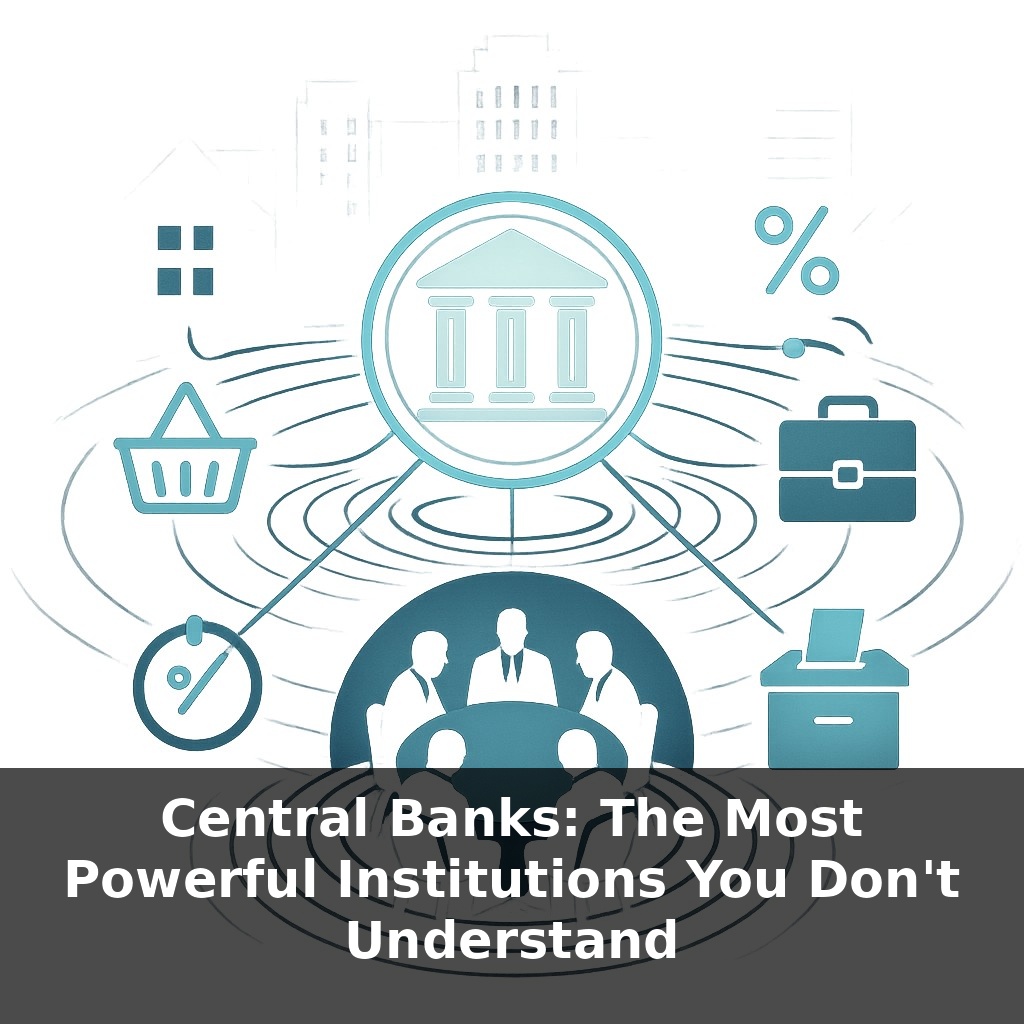
Right now, a group of unelected officials can nudge a single interest rate and, within months, your rent, your job prospects, and even your country’s politics start to shift. In this episode, we’ll follow that invisible decision from a closed-door meeting to your daily life.
When central banks move that key rate, they’re not just tweaking a number on a screen; they’re quietly rearranging the incentives that guide millions of separate decisions. A CEO deciding whether to build a new factory, a government choosing how much to borrow, a retiree debating if they can afford to stop working—all of them are, in some way, reacting to this signal. And the signal doesn’t stop at national borders. When the U.S. Fed hikes or cuts, currencies from Brazil to Turkey can whipsaw, global investors rebalance portfolios overnight, and trade flows shift as if someone just changed the rules of a complex board game mid-match. In this episode, we’ll trace how a choice made in one conference room propagates through banks, markets, and governments, and why that chain reaction can either stabilize the system—or quietly plant the seeds of the next crisis.
Central banks do all this with surprisingly few tools. They don’t run regular banks, they don’t set your salary, and they don’t write the state budget. Instead, they tweak the conditions under which everyone else makes those choices. Their legal powers come from legislation, but their real influence comes from credibility: do households, markets, and governments believe they’ll actually do what they say? That’s why so much energy goes into statements, forecasts, and press conferences. The words chosen at 2 p.m. can shift billions of dollars long before any concrete policy has changed.
Start with what actually happens in that closed-door meeting. Around the Fed’s table sit voting members of the Federal Open Market Committee (FOMC): governors in Washington and presidents of regional Fed banks from places like Atlanta, San Francisco, and Cleveland. Eight times a year, they bring in data and on‑the‑ground stories: wage pressures in Texas, factory orders in the Midwest, credit conditions in New York. It’s part statistics, part economic group therapy—each person explaining how the same national economy looks very different from their seat.
They’re not free to chase whatever outcome they personally like. Since 1977, U.S. law has given them a dual mandate: push the economy toward maximum employment while keeping prices stable. Raise borrowing costs too slowly when inflation is building, and they risk a Volcker‑style clean‑up later, when rates had to be slammed up to 20% in 1981. Tighten too aggressively when the job market is fragile, and they can trigger a recession that knocks millions out of work. Every decision is a trade‑off between pain now and pain later.
Once they vote on their target for very short‑term funding between banks, the choreography is precise. At 2 p.m. ET, the statement drops. A few minutes later, the press conference begins. Traders parse every word, but households mostly see the effects later: shifting mortgage offers, changing credit‑card promotions, different hiring plans from employers.
In crises, though, that normal routine hasn’t been enough. During the 2008 meltdown, the Fed couldn’t just cut its policy rate below zero. Instead, it began buying massive quantities of longer‑term securities—Treasuries and mortgage‑backed bonds—in what became known as QE. Over 2008–2010, that first wave alone added roughly $1.7 trillion of assets to its balance sheet. Over the following decade and through the pandemic response, the balance sheet swelled from under $900 billion before the crisis to about $9 trillion at its 2022 peak, before gradual runoff began.
That scale matters. When a single institution is one of the largest buyers of government debt and housing‑related securities on Earth, it doesn’t just nudge expectations; it reshapes whole markets. Yields on long‑term bonds, valuations of stocks, the willingness of banks to extend new loans—all become entangled with the central bank’s own portfolio choices and exit plans.
A curious pattern shows up when you zoom out from any single policy move: these institutions rarely act alone. When the Fed slashes its main rate or launches a big bond‑buying program, the European Central Bank and Bank of England often face pressure to respond—or to deliberately *not* respond—to avoid sending their own currencies lurching. That’s one reason you sometimes see “policy waves,” where several major players ease or tighten within months of each other. Another twist: their tools don’t hit every group the same way. A rate cut might relieve pressure on heavily indebted governments and homeowners, yet squeeze people living off fixed‑income savings. And while many of these institutions are formally independent, elected officials still try to lean on them—through public criticism, veiled threats about changing their legal mandate, or quiet campaigns to appoint more sympathetic decision‑makers. The tug‑of‑war over who ultimately calls the shots never fully disappears.
Future choices will push these institutions into unfamiliar roles. A CBDC, for instance, could let you pay taxes straight from a digital wallet, yet also let policymakers “nudge” spending patterns more precisely. Climate and inequality debates may pull them toward judging which assets are “green” or “fair,” blurring the line between neutral referee and political player. And if the next downturn brings tools like helicopter money, the boundary between money and government policy may thin even further.
You don’t need to predict every move; you just need to notice who’s moving the pieces. Watch how these institutions react to shocks—pandemics, wars, sudden market freezes—and you’ll see patterns, like storm tracks on a weather map. The more you recognize those patterns, the less their next announcement feels like fate and the more it looks like a forecast you can plan around.
Start with this tiny habit: When you open a news app or site and see a headline about “interest rates,” “inflation,” or the “Fed/ECB/BOE,” pause and spend 30 seconds asking yourself: “Is this about raising, lowering, or holding rates—and who wins and loses from that?” Then quickly say out loud (or in your head) one concrete effect, like “higher rates make mortgages more expensive” or “lower rates make borrowing cheaper for governments.” Next, screenshot or save just one central bank–related chart or quote you notice that day, so you can start seeing how often these institutions quietly shape your money world.