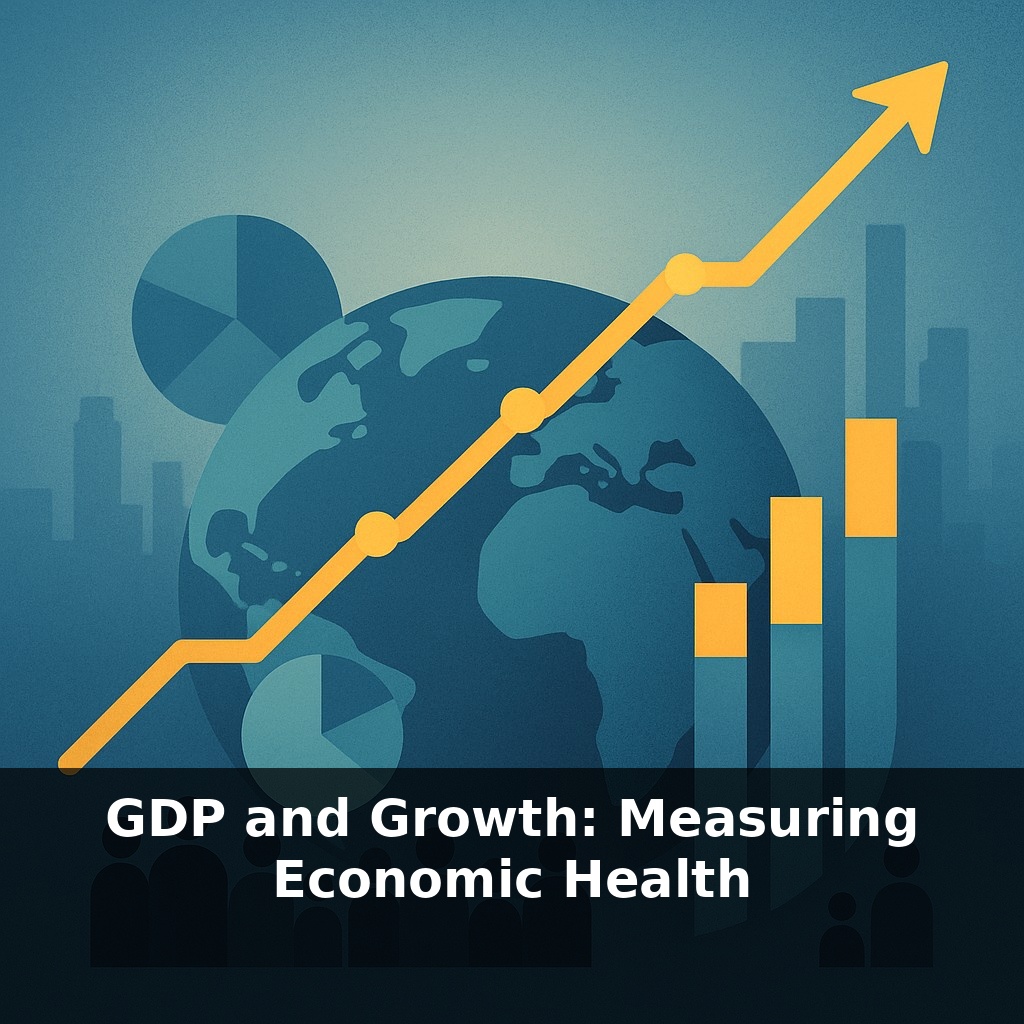
The world now produces over one hundred trillion dollars of goods and services a year—yet that giant number can rise even when most people feel no better off. In today’s episode, we step inside that contradiction and ask: what is GDP really telling us, and what is it hiding?
GDP headlines move like a scoreboard: “growth up,” “growth slows,” “recession risk.” But underneath those tidy percentages are messy stories about whose incomes are rising, whose jobs are disappearing, and what’s happening to the planet that quietly powers it all. A country can hit record output while its typical worker’s paycheck barely budges, or while its rivers, air, and soils are steadily degraded. A sudden boom might come not from new factories or better jobs, but from an accounting change when a multinational shifts patents across borders. In this episode, we’ll zoom in on what drives those big GDP swings—consumption, investment, government spending, and trade—and then zoom out to ask: when growth shows up on the chart, how can we tell whether it’s broad-based progress or just a statistical mirage that leaves most people behind?
Sometimes the GDP scoreboard jumps because of things most people never see: a new drug patent booked in one country instead of another, a surge in luxury spending while basic wages stall, or homes rebuilt after a natural disaster that first destroyed billions in value. In one place, growth might come from better factories and higher pay; in another, from households piling on debt to keep shopping. And digital life complicates it further: free apps, online learning, and open-source tools can transform daily life while barely nudging the official numbers policymakers obsess over.
To see what those GDP headlines really mean, it helps to look at who is actually doing the producing and earning inside that big number.
Start with households. In many rich countries, more than half of measured output comes from what families buy. But notice what’s missing: the unpaid care work of looking after children or elderly parents, the home cooking that replaces a restaurant meal, community volunteering. If a parent quits a paid job to care for their own child, measured output can fall even though the child may be better off and total hours of work in that household actually rise.
Firms are next. When a company builds a factory or invests in software, that shows up clearly. But when it raises prices faster than its costs—because it has market power, or because a temporary shortage lets it charge more—GDP can rise even if the physical volume of what it sells barely moves. Profits swell, shareholders cheer, yet many customers are simply paying more for the same thing. That’s why economists often separate growth in “real” terms (adjusted for price changes) from mere price inflation.
Now think about how gains are shared. Two countries can have identical output per person, yet feel completely different. In one, high wages and strong labor protections might give most workers a secure middle-class life. In the other, a small elite captures a huge slice of income, while millions in precarious work struggle to cover basics. The average looks the same, but the lived reality does not. Measures like median income, wage growth for the bottom half, or poverty rates often tell a more grounded story than the headline number alone.
Then there’s the planet. Extracting a forest, mining a riverbed, or burning cheap fossil fuels to power factories can push measured output up while quietly drawing down natural assets. Standard GDP doesn’t subtract the lost trees, depleted fish stocks, or long-run climate damage. It counts the “harvest” but not the shrinking field.
Policymakers increasingly experiment with add-ons: “green” accounts that track environmental assets, “inclusive” dashboards that combine output with health, education, and inequality metrics. None has replaced the core number, but together they hint at a future where the health of an economy is judged less by how fast it can grow at any cost, and more by how sustainably and widely that growth is shared.
Think about two neighbors on the same street. On paper, their town’s output per person looks great. But in one house, both adults work stable jobs, can handle a surprise medical bill, and send their kids to decent schools. In the other, gig income swings wildly month to month, rent eats half their paycheck, and a minor car repair means credit-card debt. The town’s average looks impressive; lived security is another story.
Now zoom out to countries. In the U.S., household spending is a large share of output, so when growth slows, layoffs tend to follow—Okun’s law shows how even a 1‑point drop in growth can nudge unemployment noticeably higher. In China, where household spending is a smaller share, construction and corporate investment do more of the heavy lifting, so a building slowdown can bite before shoppers pull back.
Your challenge this week: each time you see a “growth” headline, ask: who’s actually better off here—workers, owners, future generations, or mostly the statistic?
If GDP is the speedometer, the next decade is about building the rest of the dashboard. Expect politicians to boast less about a single “growth” number and more about mixes of carbon use, mental health, and time spent on care. Firms may be rated not just on profits, but on how they treat workers and the planet. Like doctors relying on many test results, governments will lean on richer data to spot overheating sectors early—and to justify slower, cleaner growth when the old metric says “go faster.”
Conclusion: Next time you hear that growth is “strong” or “weak,” treat it like a weather report: ask not just about today’s temperature, but the forecast and the wind chill. Is debt piling up, are ecosystems fraying, is free time vanishing? As more countries track these side-effects, the story of growth may shift from “how much” to “what kind” and “for whom.”
Start with this tiny habit: When you check the news in the morning, quickly note whether the headline about the economy is talking about GDP growth, unemployment, or inflation. Then, spend 10 seconds asking yourself, “Whose economic health does this really reflect—everyone, or mostly big producers and high earners?” This tiny pause trains you to see GDP as one indicator, not the whole story, and to connect the headline to real people’s well-being, not just the number.