Right now, almost every object around you has “traveled” farther than you ever have. Your phone, your clothes, even your breakfast—each piece likely crossed multiple borders. But here’s the twist: countries trade more rules than products, and those rules quietly shape your daily life.
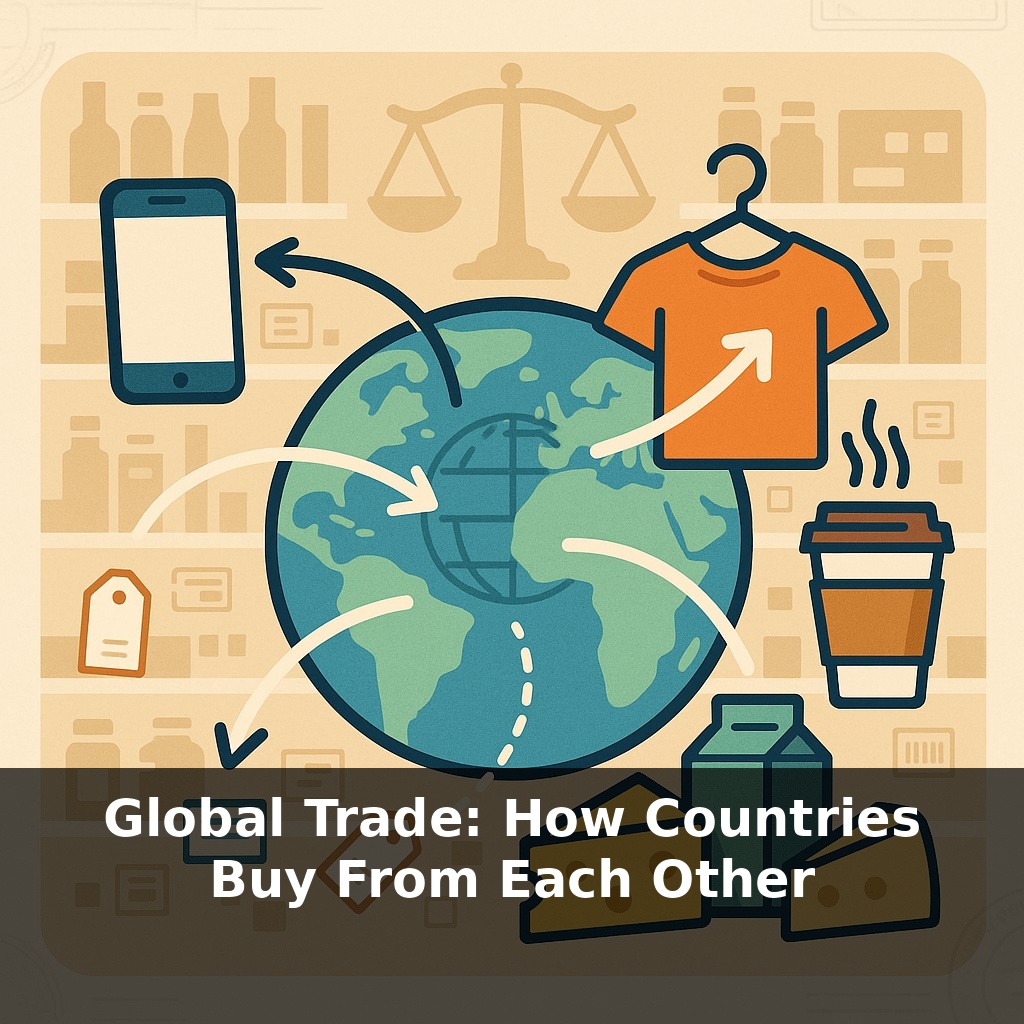
Stand in a supermarket aisle and spin slowly. Every shelf is a quiet scoreboard of which countries sell what to whom. The cheap T‑shirt from Bangladesh? That’s someone’s export victory. The pricey imported cheese? Someone else’s market access win. But behind each bar code is a deeper story: which workers got hired—or replaced by machines—because a government opened (or closed) its doors to that product. Trade doesn’t just move stuff; it rearranges power, paychecks, and even politics. A sudden tariff can feel, in a factory town, like a storm front rolling in: overtime dries up, shops close earlier, “For Sale” signs multiply. At the same time, other places boom as new export orders flow in. In this episode, we’ll follow that chain—from shipping container to city budget—to see who gains, who loses, and why the same trade deal can feel like prosperity in one zip code and betrayal in another.
Those bar codes also hide negotiations you never voted on. While you’re choosing between coffee brands, diplomats and lobbyists have already argued over pesticide limits, data rules, and whose factories get priority. A single clause in a distant agreement can decide whether a local mill upgrades and hires, or shutters and sells for parts. And it’s not just about goods on shelves anymore: consulting, streaming platforms, cloud services, even your favorite app updates can depend on how countries treat “invisible” digital exports. The scoreboard is no longer just about containers; it’s about code, contracts, and copyrights.
Walk away from the supermarket aisle and zoom out to the whole world map. The same way a city has neighborhoods that specialize—one street full of car repair shops, another dominated by restaurants—countries cluster into roles in sprawling production networks. One economy focuses on design and branding, another on precision components, another on assembly, a fourth on shipping and logistics. A “Made in X” label on the box hides the dozens of “Made in Y, Z, and W” moments inside the box.
These chains are why almost 70 percent of world trade now consists of parts and tasks, not neatly finished products. A phone might embed minerals from Congo, chips from Taiwan, software from the U.S., assembly in Vietnam, and packaging in Mexico. What looks like a simple import on one country’s statistics is actually a revenue stream for a whole cast of workers and firms along the route. When one link snaps—a port closure, a sanctions list, a cyberattack—everyone up and down that chain feels the jolt in delayed paychecks, cancelled contracts, or sudden overtime.
Who decides which country gets which role? Partly geography and wages, but also quiet strategic bets. Governments subsidize certain sectors, negotiate mutual recognition of standards, or invest heavily in ports and digital infrastructure to make themselves irresistible nodes in these networks. Some try to climb “up” the chain: from sewing shirts to designing fabrics, from assembling cars to developing batteries and software. Others dig in on a narrow niche—say, enzymes, optical lenses, or ship insurance—because being indispensable in one sliver can be more profitable than being average at everything.
This is also where politics around “bringing jobs home” collides with how production actually works. A factory returning from overseas may bring fewer roles than it took away years ago, because robots and advanced software now do part of the work. The bigger prize is often not the plant itself, but the ecosystem that grows around it: maintenance firms, specialist training programs, logistics hubs, and local suppliers feeding into that global web.
A single cargo ship pulling into port carries more than boxes; it carries choices your country has already made. One nation might lean hard into being the world’s nurse, exporting medical tourism and training, while another bets on becoming the “cloud landlord,” hosting data centers that quietly earn rent from foreign companies. These bets don’t feel abstract if you’re a student: picking engineering in a country courting semiconductor plants is a different future than studying hospitality where tourism is the star export. Think of it a bit like cooking with a strict diet plan: you can’t just crave chocolate (high-tech jobs) without also planning for vegetables (less glamorous support roles) and watching your overall intake (trade balance). Meanwhile, arguments over “buy local” versus “buy cheapest” play out in tiny, personal ways—choosing a domestic streaming platform over a global one, or a local repair shop over a foreign-branded service. Each swipe or receipt quietly votes for one trade pattern over another.
Trade’s next twists will likely show up in places that feel mundane now: a freelancer hired abroad in two clicks, a “green” label that quietly reflects carbon-based border fees, or a product printed nearby instead of shipped. As rules for data, climate, and security diverge, you may see apps vanish in some countries, flight routes reshuffle, or prices fork between regions. Your challenge this week: notice one price or service that differs sharply across borders and ask why.
The next time a headline blames “foreign competition” or celebrates a new export record, treat it like a weather forecast, not a verdict. Ask: whose skies will clear, and where will the storm hit? Behind every shifted factory line or new online service is a set of choices your society made—and can still remake—about what to sell to the world, and at what hidden cost.
Before next week, ask yourself: 1) “Looking at three everyday items I own (like my phone, coffee, or T‑shirt), which countries are actually involved in making and shipping them to me, and how would my life change if one of those trade routes suddenly shut down?” 2) “If my country suddenly raised tariffs on something I regularly buy—say electronics, clothing, or food—how would that ripple through prices, jobs, and even my own budget?” 3) “Is there one imported product I rely on that I could swap for a locally produced alternative this week, and what would that choice reveal about the trade-offs between price, quality, and supporting local vs. global supply chains?”