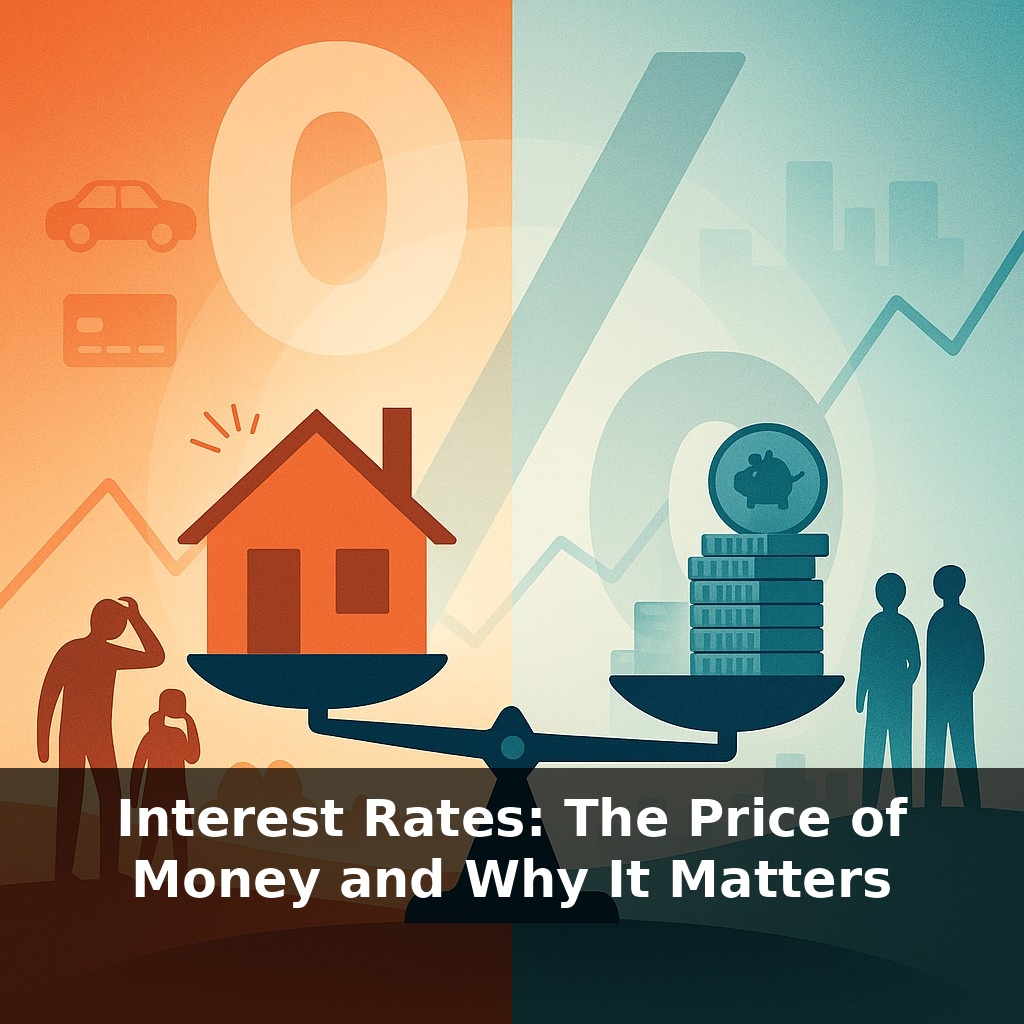
Right now, a typical thirty-year mortgage costs roughly *triple* what it did just a few years ago—without the house getting any bigger. One family’s payment jumps; another’s savings finally earn real interest. Same interest rate move, opposite life stories. Why?
When that rate quietly moves a few percentage points, it doesn’t just reshape housing—it redraws the map of who wins and loses across the entire economy. Suddenly, credit-card balances get heavier, car loans stretch thinner, and governments feel their budgets tighten as old “cheap” debt rolls into new, expensive payments. Retirees might cheer as savings accounts finally pay something, while startups shelve bold projects that no longer “pencil out” with pricier funding. Stock prices can reroute overnight as traders revalue every future profit through a new, harsher lens. These shifts don’t happen in isolation: they interact, collide, and occasionally overcorrect. Our goal in this episode is to trace how a single number—often quoted on the news and quickly forgotten—threads through household decisions, corporate strategies, and government choices, and why small moves can echo for years.
To really see what’s going on, zoom out from any single bill or investment and look at the chain reaction. Rates help decide whose plans move from “someday” to “never,” and whose stay safely on track. A small move can flip the script for renters weighing ownership, firms eyeing new factories, or cities considering long-term projects. They also quietly sort the economy’s winners: borrowers vs. savers, young vs. old, cash-rich companies vs. debt-heavy ones. In the background, central banks react to inflation and growth data, nudging this price of money and, with it, the tempo of almost every financial choice we make.
When economists call interest “the price of money,” they mean it literally. Just as a store price rations scarce goods, this price rations who gets to use money *now* instead of later. At a low price, many projects and purchases look worthwhile; at a higher price, only the best survive. That quiet sorting process reshapes the entire economy’s to‑do list.
One way to see this is through time. Interest links **today** to **tomorrow**. When you save, you’re selling your right to spend now in exchange for more later. When you borrow, you’re buying that right, and agreeing to spend less in the future. The interest rate is the exchange rate between present and future. High rates say: “Future dollars matter a lot—don’t waste them.” Low rates say: “Future dollars are cheap—use them aggressively.”
That’s why central bankers obsess over small changes. Research from the Federal Reserve suggests that a 1‑percentage‑point move in their policy rate can nudge economic growth by around 0.4 percentage points after a year. That sounds tiny, but on a $28‑trillion economy it’s hundreds of billions of dollars of output that either happens or doesn’t—factories built or shelved, hires made or postponed.
On the **saver/investor** side, the math compounds. The Rule of 72 says money roughly doubles in 72 divided by the annual interest rate years. At 2%, it takes about 36 years; at 6%, about 12. That gap is the difference between one comfortable retirement and three. Pension funds, insurers, and endowments care enormously: higher yields mean they can hit long‑term promises without taking as much risk in stocks or private deals.
On the **global** side, rates reshuffle trillions. In 2020, nearly $53 trillion of bonds had negative yields—lenders effectively paid governments and companies for safety. By 2023, under $3 trillion did. That reversal hammered some borrowers (their future refinancing costs soared) but finally rewarded cautious savers in places like Germany and Japan.
Throughout, remember a key subtlety: central banks don’t dictate every loan or bond yield. They set a crucial short‑term benchmark and steer expectations. From there, millions of investors negotiate the rest—adding premiums for risk, inflation fears, or simple uncertainty—so the “price of money” is really a crowd’s evolving guess about how the future will unfold.
Think about three different people facing the same move in the “price of money.” A nurse with student loans sees her monthly bill climb; she cancels a vacation and picks up extra shifts. A mid‑career engineer at a cash‑rich tech firm barely notices—her employer actually benefits as rivals weighed down by old borrowing slow their expansion. A city treasurer, watching debt costs rise for future infrastructure, rushes to issue long‑term bonds now, hoping to “lock in” today’s conditions before they worsen.
At the corporate level, a company like Apple, sitting on piles of cash, can self‑fund projects when financing gets pricier, while a smaller competitor delays a factory upgrade because the hurdle to justify it just jumped. That shift doesn’t merely change who expands; it can tilt entire industries toward incumbents.
In personal finance, a young saver might suddenly favor safer bonds over chasing stock gains once yields cross some mental line. Retirement timelines, college plans, even career choices quietly rearrange around this new trade‑off between patience and urgency.
Over time, shifts in this “price of money” can redraw life plans. College choices, retirement age, even whether you prefer a steady job or freelance work may hinge on how costly it is to carry debt or hold cash. Employers rethink training and automation when long‑term funding gets pricier. Cities may favor quick, patchwork fixes over ambitious, decades‑long projects. Like a changing climate rather than a single storm, the background level subtly nudges every decision.
Over a lifetime, the “price of money” quietly edits your story: when you feel safe to take a sabbatical, whether you rent a studio or buy a duplex, how bold your employer is about training you for the next role. Like a shifting recipe, small changes in this one ingredient alter the whole dish—so it’s worth noticing who’s seasoning it, and why, before you take a bite.
Here’s your challenge this week: Log into every account you have that earns or charges interest (checking, savings, credit cards, student loans, mortgage, personal loans) and create a simple 2‑column list: “rate I’m paying” vs. “rate I’m earning.” By tonight, move at least one cash balance from a low‑yield account (e.g., 0.01% checking) into a higher‑yield option you can actually open today (like a high‑yield savings account or money market account). Before the week ends, make one concrete rate change on the debt side too—either refinance, request a lower APR on a credit card, or schedule an extra payment specifically targeted at your highest‑interest debt.