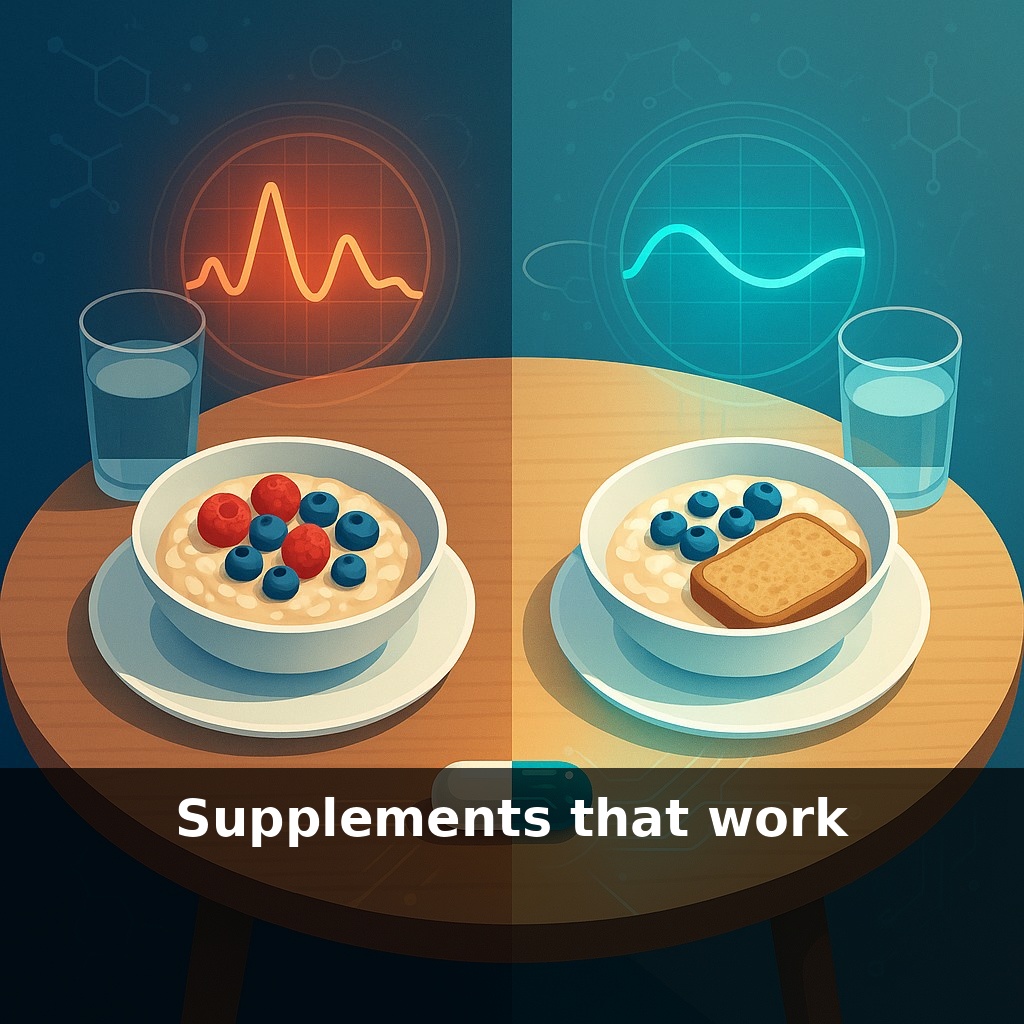
A vitamin that most people think of for bones can quietly double your risk of diabetes when you don’t get enough of it. Now, picture two people at breakfast—same meal, same weight—but one’s blood sugar barely rises while the other’s spikes. What tiny supplement tweak explains that?
Here’s the twist: the “extra” you add to your plate can sometimes matter as much as the food itself. Not extra portions—but extra molecules. Two people can clean up their eating, walk after dinner, sleep better… and still get very different lab results. One reason? Their internal “toolbox” isn’t stocked the same.
Some bodies run short on key helpers: minerals that tell cells how to respond to insulin, plant compounds that nudge the liver to behave, fibres that quietly slow the rush of carbs into the bloodstream. It’s like two musicians playing the same song; one has a finely tuned instrument, the other’s guitar is slightly warped. The notes are similar, but the performance feels completely different.
In this episode, we’ll focus on supplements that actually have human data behind them—where they help, where they disappoint, and how to plug them into a real-life plan instead of hoping for magic in a capsule.
So instead of asking “Which pill fixes pre-diabetes?”, a better question is: “Given my specific weak spots, which few tools are worth testing?” That shifts the focus from shopping lists to strategy. Some people are missing sunlight because they work indoors; others rarely eat foods that contribute key cofactors, or have gut issues that change how they absorb what’s already in their diet. Lab results, medications, and daily routines all shape what’s useful—or risky. In this context, certain supplements stop being generic add-ons and become targeted upgrades, chosen for a clear job and a clear exit plan.
Let’s start with the ones that keep showing up in decent trials, then work outward to the “maybe” category.
Vitamin D first, because the signal is strong and the fix is simple. Large meta-analyses link low levels with substantially higher diabetes risk, and newer randomized trials suggest that correcting a low level nudges that risk back down. The practical move isn’t “everyone take huge doses,” it’s: get a 25(OH)D test, then use a moderate dose—often 1,000–2,000 IU/day—to move a documented low into the middle of the lab range, re-check, and stop there. More is not better; it just adds side-effect risk.
Magnesium is next because many people fall short through diet alone. Several controlled trials in people with impaired glucose control found that adding a moderate supplemental dose lowered fasting values a bit over a few months. The key is the “elemental” amount, not the size of the pill, and the form matters: glycinate, citrate, or malate are typically better tolerated than the cheapest oxide forms. Go slow and take it with food to avoid gut issues.
On the gut side of things, soluble fibre is less of a pill and more of a daily ingredient. Trials using powders like partially hydrolysed guar gum or psyllium before meals have shown modest improvements in post-meal responses and longer-term markers. This is one of the few tools that directly changes how quickly carbohydrate from the meal you just ate appears in your bloodstream. It works best when treated as part of the meal, not an afterthought—stirred into yogurt, sprinkled into soup, or mixed into water and sipped before eating.
Then there are the “metabolic signal” modifiers: alpha‑lipoic acid and berberine. Alpha‑lipoic acid has a long history in nerve-related complications, and some studies suggest small improvements in how efficiently the body uses glucose when taken in divided doses. Berberine, used in several traditional systems of medicine, repeatedly shows drug-like effects on longer-term markers and on how the liver releases stored fuel. The flip side is that its very potency brings interaction questions; it can affect how other medications are processed and may not be appropriate if you’re already on prescriptions that influence the same pathways.
Think of this like planning a trip, not buying souvenirs at the airport. Instead of grabbing every shiny bottle, you’re mapping where each add-on might actually move the needle for you. For someone who eats at irregular hours, a fibre drink before the biggest carb-heavy meal might matter more than anything else. For a night-shift nurse who never sees the sun, checking a lab and then using a modest D dose for a few months could be the smarter “upgrade.”
Magnesium might be worth testing if your diet is light on nuts, beans, and greens, or if you’re on meds that deplete it. Alpha‑lipoic acid often gets considered when people have tingling or burning in their feet and are also trying to smooth out glucose swings. Berberine, because it behaves a bit like a drug, belongs in the same mental bucket as a prescription: you’d time it around meals, watch your bowels, and double‑check other meds for clashes. The through‑line: treat each option as a time‑limited experiment with a clear start, dose, and review date.
By 2035, you might not “pick” products at all—your phone could suggest a combo after watching months of sleep, meals, and stress data, then adjust it like a DJ tweaking levels as your life changes. That raises new questions: Who owns that pattern data—your clinic, an app, or you? Will insurers reward people whose numbers improve, or quietly penalize those who don’t “adhere”? The more we personalise, the more we’ll need simple guardrails so nudges stay helpful, not pushy.
So the real experiment isn’t “Does X pill work?” but “What happens when *you* combine the right one with your routine?” Treat each add‑on like adjusting a music mix: small tweaks, one dial at a time, then listen for changes in energy, focus, and lab trends. The most powerful “stack” will be the one you can play on repeat without burning out.
Before next week, ask yourself: “If I only kept 2–3 supplements I’m currently taking, which ones actually have solid evidence (like creatine, vitamin D, omega‑3s, or magnesium) and a clear benefit I can feel or measure—and which ones am I taking just because of marketing or habit?” “Looking at my real diet, sleep, and stress levels right now, is there a basic I’m trying to ‘patch’ with a pill (for example, using melatonin instead of fixing my late-night screen time, or a multivitamin instead of eating any vegetables)?” “What’s one specific way I could test whether a supplement is helping—such as stopping it for 2 weeks, tracking sleep, mood, or workouts, and then restarting it—to see if it actually makes a difference for me?”