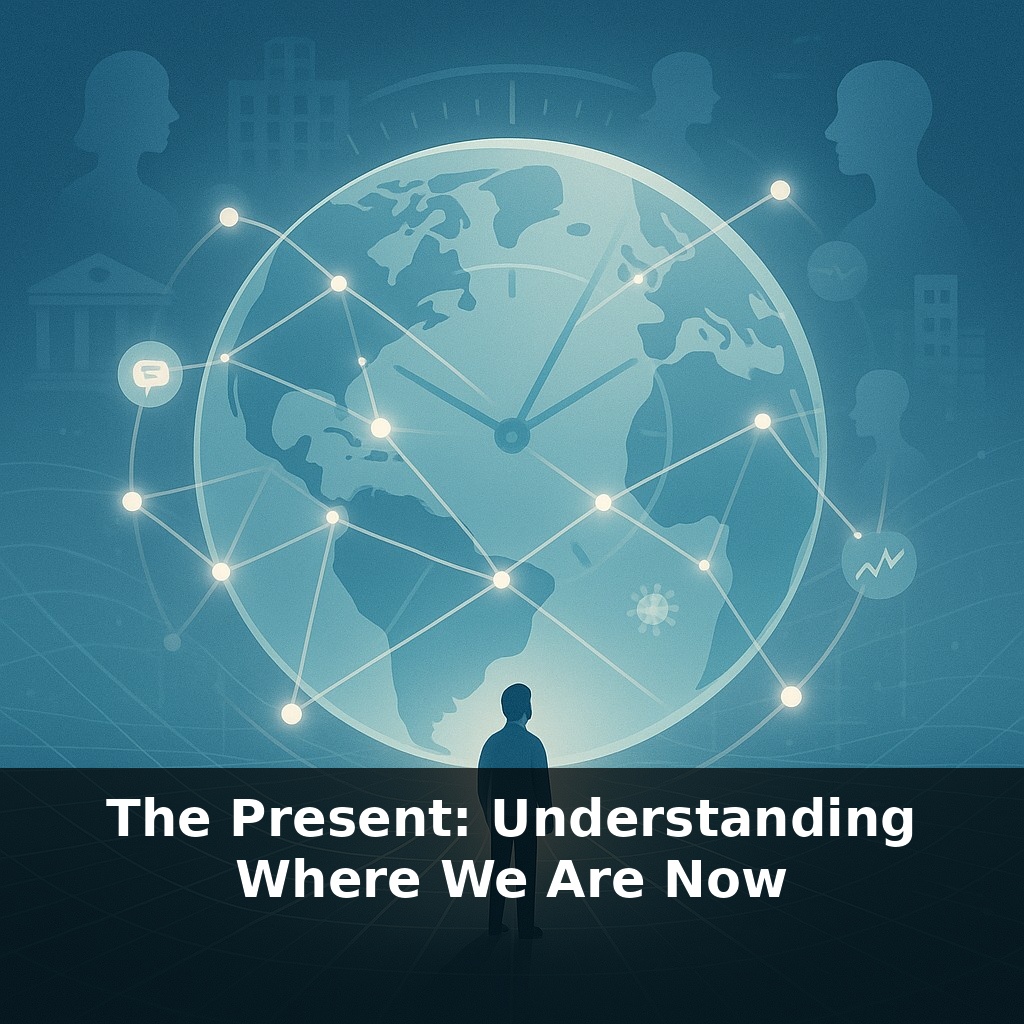
Right now, most humans are closer to a stranger on another continent than to their own grandparents a century ago. A message can cross the planet in a heartbeat, but a virus, a rumor, or a market shock can too. We’ve never been so connected—and so vulnerable—at the same time.
In the early 2020s, humanity feels like it’s living in “beta mode.” Old systems—schools, governments, healthcare, even work itself—were built for a slower, more local world, yet we’re using them to navigate a reality that updates as often as our apps. Climate headlines arrive alongside stock alerts, personal health data, and breaking news from three different continents. It’s not just more information; it’s more decisions, more often, with higher stakes.
At the same time, the boundaries between the physical and digital are thinning. Your phone tracks your steps, your bank lives in the cloud, your friendships may stretch across time zones. A lab breakthrough in one country can transform a disease outlook worldwide; a policy change in another can shift energy prices everywhere. The present is no longer just where you are—it’s a constantly shifting intersection of technology, biology, and global politics that you inhabit every day, often without noticing.
Open your phone, and you’re peeking into a world that’s younger, older, richer, and more fragile than any before it. Most humans are just 30 years old, yet we’re heading toward a future where gray hair is as common as teenage playlists. Extreme poverty has dropped sharply, but each new crisis—pandemic, war, climate shock—slows the slope, like a cyclist hitting patches of mud. Meanwhile, renewables quietly power nearly a third of our electricity, not as a distant ideal but as part of the grid that keeps your lights on and your feeds refreshing. The present is a moving target, but its pressures and possibilities are measurable.
About 6.8 billion smartphone subscriptions exist for 8 billion people. That number quietly captures where we are now: not just connected, but reorganizing how power, work, trust, and risk operate.
Start with power. A majority of humans can now record, publish, and coordinate without asking permission from a newspaper, TV station, or political party. Protest movements learn tactics from each other in real time; so do conspiracy groups. Trade hasn’t vanished; it’s rerouting. Supply chains are being redesigned around “friend-shoring” and resilience, as governments and companies try to avoid being held hostage by a single factory, port, or rare mineral.
Then there’s the climate layer. As energy systems tilt—slowly—toward low-carbon sources, entire regions face identity questions. What happens to petrostates when oil demand plateaus? To coal towns when mines close? At the same time, countries racing to secure lithium, cobalt, and rare earths for batteries are creating new forms of dependency and new bargaining chips.
Demographically, a 30-year-old median age hides stark contrasts. In some countries, classrooms are overflowing with young people entering weak job markets; in others, hospitals and pension systems strain under aging populations. This “youth bulge vs. silver wave” split shapes everything from migration pressure to election outcomes to innovation hubs.
Overlay rapid advances in AI and life sciences, and the present becomes even stranger. Algorithms help design proteins, predict floods, screen job applicants, and decide which posts you see first. Biotech startups edit genes, grow meat in tanks, and chase longevity drugs. These tools promise better health and efficiency, but also raise questions about bias, surveillance, privacy, and who profits from your data and DNA.
The result is a world where local decisions ripple globally, and global shifts land in local routines: the price of your groceries, the air you breathe, the feeds you scroll at night. Understanding “now” means noticing how these layers—geopolitics, demographics, climate, and computation—interlock, not as background noise, but as the environment you move through every day.
Your challenge this week: pick one ordinary habit—commuting route, food choice, or app you check daily—and trace three hidden global systems shaping it (energy, labor, data, regulation, materials). See how far “right now” actually reaches.
Open your food delivery app and tap “order.” In a few seconds, you’ve voted in half a dozen hidden elections. You’re choosing which farms and factories stay in business, which streets stay clogged with scooters or cars, which neighborhoods attract new kitchens and which ones don’t. A discount nudges you toward one cuisine; a surge fee quietly punishes you for ordering at 7 p.m. rather than 5:30. None of this feels political, but it shapes local wages, traffic patterns, and even storefront rents.
Or think about a routine medical checkup. That blood test doesn’t just tell your doctor how you’re doing; anonymized versions of it may train diagnostic algorithms, influence which drugs get more investment, and feed insurance models that decide which treatments seem “cost-effective.” The clinic is local, but the data trail is not.
Like a weather map layering temperature, wind, and humidity, the present only comes into focus when you stack these invisible patterns on top of your daily choices.
Today’s choices don’t just add up; they react with each other. A city investing in trees to cool streets may quietly lower hospital admissions and energy bills. A country tightening data laws can shift where startups form, which in turn shapes where young people move for work. The near future will likely feel less like a straight line and more like a recipe: small substitutions today may completely change the dish a decade from now.
The present isn’t a waiting room before “real history” resumes; it’s the mixing bowl where past choices and future possibilities are already combining. Paying attention to how tiny routines link into bigger patterns is less about constant vigilance and more like tasting as you cook: adjust a little now, and the whole flavor of what comes next can change.
Start with this tiny habit: When you first touch your phone in the morning, pause for just one breath and quietly say, “Right now, I am in [name the room you’re in].” Then let your eyes land on one specific, ordinary object around you (your mug, the window, your shoes) and simply notice three details about it—its color, shape, and texture. Do this once a day only, no extra journaling or reflection required—just a tiny, 10-second check-in with the present before your day sweeps you away.