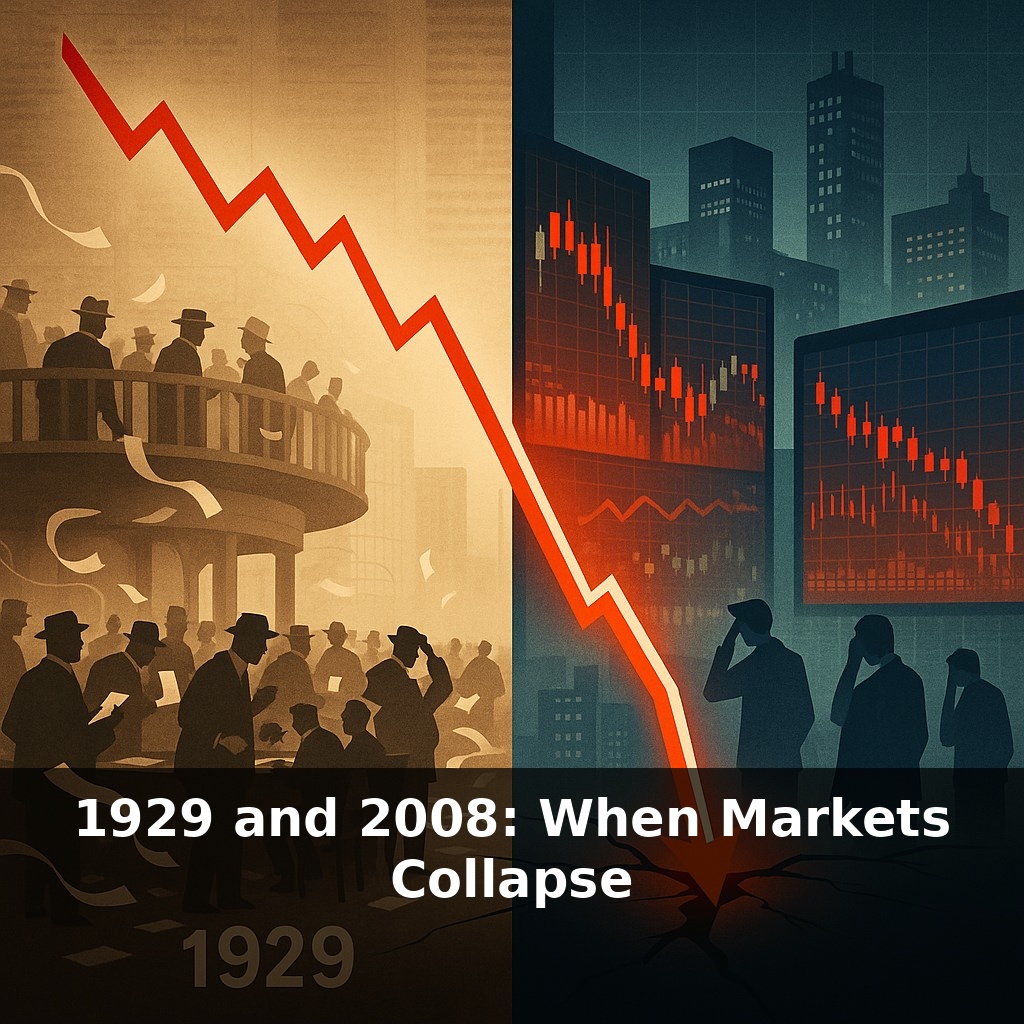
1929 and 2008: When Markets Collapse
📝 Transcript
Traders once watched the stock market lose almost nine out of every ten points it had gained, yet many still believed “the fundamentals are sound.” Today’s episode asks: how do smart people miss a cliff that big, and could we be walking toward another one right now?
In 1929, telegrams carried the panic; in 2008, it was glowing screens and collapsing charts. Different tools, same mistake: people trusted rising prices more than uncomfortable data. Before each crash, warnings were there—slowing output, rising defaults, strange new financial products that few fully understood—but the story everyone preferred was that “this time is different.”
In this episode, we’ll trace how easy money, new technologies, and political choices built towering structures of confidence, then quietly removed the supports. We’ll look at how ordinary households got pulled in—through margin loans in the 1920s and subprime mortgages in the 2000s—and how policymakers either froze or moved fast when pressure hit. Think of it as walking through a blueprint of two collapses, to see which beams cracked first, and which reinforcements actually held.
By the time headlines scream “crash,” the real damage has usually been quietly accumulating in balance sheets and policy meetings for years. In 1929, credit fueled bets on stocks; in 2008, it seeped into housing and complex securities, threading risk through pensions, money-market funds, and foreign banks. Both eras shared a blind spot: trust in institutions that said, “We’ve modeled this.” Yet those models often left out human behavior—herding, denial, fear. To understand why both crises became global, we have to follow the plumbing of money: who owed what, to whom, and on what assumptions those promises rested.
By 1928, the U.S. didn’t just have exuberant investors; it had a central bank trying, and failing, to cool them down. The Federal Reserve nudged interest rates higher but hesitated to clamp down hard, worried about choking off business. That hesitation let leverage pile up. When prices finally broke, the Fed then swung the other way—tightening into weakness. Between 1930 and 1933, the money supply shrank dramatically, starving banks and firms of liquidity right when they needed it most.
Regulators also misread their job. The Fed saw itself as protector of the gold standard, not as backstop for failing banks. So when deposits fled, authorities mostly stood aside. Thousands of local banks disappeared, not just wiping out savings but also the local knowledge those lenders had about their communities. Credit didn’t just get expensive; in many towns, it vanished.
Contrast that with the 2000s. The official inflation numbers looked tame, so central bankers were slow to see danger in swelling balance sheets. Risk had migrated into the shadows: investment banks, money-market funds, off‑balance‑sheet vehicles. On paper, diversification looked sophisticated. In practice, it concentrated exposure to the same underlying bets on housing. When losses hit, they ricocheted through institutions that had never been stress‑tested for such a scenario.
Here’s where 1929’s scars mattered. In 2008, the Fed cut rates aggressively, extended emergency loans far beyond traditional banks, and helped orchestrate capital injections. Congress passed a large fiscal package, and automatic stabilizers—unemployment insurance, progressive taxes—kicked in. These tools didn’t prevent a sharp downturn, but they kept a severe recession from mutating into a depression‑level collapse.
Regulation also evolved differently. After the 1930s, deposit insurance and stricter rules on commercial banks created a sturdier “core” system, but risk migrated to less‑regulated edges. Post‑2008 reforms—higher capital requirements, stress tests, new oversight of derivatives—tried to widen the circle of supervision. The lesson embedded in both eras is uncomfortable: stability in one part of the system often encourages risk to flow somewhere else, unseen, until pressure reveals where the real weak beams are.
Think about how risk hid in plain sight through everyday products. In the late 1920s, investment trusts bundled dozens of companies into single shares, promising diversification while quietly loading up on the same fashionable industries. In the 2000s, mortgage‑backed securities did something similar with home loans, slicing them into tranches that ratings agencies often stamped as safe. Both eras used complexity like decorative scaffolding on a skyscraper: impressive to look at, but not always carrying real weight when stress hit higher floors.
When Lehman Brothers fell, money‑market funds that many households treated like cash suddenly “broke the buck,” revealing that even cash‑like assets carried hidden exposure. In 1931, when Austria’s Creditanstalt failed, it transmitted shock through trade finance and interbank loans, freezing credit far beyond Vienna. In each case, the real story wasn’t just price drops; it was the sudden discovery that the “safe” corners of the system weren’t as insulated as they looked on paper.
Today’s risks don’t wear 1930s bowler hats or 2008 banker suits. They hide in code, climate, and corporate balance sheets. Digital platforms can move trillions at the tap of a screen, turning whispers into stampedes before regulators blink. Green projects may attract so much capital that valuations drift far from reality. Your challenge this week: follow one financial headline into its footnotes and data, and see how quickly a simple story becomes a web of hidden links.
Crashes don’t arrive on schedule; they creep in through side doors—corporate debt binges, shadow lenders, sudden liquidity droughts. Treat headlines like weather apps: a single storm icon means little, but shifting pressure over days hints at a front moving in. Staying curious about those subtle changes won’t stop the next break, but it can keep you from standing right beneath it.
Here’s your challenge this week: Open your actual investment or retirement account and run a “1929 & 2008 stress test” on it. Using real numbers, calculate what a 50% drop (like 1929) and a 35–40% drop (like 2008) would do to your current balance, then write the exact dollar amounts next to each scenario. Before the day is over, change at least one concrete thing based on what you see—this could be increasing your emergency cash buffer, lowering a too-aggressive stock allocation, or setting up automatic monthly investing so you’re ready to buy when markets are down.
From this course

How We Got Here: The Crises That Shaped Us
8 episodesUnlock all episodes
Full access to 8 episodes and everything on OwlUp.
Subscribe — $1.99/monthLess than a coffee ☕ · Cancel anytime