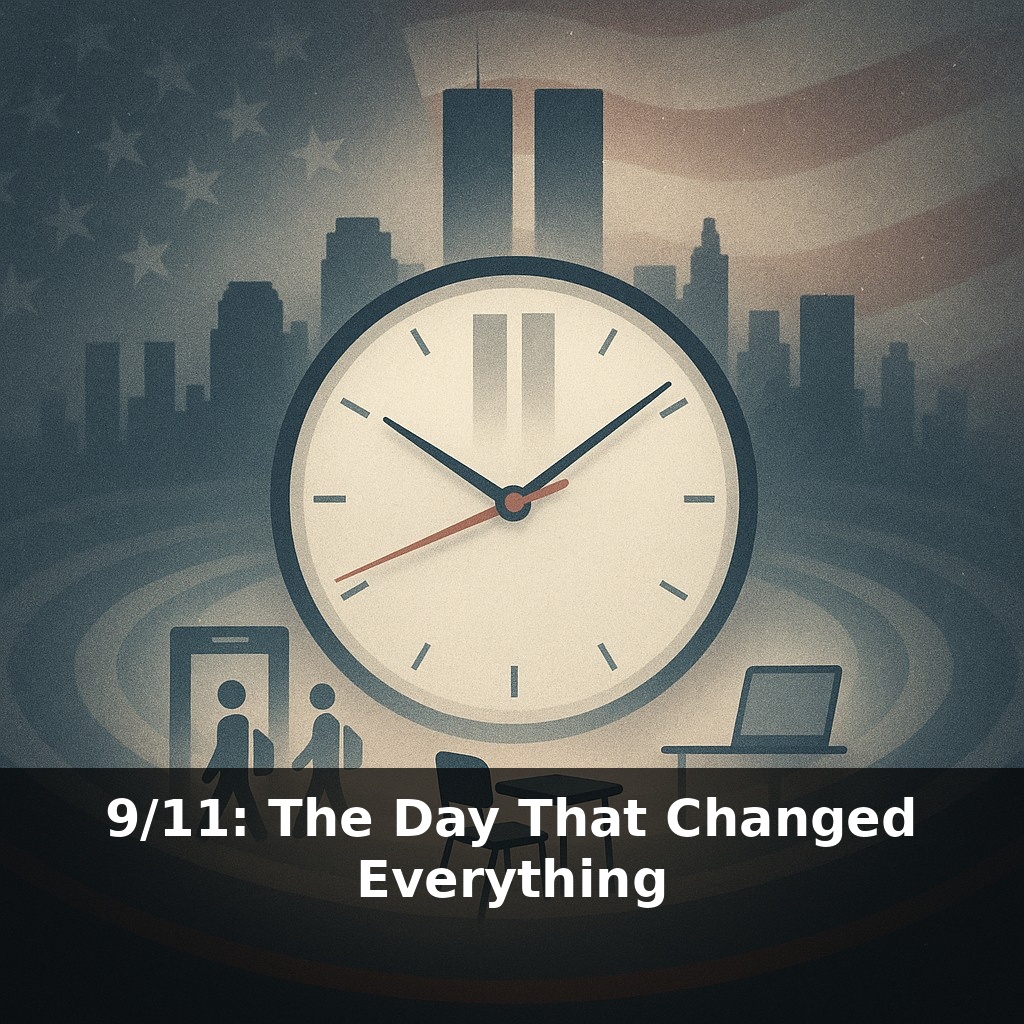
Nearly 3,000 lives ended in a single morning—yet for millions more, that day never really stopped. You’re in an airport line, a school classroom, a routine Zoom meeting, and without naming it, you’re following rules written on September 11th. How did one day rewrite ordinary life?
The shift wasn’t just in policy memos and presidential speeches; it seeped into calendars, careers, even childhood memories. A whole generation grew up doing “lockdown drills” the way earlier kids did fire drills. Parents weighed vacation spots not only by price and beaches, but by headlines and threat levels. Universities built entire programs around homeland security and counter‑terrorism, the way they once rushed to add computer science in the 1980s. Neighborhood mosques hired lawyers and PR consultants; Sikh cab drivers kept extra documents in their glove compartments, just in case. News tickers at the bottom of TV screens—once rare—became a permanent fixture, turning background anxiety into a 24/7 crawl. Bit by bit, the “before” and “after” of that day hardened into a line you could feel, even if you were too young to remember crossing it.
Flights didn’t just get slower; the whole architecture of movement changed. Airport security lines stretched, but so did border databases and watchlists, quietly syncing up behind the scenes. Government agencies that once guarded their information like rival sports teams started trading intel in real time. “Security clearance” stopped sounding like a spy‑movie phrase and more like a career path. Even pop culture shifted: TV dramas swapped courtroom twists for counter‑terror plots, while thrillers and news specials trained audiences to track acronyms—DHS, TSA, NSA—the way fans follow league stats.
The shock of the attacks hit first as grief and fear, but the deeper change came in the months after, as governments started rewiring how power worked. In Washington, politicians from both parties moved with rare speed: within 45 days, the PATRIOT Act cleared Congress, quietly giving investigators broader authority to monitor phone calls, emails, bank records, and library checkouts. Tools that once required narrow warrants or slow approvals became easier to deploy, especially when officials could invoke terrorism. The logic was simple: if the threat could be everywhere, government needed to be everywhere too.
Money followed that logic. U.S. defense spending ballooned over the decade, but not just for tanks and fighter jets. Intelligence agencies expanded; special operations forces grew; new fusion centers popped up across states to sift tips, rumors, and intercepted chatter. Local police departments applied for federal grants and came away with gear and training that blurred the line between soldier and officer. A city parade and a high‑risk raid might now involve similar equipment—different missions, shared mindset.
Abroad, the “War on Terror” became a guiding framework, shaping decisions in Afghanistan, Iraq, and far beyond. Alliances were recalibrated around intelligence sharing, drone access, and basing rights. Visa policies tightened; refugees and students discovered their paperwork now lived inside a security debate. The threat label “terrorist” became a powerful foreign‑policy tool—sometimes clarifying real dangers, sometimes used by governments to sideline their own opponents under a language the U.S. would accept.
At home, the costs and consequences multiplied in slower motion. New surveillance powers raised old questions: How much privacy are citizens willing to trade for safety, and who decides when an emergency ends? Court cases and whistleblowers later revealed just how far bulk data collection had gone. Meanwhile, nearly 350,000 people would eventually enroll in health programs linked to that day’s dust and debris, turning a single morning’s exposure into a lifelong medical story. And as years passed, focus on one kind of terrorism obscured others; while public imagination stayed fixed on foreign plots, intelligence reports increasingly warned about homegrown extremism, especially from the far right.
In technology terms, that morning functioned like a zero‑day exploit: systems weren’t just damaged, they were revealed. Air marshals became more common on flights; “no‑fly lists” grew from a few names to tens of thousands, sometimes snagging toddlers or famous musicians whose names resembled a suspect’s. Universities launched Middle East and security studies centers, and think tanks pivoted to forecasting asymmetric threats instead of Cold War standoffs. Insurance companies rewrote fine print to carve out “terrorism risk,” pushing governments to create backstop programs so skyscrapers could still be built and insured. Architects started factoring blast resistance, emergency stair capacity, and evacuation modeling into glamorous glass‑tower designs. In entertainment, war coverage and terrorism storylines trained audiences to absorb distant violence as breaking‑news rhythm. Meanwhile, American Muslims and people perceived as Muslim navigated extra layers of scrutiny at work, at borders, and in neighborhoods, reshaping daily routines in ways that rarely made headlines.
Teenagers now learn about 9/11 as “history,” yet they inherit its unfinished arguments. Digital life folds those debates into every tap: facial‑recognition in stadiums, location logs in phones, “smart” doorbells watching sidewalks. As climate shocks, pandemics, and cyber‑attacks pile up, leaders may reach for the same emergency toolkit, like reusing a familiar playbook in a different sport. The open question is whether the next generation quietly accepts that script—or edits it.
Today’s teens meet that day through clips, curriculum, and comments, then remix it into memes, protests, and policy threads. They inherit metal detectors at concerts and data trails in every swipe, yet also new tools to question them. Your challenge this week: notice one small rule that traces back to 9/11—and ask who benefits from keeping it, and who pays.