Nuclear weapons once numbered in the tens of thousands, yet not a single one was used in battle after World War Two. We’ll drop into closed-door debates, tense stand‑offs, and quiet deals to trace how a world built for conflict still shapes your newsfeed today.
The story of the Cold War really begins with a strange kind of peace: no formal World War Three, but constant preparation for it. Daily life—your grandparents’ job prospects, the layout of cities, even classroom drills—was shaped by decisions made in quiet conference rooms from Washington to Moscow. Tax money flowed into missile programs instead of housing, and scientific races didn’t just aim for the Moon; they redefined what counted as “progress.”
To follow how we got from those tense standoffs to today’s headlines, we’ll track three threads: how alliances hardened into long‑term security clubs, how local conflicts were “scaled up” into global tests of loyalty, and how a cautious habit of crisis‑management evolved. Step by step, we’ll see why arguments over Ukraine, Taiwan, or defense budgets still follow paths laid down in that divided era.
Governments didn’t just stockpile weapons; they built rules, habits, and institutions that outlived the rivalry itself. Think of today’s world like a city whose streets were laid out decades ago: new buildings appear, new residents move in, but traffic still follows old routes. NATO expanded into former Soviet‑aligned territory, the UN kept its veto logic, and arms‑control deals such as START reshaped what “acceptable” power looks like. Meanwhile, rising powers like China and India learned from past standoffs, adapting those inherited patterns rather than discarding them.
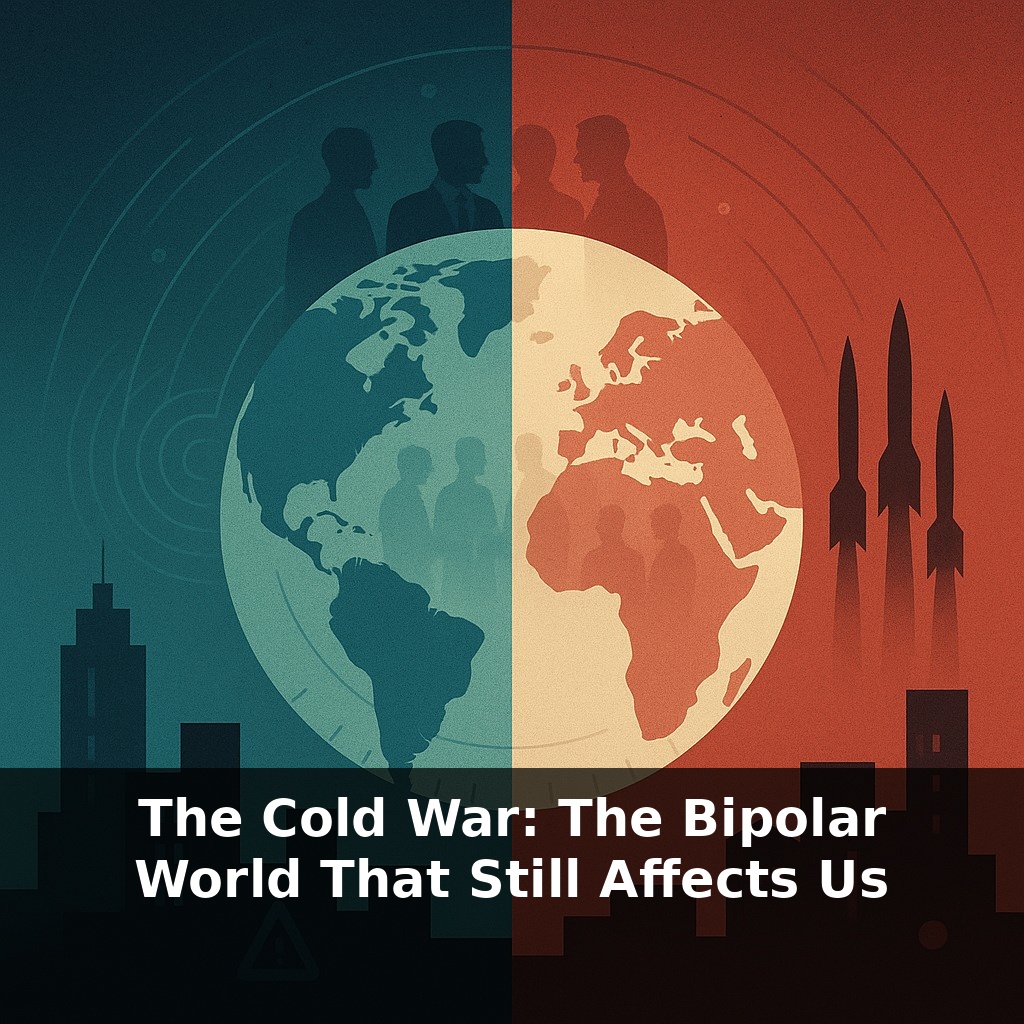
When people talk about a “bipolar” world, they’re describing more than two superpowers glaring at each other; they’re pointing to an entire operating system that sorted nearly every government into compatible or incompatible camps. After 1945, Washington and Moscow sponsored rival economic models, security guarantees, and development paths that came bundled like software ecosystems. Sign up for one, and you usually inherited its trade partners, weapons suppliers, intelligence links, and voting patterns at the UN.
States that didn’t want to be locked in—India, Yugoslavia, Egypt, Ghana and others—experimented with a different script: the Non‑Aligned Movement. They met at Bandung (1955) and Belgrade (1961) and tried to turn “we’re not with either bloc” into a collective bargaining chip. Instead of picking a side in the rivalry, they treated it as leverage, extracting aid, technology, and diplomatic support by threatening to lean one way or the other. Many post‑colonial leaders framed alignment choices as questions of sovereignty rather than ideology, even as both superpowers tried to dress their offers in universal principles like “freedom” or “social justice.”
Inside each camp, competition didn’t vanish just because members nominally shared a banner. France built its own nuclear force and pulled parts of its military structure away from its closest partners in 1966. China broke with Moscow in the Sino‑Soviet split, turning what had seemed like a single communist front into rival centers of gravity. Smaller states learned to play this internal friction: Pakistan balanced its security needs by courting support from very different patrons over time; Cuba used its symbolic weight to punch above its size in both diplomacy and expeditionary adventures.
By the 1980s, the economic side of this architecture was under immense strain. Resource booms turned to debt crises across Latin America and Africa. Central planning produced chronic shortages and technological lag in Eastern Europe. Western institutions responded with structural‑adjustment programs that pushed privatization and austerity, while critics in the global South argued these “cures” locked them into subordinate roles. When one pole collapsed, the physical checkpoints and wall segments could be cleared in a few years, but the deeper patterns—who finances whom, who sells arms to whom, who gets to set the terms of “reform”—proved far more durable.
Your challenge this week: Trace a single current headline—about a security pact, a debt dispute, or a vote at the UN—back through the alignments, rivalries, or institutions that took shape between 1947 and 1991. Note how many steps you can count before you reach something that predates that era.
Look at today’s energy politics for a concrete spin‑off from that old “operating system.” Western Europe’s move away from Russian gas after 2014 didn’t start from a blank slate; pipeline routes, pricing habits, and supplier trust all reflected decades of earlier choices about whom to wire your economy to. Or take tech: export controls on advanced chips, especially involving China, echo older worries about letting rival states climb the ladder into cutting‑edge industries that once centered on aerospace or mainframe computing. Even pop culture carried these patterns: film studios and publishers learned to market different “villains” depending on local censors and readers, building narrative templates still recycled in thrillers and video games. In sports, too, medal tables and boycotts in the 1970s and 1980s trained broadcasters to frame global tournaments as symbolic scoreboards, a habit revived whenever commentators turn medal counts or World Cup fixtures into shorthand for deeper political rivalry.
Today’s fault lines don’t just reheat old rivalries; they splice new code into that inherited system. Climate negotiations, rare‑earth supply chains, and data cables now matter as much as tanks. Think of undersea internet lines as the railroads of this era: whoever maps and protects them shapes whose voices travel fastest. The open question is whether rising powers will renovate Cold War‑era institutions or build parallel ones—from BRICS banks to regional trade pacts—that slowly rewrite the rules.
We’re still learning how to live with institutions built for a different century, like moving into a house wired for plug‑in radios and trying to run fiber‑optic cable through the same walls. As new problems—AI, pandemics, space traffic—pile up, the unresolved question is whether we retrofit those walls or start sketching blueprints for an entirely new floor plan.
Here’s your challenge this week: Pick one current geopolitical tension (for example, NATO–Russia over Ukraine or U.S.–China in the Pacific) and, in a single evening, map it like a mini–Cold War by listing the two main “blocs,” their key allies, and what each side is trying to protect (security, ideology, resources, prestige). Then compare it directly to the U.S.–Soviet rivalry: note at least two parallels (like proxy conflicts or arms races) and two key differences (such as economic interdependence or cyber warfare). Finally, explain your mini–Cold War map out loud to a friend, family member, or voice recorder in under three minutes, as if you’re teaching how Cold War logic still shapes that conflict today.