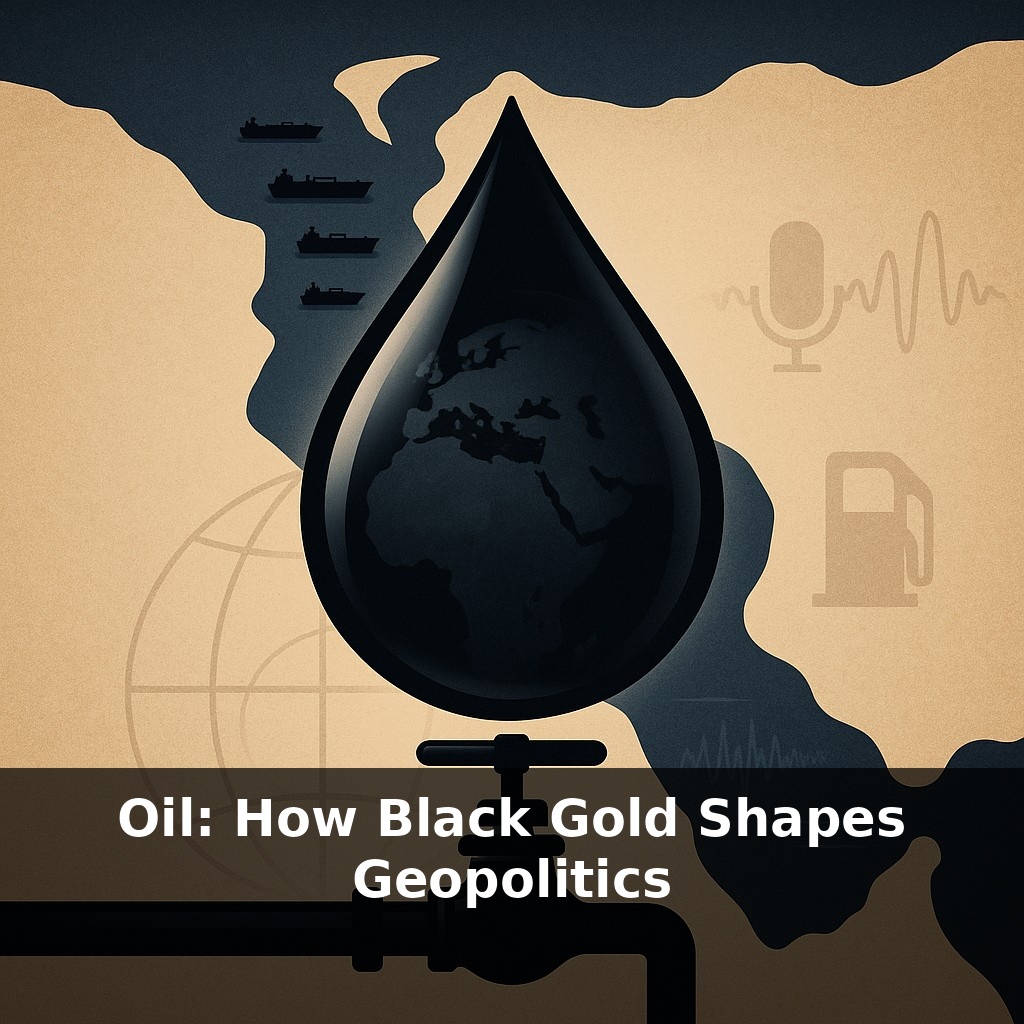
A single narrow waterway in the Middle East carries close to a fifth of the world’s oil. One tense standoff there, and drivers from Delhi to Detroit feel it at the pump. In this episode, we’ll trace how one black liquid quietly steers wars, alliances, and your daily commute.
Here’s the twist: the story of oil isn’t really about fuel—it’s about who gets to say “no.” No to sanctions. No to pressure. No to going along with the plan. Nations that can flip a valve and rattle global markets often gain a kind of veto power in world affairs that far exceeds their population or military size. That’s why small states with huge reserves sit at big tables, while larger, poorer states queue for loans and aid.
But this power is unstable. New producers emerge, old fields decline, and technologies like shale drilling or electric vehicles quietly rearrange who holds leverage. Treaties, wars, and trade deals start to look different when you see them through oil’s shadow—like reading secret annotations in the margins of world history.
Oil’s grip on geopolitics comes from three quirks that don’t usually coexist in one resource. First, it packs enormous energy into a small, movable volume, perfect for ships, planes, and tanks. Second, it’s abundant enough to run whole societies, not just niche sectors. Third, it’s clustered under specific soils and seas, often far from where it’s burned. That trio turns geology into strategy. It’s why desert kingdoms bankroll welfare states, why Washington cares about fields thousands of miles away, and why a drilling rig in Texas can quietly redraw a balance of power in Europe.
At the dawn of the 20th century, a quiet bureaucratic decision in London set the stage for oil’s rise: the British Navy switched its ships from coal to oil. That choice tied national security to distant wells and concession contracts. Suddenly, diplomats and spies were not just counting battleships; they were counting barrels.
From there, a pattern emerged. Whenever a country’s military or economy hinged on imported crude, foreign policy followed the tanker routes. Japan’s push into Southeast Asia in 1941 was driven in part by a U.S. oil embargo that threatened to choke its war machine. Decades later, Iraq’s invasion of Kuwait in 1990 wasn’t just about a border dispute; it was about absorbing reserves that could have vaulted Baghdad into a price-setting role.
Control doesn’t always mean ownership. The United States, now the world’s largest producer, still imports and exports significant volumes, using infrastructure, finance, and naval protection of sea lanes as levers. Meanwhile, export-dependent states like Saudi Arabia or the UAE wield influence by adjusting how much spare capacity they keep in their back pocket—a few million barrels a day that can cool or heat markets.
The 1973 Arab oil embargo revealed how vulnerable consuming nations were. Lines at gas stations in Western capitals translated almost overnight into new institutions: stockpiles like the U.S. Strategic Petroleum Reserve, the creation of the International Energy Agency, and efficiency standards that reshaped cars and industry. Energy security became an organizing principle, not a niche concern.
Today, the landscape is more crowded. Russia’s pipelines knit it into Europe’s energy system; China courts producers from the Gulf to Angola with loans and infrastructure; emerging producers in places like Guyana or Mozambique must decide whose orbit to enter. Think of the global network of wells, pipelines, and ports less as a commodity market and more as a constantly shifting tournament bracket, where alliances, sanctions, and investments are all moves designed to secure a better seed.
And looming over it all is climate policy: efforts to phase down demand without triggering destabilizing shocks for states whose budgets and regimes rest on crude. That tension—between decarbonization and the entrenched power of petrostates—is where the next chapter of oil geopolitics is already being written.
On a map, the story shows up as odd “hotspots” where politics twists around wells and pipelines. Consider Nigeria: Africa’s largest exporter, yet its oil-rich Niger Delta has seen sabotage, theft, and insurgency as local communities demand a bigger slice of profits. Or Venezuela, sitting on colossal reserves but crippled by mismanagement and sanctions, showing that barrels alone don’t guarantee strength if institutions rot.
Then there’s Norway, which treated crude like a finite inheritance: strict rules, high taxes, and a sovereign wealth fund now worth over a trillion dollars. Its leverage comes less from threatening supply than from how prudently it turned geology into financial muscle.
Think of these models—fragile giant, failing petrostate, disciplined trustee—as different “software” running on the same hardware. As demand plateaus and climate rules tighten, countries from Brazil to Guyana are effectively choosing which code to copy, knowing it may lock in their geopolitical role for decades.
Future leverage may depend less on who drills and more on who adapts. States that treat oil income like a fading star—using today’s glow to fund education, grids, and clean tech—could still anchor regional influence. Others may cling to every barrel and find their budgets behaving like a volatile stock. Your challenge this week: scan headlines and note which petrostates are investing beyond oil, and which are doubling down. That split is tomorrow’s fault line.
As energy systems diversify, oil’s role may start to resemble a seasoned captain on a team rather than the lone star player—still decisive in big moments, but no longer taking every shot. Watching who rewrites their playbook first—producers, consumers, or institutions—will tell us who shapes the rules of the next energy era, not just who wins on price.
Here’s your challenge this week: Pick one oil-producing country mentioned in the episode (like Saudi Arabia, Russia, or Nigeria) and spend 20 minutes tracing how a single barrel of its oil could end up influencing your own life—through gasoline prices, plastics you use, or imported goods. Then, switch one product or habit that depends on that oil (for example, one weekly car errand you replace with transit or biking, or one plastic-heavy product you swap for a lower-oil alternative) and track the change in cost and convenience for 7 days. Finally, share a 3-sentence summary of what surprised you most with one other person and ask them where they think the oil for their daily commute comes from.