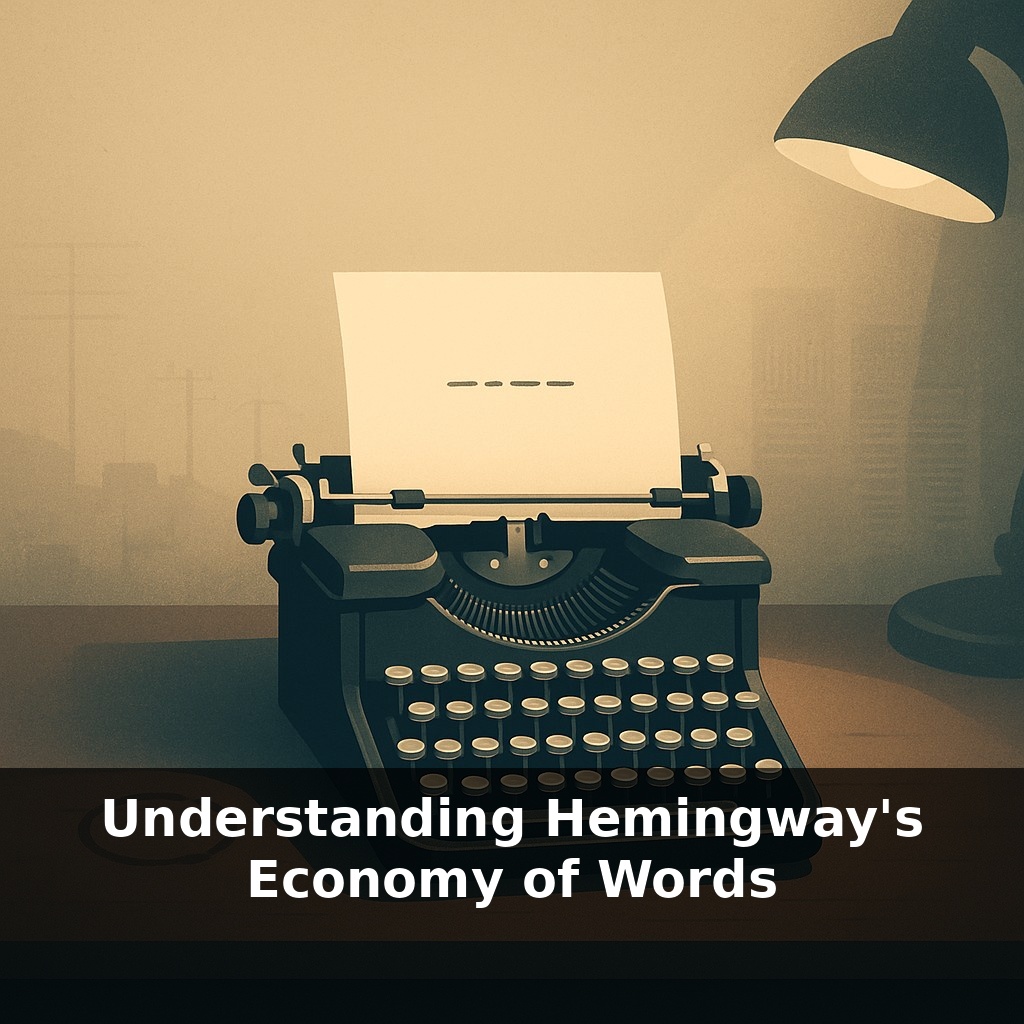
Understanding Hemingway's Economy of Words
📝 Transcript
A Nobel-winning novelist once bragged he could write an entire story in just six words—and make you feel it. In a cramped newsroom, a young war reporter at a battered typewriter cuts sentence after sentence, chasing an elusive truth: how little can you say, and still tell the whole truth?
Hemingway’s answer to “how little can you say?” wasn’t just “less.” It was “less, but sharper.” Before he was a novelist, he was a young reporter filing stories on tight deadlines and even tighter column inches. Every extra word had a cost, so he learned to treat language like a budget: if a sentence didn’t earn its place, it was cut. Later, the trauma of war layered urgency onto that discipline—no patience for ornament when life itself felt provisional. Out of those pressures came a style built on small, strong units: short sentences that move like linked train cars, each carrying only what the story truly needs. When critics praised his “powerful” prose, they weren’t admiring fancy phrasing; they were responding to how much emotion remained after everything unnecessary was stripped away.
Hemingway pushed this discipline into a method: draft freely, then carve back until only the load-bearing pieces remain. His pages reportedly came back from editors bleeding with cuts, and instead of resisting, he treated those marks as a training program. Over time, he began to anticipate the red ink and self-edit before anyone else saw the work. That’s where his “Iceberg Theory” becomes practical craft: the writer knows what’s below the surface, but chooses—line by line—what the reader actually sees, trusting implication more than explanation. The emotional weight lives in what’s hinted, not spelled out.
main_explanation -----------------
Look closely at a page of Hemingway and you’ll notice something subtle: the sentences don’t all look the same. Yes, many are short, but they’re not mechanically uniform. A line of quick, plain statements will suddenly stretch into a longer, flowing sentence when the moment demands a different rhythm. Scholars who charted *A Farewell to Arms* by sentence length found small “waves” of variation—bursts of speed followed by slower, more meditative passages. That contrast is part of why his pages feel alive instead of robotic.
The real discipline is where he places detail. Concrete nouns and precise verbs do almost all the heavy lifting. Instead of “he moved quickly,” you get a character “running, stumbling, sliding in the mud.” Not decorative, just specific—and specificity creates immediacy. Adjectives and adverbs show up, but as specialists, not staff: brought in when they clarify something the verb can’t handle alone.
This is where many “Hemingway imitators” go wrong. They copy the surface—short sentences, few commas—but forget that minimalism without knowledge behind it is just emptiness. Hemingway could cut because he’d done the work to know exactly what was happening in a scene: the room’s layout, the history between characters, the weather pressing on the window. He carried all that in his head or in notes, then selected only the details that changed the stakes.
You can see the same principle in good product design. A clean interface isn’t “simple” because the designer was lazy; it’s simple because every pixel had to justify its existence. That restraint only works when someone has thought deeply about all the options they *didn’t* put on the screen.
Crucially, omission for Hemingway wasn’t an aesthetic stunt—it was an ethical stance. Coming out of war and journalism, he distrusted grand speeches and abstractions. He preferred to present actions and let readers draw conclusions. That’s why his work often feels more intense on a second or third reading: once you know the plot, you start to notice how carefully he’s arranged what *isn’t* said.
His influence now reaches well beyond novels. Ad agencies study his clarity to craft taglines that land in a breath. Screenwriters borrow his unadorned dialogue to keep scenes playable. Even tools like Hemingway Editor try to train everyday writers toward leaner, more active prose. What matters isn’t copying his sound, but learning his habit: say just enough—and then trust the reader to meet you halfway.
Hemingway’s economy of words becomes clearer when you watch how similar principles show up elsewhere. Consider how the best tech companies write release notes: instead of “We have implemented various improvements to enhance user experience,” you’ll see something like “Search is faster and works offline.” The first line clutters; the second line decides. That same decisiveness runs through strong product one-liners like Airbnb’s early “Book rooms with locals, rather than hotels”—a whole worldview in a single move.
You can test this in your own writing by drafting a paragraph, then forcing each sentence to answer: “What changes if I cut you?” If the honest answer is “nothing,” you have your verdict. Poets do this ruthlessly; every line break risks losing the reader, so each surviving word must carry at least two jobs: meaning and mood, image and rhythm. The discipline isn’t about being brief at all costs; it’s about making sure that when you *do* spend a sentence, it buys something you actually care about.
In a world of notifications, dashboards, and feeds, Hemingway’s restraint points toward a quieter kind of power: choosing what *not* to display, say, or automate. Think of a smart home app that shows only three actions on the main screen—the ones you actually use. That same discipline will matter as AI drafts emails, briefs, even laws. The risk isn’t just wordiness; it’s hiding intent in fog. The opportunity is bolder: to make every visible word a deliberate promise.
Hemingway’s restraint hints at a creative twist: constraint as fuel, not cage. Treat word limits like a chef treats a sparse pantry—fewer ingredients, sharper flavor. Your challenge this week: take one bloated email, post, or slide and cut it by half without losing meaning. Notice not just what disappears, but what finally comes into focus.
From this course
Iconic Writers and Their Creative Processes
6 episodesUnlock all episodes
Full access to 6 episodes and everything on OwlUp.
Subscribe — $1.99/monthLess than a coffee ☕ · Cancel anytime