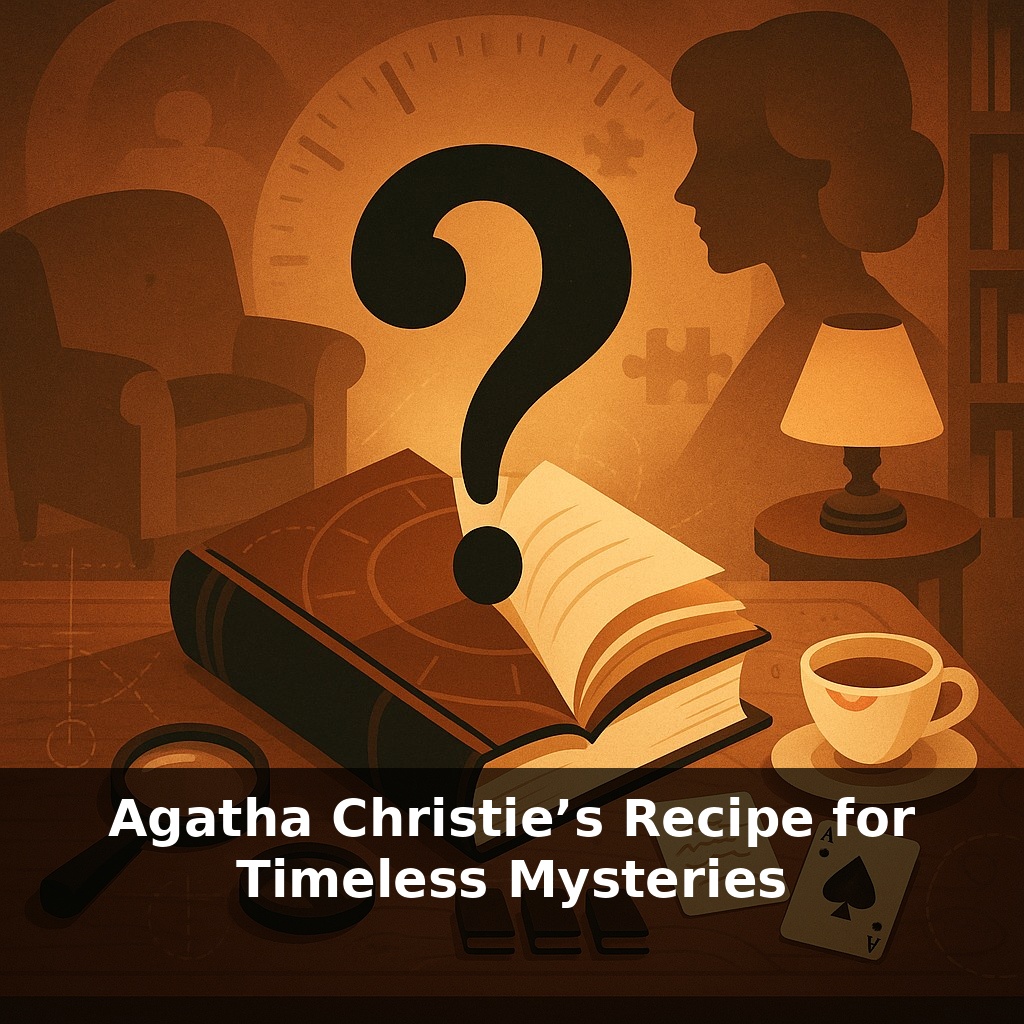
A new Agatha Christie book is sold somewhere in the world every few seconds—yet her plots are built on the same quiet ingredients: small rooms, ordinary people, and simple clues. So how do these modest setups keep outsmarting readers, decade after decade?
Christie’s real magic isn’t just that she fools you—it’s that, afterwards, you feel you *should* have seen it. That strange mix of irritation and delight is engineered, not accidental. She builds her mysteries on a disciplined “fair-play” promise: the killer is never pulled from a hat, and the decisive clue is always hiding in plain sight. What keeps this from feeling mechanical is how she layers human behavior over the puzzle. Jealousy, pride, fear, boredom—ordinary motives, rendered with just enough detail that you recognize people you know. Then she tightens the space: trains, country houses, islands, hotels. Within those boundaries, every gesture can matter, every overheard line can be a thread. In this episode, we’ll unpack how she controls viewpoint, timing, and psychology to keep readers willingly lost, right up to the final page.
To see how deliberate her craft is, look at the constraints she quietly sets herself. A limited cast means every new arrival must matter. A contained location turns floorplans and furniture into narrative tools. Her background in hospital dispensaries gives her an arsenal of poisons, each with symptoms that double as plot devices: timing alibis, masking motives, or mimicking natural causes. Even dialogue isn’t small talk; it’s calibrated, like adjusting dials on a mixing board, to shift suspicion from one character to another without breaking the “fair-play” contract with the reader.
Christie’s “blueprint” starts with where you stand as a reader: whose eyes you’re looking through, and what that person refuses to see. She often picks narrators who are observant enough to notice everything, but not insightful enough to interpret it correctly. Dr. Sheppard in *The Murder of Roger Ackroyd* and Hastings alongside Poirot are classic examples—present for every vital moment, yet constantly mislabeling what they witness. This lets Christie lay out all the data while quietly distorting its apparent meaning. You trust the guide, then later realize that trust was your first mistake.
From there, she layers in different *types* of clues. Some are “loud”: a quarrel, a missing will, a broken teacup. Others are “quiet”: a hesitation before answering, a word someone never uses, a timetable that technically works but feels too neat. She scatters both, but pushes your attention toward the dramatic fragments. The mundane details—train schedules, drug dosages, household routines—sit in the background until the end, when they snap into focus.
A crucial trick is how she turns genre expectations against you. You’ve been trained to suspect the brooding stranger or the bitter heir. Christie knows this and uses it as cover. She’ll load them up with motive and strange behavior, then let the genuinely dangerous character hover at the edge of scenes: helpful, practical, apparently transparent. In *Murder on the Orient Express*, she even multiplies this effect, distributing suspicion so evenly that the real answer doesn’t look like an answer at all.
Her settings quietly enforce structure. A snowed‑in train, an isolated island, a country house after the last train has gone: these aren’t just atmospheric; they fix the timeline and limit the possible movements. Once the crime occurs, the story becomes a controlled experiment. Who could have been where, with what knowledge, and for how long? Christie then paces interviews and revelations so each new fact reorganizes the suspect chart in your head without collapsing it.
All of this builds toward the gathering scene—Christie’s signature endgame. Everyone in one room, the detective walking back through the story, re-labeling each earlier moment. The solution feels shocking, but structurally it’s a re-sort of information you already had, a final re‑indexing of everything you thought you understood.
Think about *how* her tricks feel in action. In *The ABC Murders*, the killer seems to follow a clear alphabetical pattern, and you relax into that “logic”—only to find the pattern itself is camouflage for a personal crime. In *And Then There Were None*, there isn’t even a detective onstage; the “investigation” happens inside the panicking characters’ minds, and your own, as each death redraws the mental map of who could be responsible. Or take *The Mousetrap*: it’s been staged over 28,000 times, yet the core surprise still lands because the script weaponizes theater basics—entrances, exits, even where the audience is looking—as part of the misdirection. Constructing that kind of story is like coding a program whose *bugs* are intentional: the plot runs correctly, but it’s designed so the user–reader–keeps misinterpreting what the output means until the final “debugging” scene.
Christie’s method is quietly shaping how stories will work when you’re not just reading them, but moving through them. AI mysteries, branching games, even XR crime scenes can borrow her rule that “everything you need is already here,” then update it so clues hide in your choices, eye‑tracking data, or silence on a voice channel. Like a savvy investor diversifying a portfolio, future designers will remix her logic across theater, apps, classrooms, and collaborative online sleuthing.
Christie’s deeper lesson isn’t just *how* to deceive, but how to design trust: you agree to her rules, then enjoy being outplayed. That contract matters beyond novels—anyone crafting products, lessons, or games can borrow her ethic of “all pieces visible, surprises earned,” like a chef revealing the pantry yet still serving an unexpectedly unforgettable dish.
Try this experiment: Tonight, outline a mystery short story using Christie’s “closed circle” setup—pick a single location (a train, a country house, or a small hotel), list 5 suspects with one clear secret each, and decide on a victim and a hidden motive that only one suspect could logically have. Then, write just the opening scene where every suspect appears and you plant exactly three tiny clues (one line of dialogue, one object, one behavior) that would let a sharp reader solve it. Tomorrow, hand the scene to a friend and ask them to underline what they *think* are clues—compare their guesses to your intended three, and tweak your scene so the real clues stand out just enough without feeling obvious.