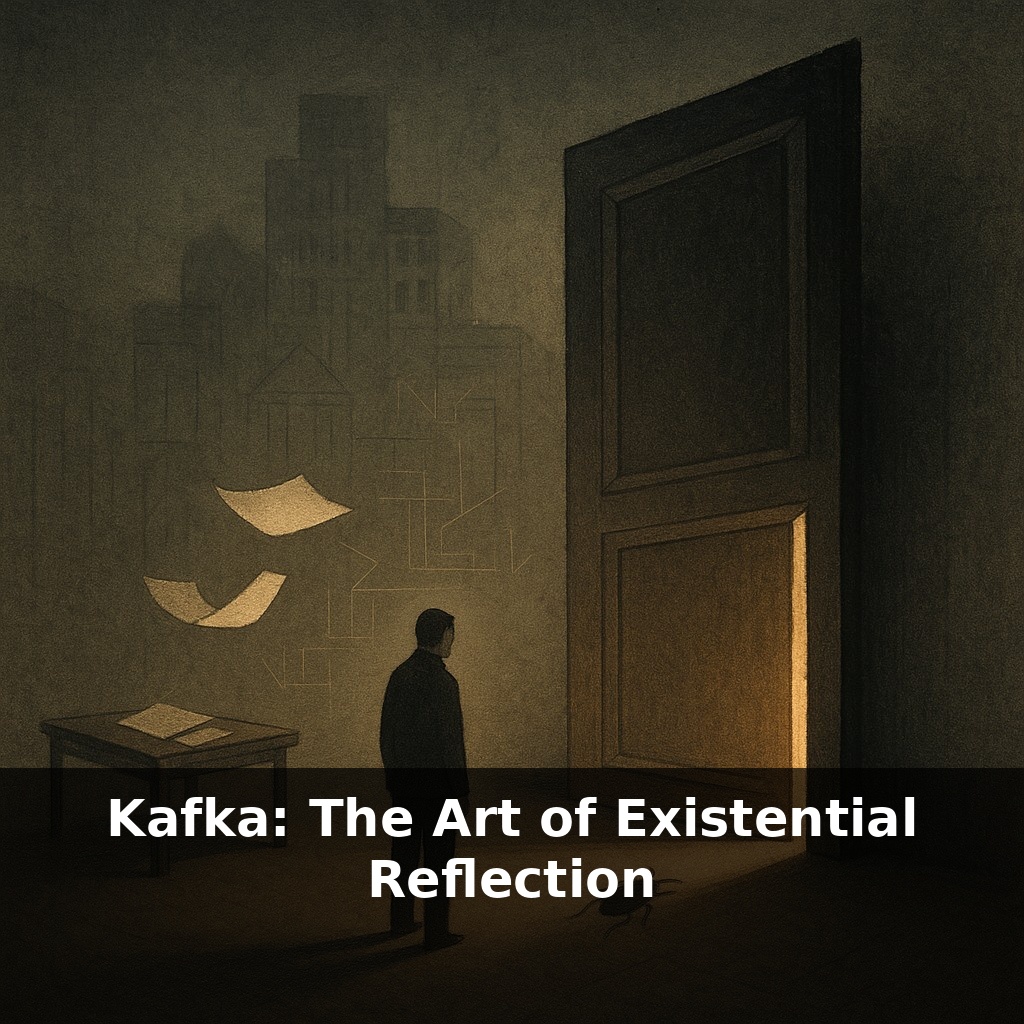
Kafka asked his best friend to burn his manuscripts. Instead, those pages reshaped how we talk about anxiety, power, and guilt. A man wakes up accused of a crime he never learns. Another wakes up as an insect. Between those two mornings lies the world we live in.
Kafka doesn’t just tell strange stories; he quietly rearranges how we notice our own lives. In his worlds, doors are almost open, answers nearly arrive, and explanations hover just out of reach. The real pressure isn’t the spectacle of a man-insect or a shadowy court—it’s the slow, suffocating sense that the rules exist, but no one will write them down for you. That uncertainty feels familiar in a time of unread terms of service, automated rejections, and “your call is important to us” loops. Kafka’s genius is to turn that blurry unease into sharp narrative detail: a missing file, a silent official, a hallway that never ends. His characters keep moving, keep asking, keep filing forms, long after sense has broken down. In watching them, we’re forced to ask not only what traps us, but why we keep cooperating with the trap.
Kafka wrote from the edges of his own life: a day-job lawyer in an insurance office, squeezing sentences into the hours between 10 p.m. and 3 a.m., then judging them mercilessly by morning. That tension—between ordinary paperwork and impossible systems—seeps into his pages. The Trial appears after his death, missing its intended ending, yet still feels disturbingly complete, like an email thread where the crucial final reply never arrives. Decades later, “Kafkaesque” enters our dictionaries, proof that his peculiar mix of precision and opacity became a shared language for modern entrapment.
Kafka’s pages feel so inward that it’s easy to forget how outward-looking his craft was. He spent his days inside an insurance office, drafting reports on factory accidents and workplace safety. Those files taught him something crucial: how institutions turn individual pain into abstract categories. In his fiction, a crushed worker becomes not a statistic but a son, a husband, someone whose fate will be decided by people who never meet him. That collision between intimate damage and distant decision-making is where his art quietly sharpens.
Crucially, Kafka never gives us the comfort of a single “right” interpretation. Is Gregor Samsa’s transformation in “The Metamorphosis” a punishment, an illness, a fantasy, a social role made grotesibly visible? The story stubbornly supports all of these readings and none of them fully. His manuscripts and notebooks show this wasn’t indecision but method: he drafts toward meanings, then deliberately refuses to close them off. The result is fiction that behaves more like a question than an answer key.
That open-endedness is why his work crosses into law, philosophy, film, and even UX design. Legal theorists study his courts and offices as extreme versions of real systems where access to rights depends on navigating opaque procedures. Filmmakers borrow his long corridors, cluttered desks, and endless lines to show how spaces themselves can accuse or exclude. Designers who build digital platforms quietly face a Kafka problem: how much friction can a user endure before they feel less like a participant and more like a defendant?
Kafka’s revision habits deepen this sense of suspended clarity. He often abandoned stories mid-stream, not because nothing was left to say, but because stopping at the moment of almost-explanation intensified their charge. In “The Castle,” the very structure of the unfinished narrative becomes part of the message: we inhabit a world where some files will never be found, some conversations will never conclude.
Reading him today, you’re not simply observing someone else’s nightmare; you’re rehearsing how to stay alert when the logic of a system stops matching the language it uses to describe itself. His fiction trains a kind of double vision: to function inside our worlds of forms and platforms, and at the same time to notice when they quietly stop serving the people they claim to organize.
Open Kafka beside today’s headlines and the correspondences stack up quickly. A rideshare driver banned by an algorithm that won’t disclose its criteria echoes Josef K. blocked by faceless clerks. Gig workers refreshing opaque apps, migrants lost in overlapping legal regimes, even users appealing a social-media takedown to a “review team” that never quite materializes—all replay his situations in mundane key. Artists and filmmakers borrow his structures: Charlie Chaplin wrestling factory gears in “Modern Times,” Terry Gilliam’s “Brazil” drowning its hero in forms and ducts, or contemporary legal dramas where the courthouse is shot like a maze instead of a forum. Software teams quietly use “Kafka moments” as shorthand for any feature that traps users in loops. And in therapy rooms, clients cite Gregor Samsa not for theory but as a gut-check: “Do I feel like that in my family, or at work?” One page written between midnight and 3 a.m. can become a diagnostic tool for a century’s worth of systems.
As digital systems quietly decide who gets loans, visas, or visibility, Kafka becomes less a “weird classic” and more a field guide. Scholars now treat his work like early UX research on being a user with no manual. Some legal clinics even assign Kafka alongside case law, training students to notice when procedure silences people. Think of future AI audits as literary criticism turned practical: tracing where a system’s story about fairness no longer fits what its users actually live.
Kafka’s pages don’t hand us courage, but they do sketch ways of staying awake inside systems that prefer we sleepwalk. Read as field notes, they suggest we can annotate our own mazes: noticing each silent redirect, each vanishing door. Your challenge this week: when a process feels off, write down its steps as if you’re documenting a strange new machine.