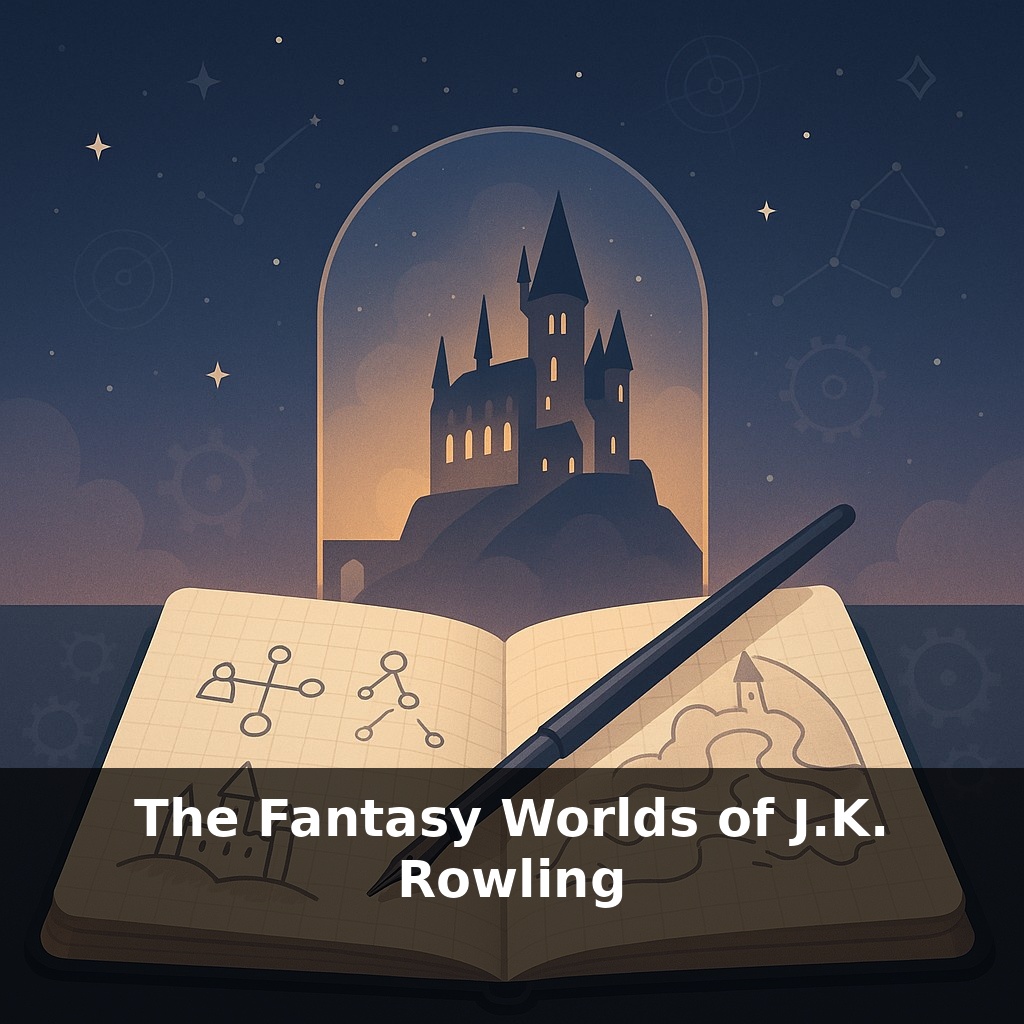
Somewhere between a train platform you can’t see and a castle that doesn’t exist, a billion‑dollar idea quietly took shape on graph paper. In this episode, we’re stepping behind the curtain of J.K. Rowling’s worlds to see how strict rules make impossible magic feel real.
Rowling didn’t just dream up a boy wizard; she quietly engineered a machinery of meaning around him. Before most readers ever opened a book, she’d already sketched family trees, school schedules, newspaper ecosystems, even the politics behind who gets a wand and who doesn’t. That invisible scaffolding lets her stories carry surprisingly heavy themes: prejudice, propaganda, grief, the seduction of power. And yet, on the surface, everything feels playful—moving staircases, joke shops, living photographs. The tension between that lightness and the darkness beneath is part of what pulls us in. Think of how a well-organized kitchen lets a chef improvise freely; Rowling’s behind-the-scenes order gives her room to surprise us on the page while keeping the world itself steady under our feet.
That carefully built order scales far beyond seven books. It underpins theme‑park lands that boosted attendance by over 40%, lets video games and stage plays slot into the same timeline, and even supports a real‑world sport played in more than 40 countries. Rowling’s notes—who was at school when, what each spell can’t do, how wizard law clashes with Muggle systems—act like a shared instruction manual for anyone expanding the franchise. This consistency is why fan debates about wand ethics or house‑elf rights feel as grounded as arguments over real‑world politics.
Rowling’s method starts with something deceptively simple: limits. She decides who can’t solve a problem with magic long before she decides who will. That’s why a Time‑Turner can’t just be wheeled out every time someone dies, and why certain protections around Hogwarts quietly block the most overpowered spells. By fencing herself in, she forces smarter, more character‑driven solutions: Hermione researching obscure laws, Dumbledore making morally compromised bets on people’s choices, Harry winning not with a new spell but with a decision about mercy.
Those limits extend to society, not just spells. Rowling anchors wizard institutions to recognizable pressures: a sensationalist press; a risk‑averse government; schools that sort and label children early, then pretend the labels are destiny. When Voldemort rises, it doesn’t feel like a monster appearing out of nowhere; it feels like complacency, fear, and quiet bigotry finally cashing in the credit they’ve been running up for years. The fantasy lets us see those forces with the contrast turned up.
Her timelines work the same way. Birth years, exam schedules, and war dates aren’t trivia; they’re the rails that keep decades of backstory aligned. Because she knows, for example, exactly which adults fought in which conflict at what age, their traumas and loyalties stay consistent. The effect for the reader is subtle but powerful: when a character reacts strangely, we trust there’s a history we haven’t seen yet, not a mistake on the author’s part. That trust makes slow‑burn mysteries—Snape’s motives, Dumbledore’s past—feel earned instead of contrived.
Crucially, Rowling doesn’t reveal this architecture in a lore dump. She trickles it through jokes, throwaway lines, textbook titles, and classes that seem like color until they suddenly matter. The Weasley twins’ experiments foreshadow resistance tactics. A silly Divination lesson primes us to question prophecy. Background wizarding war stories heard in a pub become the emotional payload of an entire final book.
The big lesson for any creator isn’t “copy her world,” but “copy her balance.” She builds more than she shows, but she always shows just enough to make us suspect there’s more.
Rowling’s notebooks function a bit like a producer’s spreadsheet on a long‑running TV show: every character, location, and rule is a “line item” that has to reconcile across episodes, years later. You see echoes of this when a throwaway student in one book reappears with a job, a voting stance, or a family connection several books later; the world remembers its own details. Her invented schoolwork, minor holidays, and niche careers are less about trivia and more about cash flow in a story economy—each small element pays “interest” when it’s reused in a fresh context. The Ministry isn’t just a backdrop; it spawns departments, scandals, and promotions that ripple outward into plot. Even sweets, shops, and bus routes tend to come back wearing new narrative disguises. For creators, that’s a clue: the side jokes and background color you invent today can become tomorrow’s emotional hinge if you track them with the same care you give your main storyline.
Rowling’s world hints at where storytelling is headed: readers don’t just visit; they linger, remix, and argue over canon like fans trading strategies in an online game lobby. As tools like VR and AI mature, expect “wizarding-style” universes where you can test edge cases the author never wrote—like stress‑testing software. The pressure point will be ownership: who steers a living world when fans, corporations, and creators all treat its lore as shared infrastructure?
Rowling’s great trick isn’t just inventing places; it’s leaving deliberate blanks, like unbuilt lots in a city grid, where readers and future creators can move in. Your challenge this week: reread a favorite scene and list three background details that hint at untold stories. Treat them like undeveloped apps—what would you “code” on top of what’s already there?