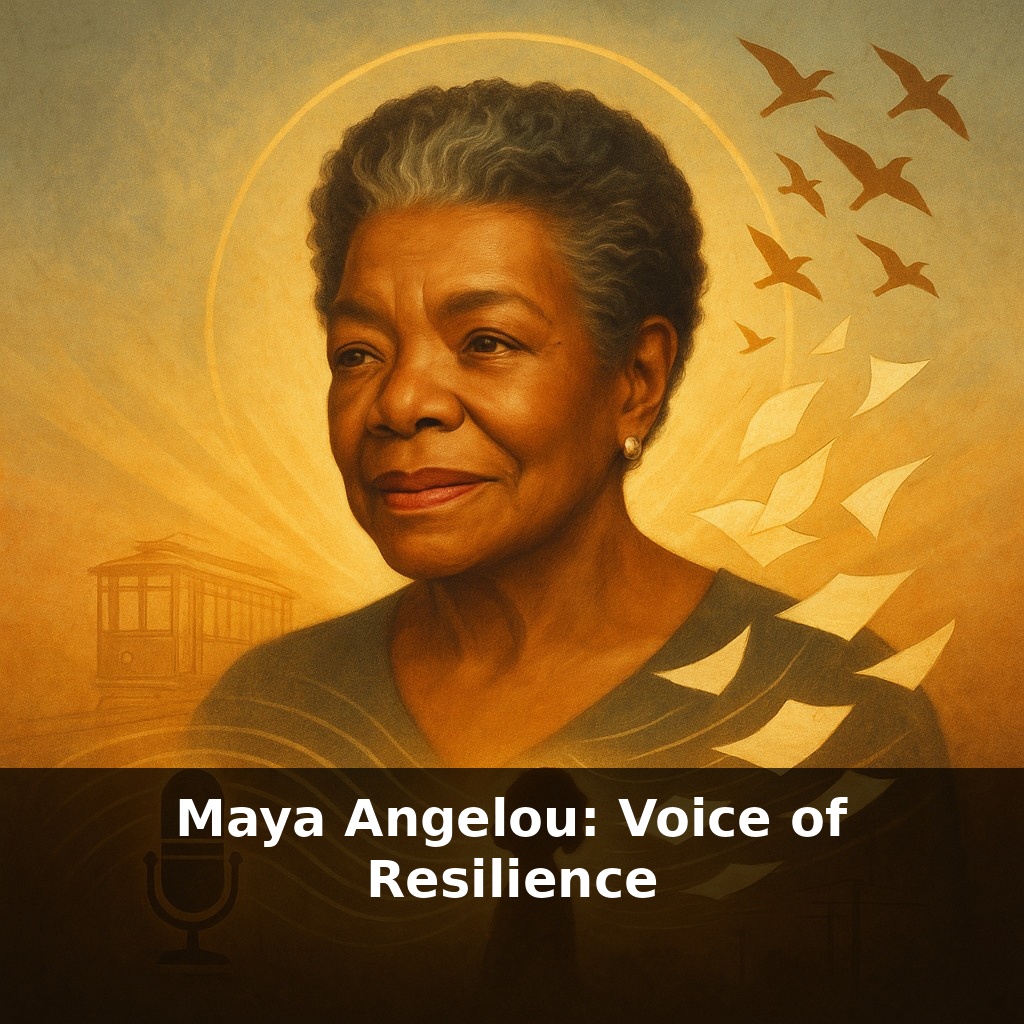
Her voice once boosted book sales by about five times in a single week—without a new book, a scandal, or a marketing blitz. Just her words, spoken aloud. Now, step into the moment where a silenced child becomes the poet a president asks to speak for a nation.
Maya Angelou did not set out to be a symbol; she set out to survive. Long before award committees and presidential invitations, she was a teenage single mother working as a streetcar conductor—the first Black woman to do so in San Francisco—learning that simply showing up in a uniform could unsettle an entire system. That quiet disruption would become a pattern: nightclub singer, calypso performer, civil rights organizer alongside Malcolm X and Martin Luther King Jr., journalist in newly independent Ghana. Each role added a new layer to her craft, like a cook testing how many flavors a single ingredient can carry. When she finally turned to the page, she wasn’t just telling her story; she was testing how much history, pain, humor, and defiance a single life could hold without breaking.
Angelou’s breakthrough came when friends urged her to write down her life “as it really happened,” not as a tidy success story. The result, *I Know Why the Caged Bird Sings*, startled publishers: a Black woman writing frankly about childhood assault, racism, and desire in the late 1960s was closer to a cultural earthquake than a debut. She ignored the rulebook—mixing dialogue with memory, gossip with geography—like a jazz musician bending a standard until it sounds new. Each later volume pushed further, turning the parts most people hide into the foundation of her authority.
Resilience, for Angelou, was not a slogan; it was a method. On the page, she keeps returning to the same materials—assault, abandonment, racism, desire—not to relive them, but to rework them until they yield meaning. Across seven autobiographies, she revisits the girl in Stamps, Arkansas, the young mother in California, the activist on the road, testing how each retelling can reveal a different angle of power. That repetition isn’t redundancy; it’s revision in the deepest sense: the right to “re‑see” your own life rather than accept the version imposed on you.
Formally, she does something bold. Autobiography had long promised linear truth: this happened, then that. Angelou writes instead as if memory were a series of spotlighted stages. One book lingers on adolescence, another on her time in Africa, another on the civil rights years; side characters vanish and reappear, timelines compress, conversations are sharpened. She is less a historian than a director, deciding where to point the light so that the emotional and political stakes come into focus.
Her poems distill that same process into a few fierce lines. “Still I Rise,” “Phenomenal Woman,” and “On the Pulse of Morning” do not describe events so much as announce stances: you may write me down in history / with your bitter, twisted lies, but still, like dust, I’ll rise. The power lies in how plain the language is. No elaborate ornament, no obscure references—just everyday words stacked until they carry the weight of centuries. That clarity lets readers who have never shared her specific experiences feel their own bruises acknowledged.
What makes this resilience creative rather than merely stubborn is that she doesn’t stop at enduring harm; she rearranges it. Like a software engineer refactoring buggy legacy code, she takes inherited scripts—“victim,” “unwed mother,” “poor Black girl from the South”—and rewrites their logic. Onstage, in the classroom at Wake Forest, in a presidential inauguration, she performs that rewrite in real time, modeling a self who remembers every injury yet refuses to be reduced to it.
Angelou’s creative resilience shows up in small, practical choices. When schools banned *Caged Bird*, she didn’t campaign to make it “safer”; she defended students’ right to confront difficult material, insisting that shielding them from ugliness also shields them from their own capacity to face it. In the classroom, she required students to memorize poems—not to worship the canon, but to feel language moving through their bodies, changing their posture, their breath, their sense of what they could claim in public. She also kept redefining her medium. If a book reached one kind of audience, a stage performance reached another; if adults were resistant, she’d visit children’s classrooms and start earlier in the human timeline. Her method resembles a patient investor diversifying a portfolio: instead of trusting a single channel to carry her message, she kept placing stories in new forms—album, play, lecture—so at least one would mature in each listener’s life.
Angelou’s influence is seeping into how we design classrooms and protests alike. Trauma‑aware teachers use her work as a kind of emotional “warm‑up,” letting students test difficult truths in language before speaking from their own lives. Activists borrow her cadences for chants, zines, even TikTok clips, treating her lines like open‑source code—forked, remixed, and localized for new fights over policing, gender, migration. As AI voices proliferate, her insistence on lived authority may become a sharper ethical yardstick.
Angelou’s work hints that your past isn’t a script; it’s raw material. She treated each experience like ingredients in a stew—adjusting seasoning, turning down the heat, letting it rest, tasting again. Your challenge this week: revise one hard memory on the page three times, each from a different angle, and notice which version frees you most.