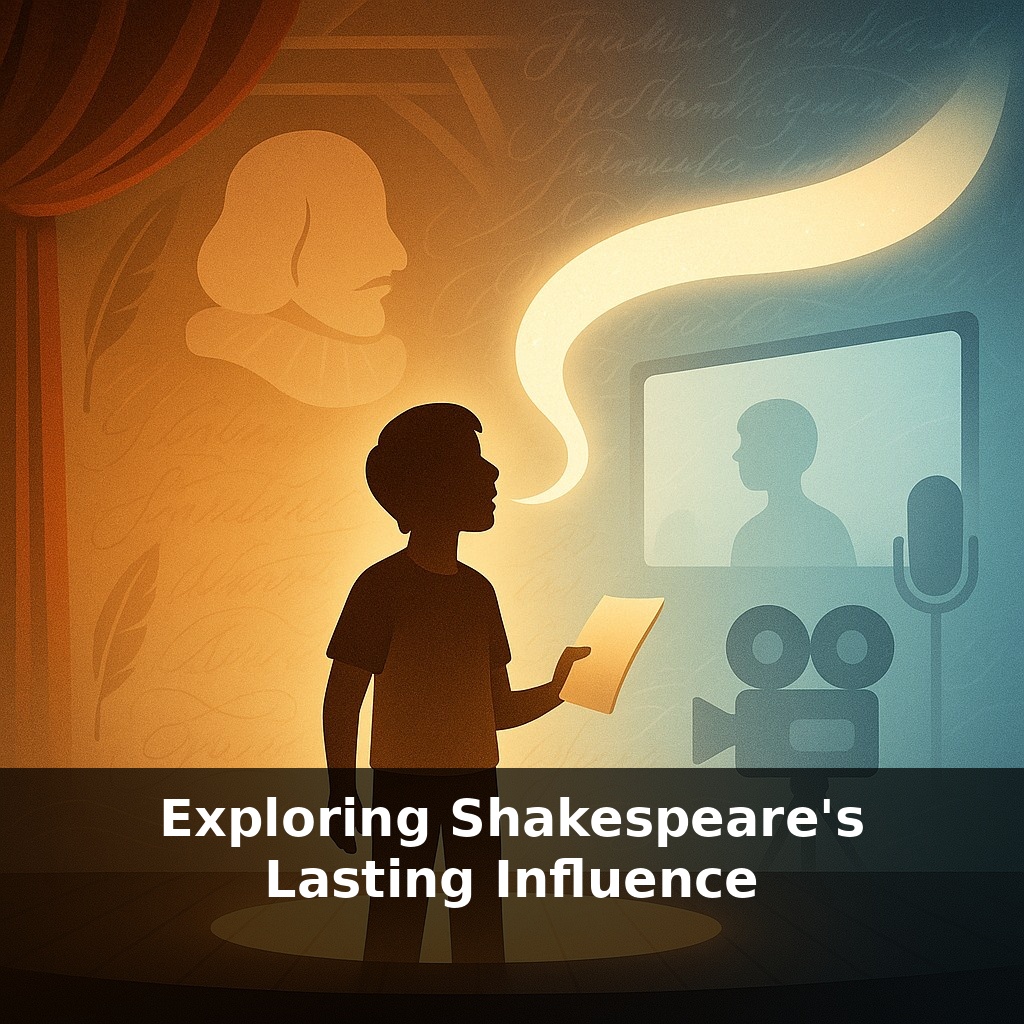
On a tiny stage in a small town, a teenager whispers, “To be, or not to be.” On a blockbuster film set, an actor does the same. Four centuries apart, same words, same pulse. Why does one writer’s voice keep echoing every time we try to tell a powerful story?
On paper, Shakespeare’s world looks nothing like ours: no smartphones, no social media, no streaming platforms—yet his characters feel oddly familiar. A jealous soldier self-destructs over rumors. A leader clings to power long after he should step down. A teenager thinks one reckless decision will fix everything. These patterns show up in boardrooms, comment sections, and group chats every day. That’s the strange thing about his plays: they’re museum-old, but they behave like live voltage in modern life. Directors reset them in high schools, prisons, war zones, and sci‑fi futures, and the stories barely need rewiring. In this episode, we’ll trace how a playwright from 1600 keeps sneaking into 21st‑century language, headlines, and even the way we binge-watch character-driven TV.
Shakespeare’s influence isn’t just artistic; it’s infrastructural. Open a news app and you’ll see headlines echoing plots he once staged: succession crises, public downfalls, overnight celebrity. Look closer at the language and his fingerprints multiply—words like “addiction,” “bedroom,” and “fashionable” quietly doing daily work in your sentences. Directors borrow his structures without the costumes: slow‑burn tension, rotating viewpoints, twists that feel “inevitable but surprising.” It’s like discovering your favorite streaming series runs on a centuries‑old narrative engine, still humming underneath all the CGI.
Critics often start with the big themes, but the real shock is how technically aggressive Shakespeare is on the page. He treats English like a beta version he’s stress‑testing: bending nouns into verbs (“elbow,” “grace”), welding words together (“cold‑blooded”), or stretching meaning until it clicks into a new groove (“gloomy,” once rare, becomes a mood you can live inside). He isn’t just decorating speech; he’s widening what it can carry. That’s one reason his lines keep getting recycled—journalists, marketers, and meme‑makers find ready‑made phrases that already feel slightly larger than everyday talk.
You can see this experimentation in how he splices high and low registers. A king will speak in stately rhythm one moment, then snap into streetwise insult the next. That sliding scale of diction lets him map social class, emotional distance, and power shifts in real time. Modern screenwriters do similar work with code‑switching or slang, but he’s doing it before there’s a director to explain the subtext. The language itself is the camera angle.
Then there’s how he builds complexity by refusing to give you a single, stable version of a character. Hamlet changes depending on who’s in the room. Iago speaks differently to Othello than to the audience. Instead of clear moral labels, you get people whose motives keep branching and contradicting. This ambiguity trains readers to tolerate unresolved questions—something prestige TV now relies on, but which audiences once found dangerously slippery.
His plays also tinker with genre expectations. A “tragedy” will suddenly crack a joke at the worst possible moment; a “comedy” may end with marriages that feel slightly uneasy. The categories are there, but he leans against their walls, testing how far they flex. That gives later writers permission to hybridize: crime stories with romance cores, superhero films with political allegory, YA novels that smuggle philosophy into cafeteria drama.
Under all this experimentation is a surprisingly modern idea: language and form are not fixed containers; they’re tools you can rewire to fit the messiness of human feeling. That’s why, centuries later, artists still treat his plays less like sacred relics and more like open‑source code they can fork into something new.
Look at where Shakespeare pops up when no one’s trying to be “literary.” A courtroom lawyer leans on “the quality of mercy” to soften a jury. A sports columnist calls a star’s transfer “much ado about nothing.” A politician’s fall gets framed as “a tale told by an idiot.” These aren’t classroom quotations; they’re shortcuts that smuggle in emotional weight, turning a line into a small stage where readers fill in the drama.
Musicians raid him too. Taylor Swift threads Romeo and Juliet through “Love Story,” shifting the ending to give Juliet agency. Hip‑hop artists twist “out, damned spot” into lines about guilt and money. Each time, a centuries‑old fragment is refitted to a new beat, like sampling an old vinyl riff inside a modern track.
On screen, creators echo his multi‑angle character clashes in shows where allies flip to enemies mid‑season, and nobody’s motives stay still. Even video games borrow his layered choices—no perfectly “good” option, just consequences that keep rippling outward, long after you’ve clicked.
Shakespeare’s afterlife may hinge less on reverence and more on remixability. As archives digitise and rights barriers vanish, his plays become raw material for creators who’d never touch a quill: coders turning scenes into interactive chatbots, educators building AR street productions, activists mining speeches for protest scripts. Think of his works as a public “language lab,” where students, playwrights, and AI models all stress‑test what emotion, power, or justice can sound like in their own accents.
In the end, Shakespeare’s real legacy might be less about reverence and more about permission. He shows that you can raid history, twist form, and still sound fiercely personal. The next time you tweak a caption, draft a speech, or shape a scene, you’re stepping into that same arena—testing how far language will stretch before it snaps, or suddenly, brilliantly, fits.
Before next week, ask yourself: 1) Which Shakespearean theme from the episode—like ambition in *Macbeth* or identity in *Twelfth Night*—mirrors a real situation in your life right now, and how would your choices look different if you treated that situation as a scene you could rewrite? 2) When you next consume a modern story (a movie, series, or song), can you pause once and ask, “If this were a Shakespeare play, which one would it be—and why?” 3) Thinking about the episode’s examples of timeless characters, which Shakespeare character do you most instinctively empathize with, and what does that reveal about the role you’re currently ‘playing’ in your own story?