Nikola Tesla: The Man Who Lit Up the World
📝 Transcript
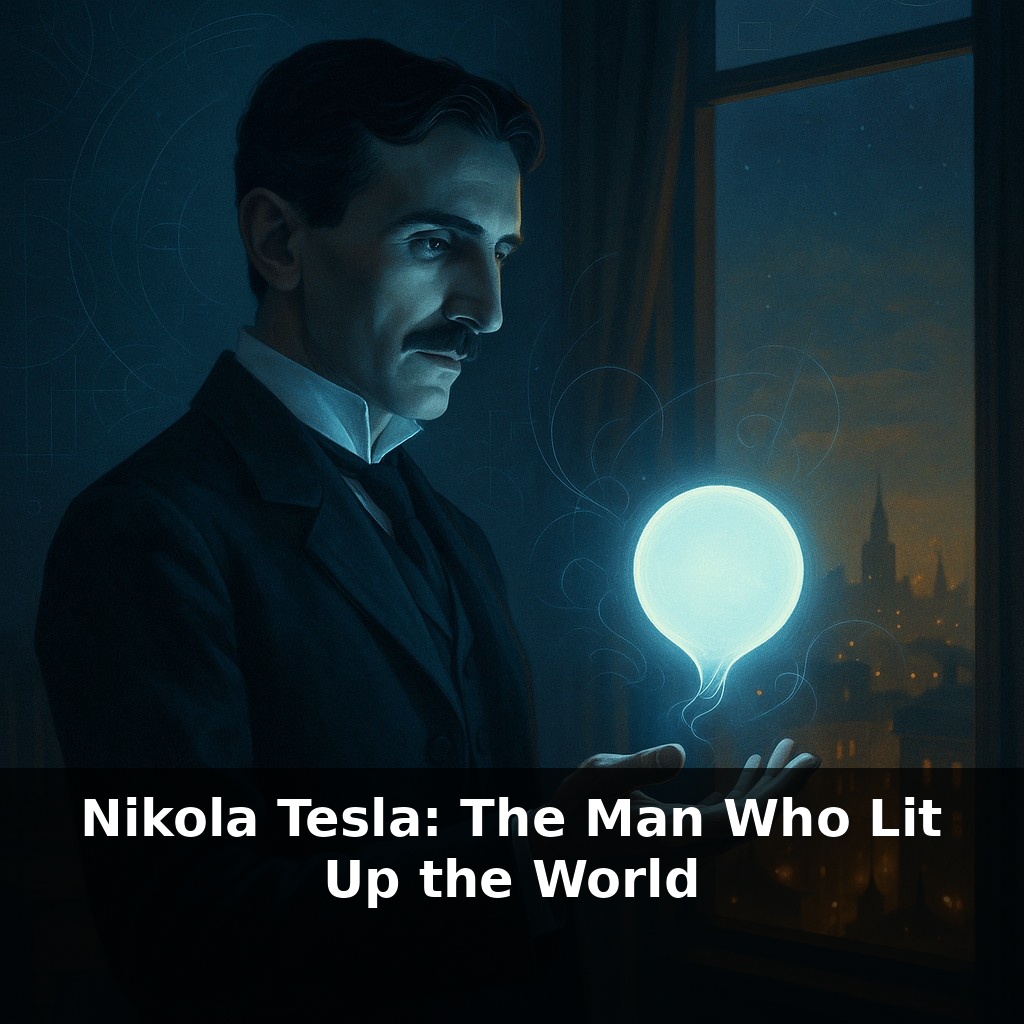
In a New York hotel room, a tall, restless inventor stares at a tiny glowing bulb—no wires, no battery, just light hanging in midair. Outside, the city still flickers on gas flames. He whispers, “The present is theirs; the future, for which I really worked, is mine.”
Tesla steps to the window and looks down at streets ruled not by gaslight, but by something far more powerful: corporations fighting a “War of Currents.” Down there, Thomas Edison is the household name, the media favorite, the man selling a safer, simpler world powered by direct current. Tesla is the outsider—the immigrant with an accent, wild ideas, and notebooks full of sketches no investor quite understands. Yet, while Edison refines what already exists, Tesla redraws the blueprint. He isn’t just asking, “How do we power a city?” but “How do we power continents?” His alternating-current system is like redesigning not just a bridge, but the entire highway network it connects to. Where others see devices, Tesla sees an invisible infrastructure stretching from waterfalls to workshops.
Banks of dynamos roar in dusty factories; overhead, belts and shafts rattle like exposed bones of the industrial age. Every workshop needs its own little powerhouse, chained to the building the way a desktop computer is chained to a desk. Tesla walks through these places and sees waste: heat boiling off cables, copper devoured by distance, neighborhoods locked out because they’re “too far” to serve. Investors want quick profits from brighter bulbs; Tesla talks instead about networks, standards, and reach—about turning scattered islands of power into something closer to a continent‑wide electric railway.
Tesla’s answer begins with a deceptively simple twist: don’t just spin one magnetic field—spin many, in careful rhythm. In 1888 he files a patent for a “polyphase” system, a choreography of currents that makes magnetic fields whirl like a well‑drilled team of dancers circling a stage. Put a metal rotor in the middle of that invisible whirlpool and it starts to turn on its own: the induction motor. No brushes to wear out, no sparks, no constant tinkering. Machines that once needed their own cramped steam engines can now be driven cleanly, quietly, from afar.
This is the part of Tesla’s work that factories actually understand. That rotor means cheaper maintenance, more uptime, fewer fires. When Westinghouse licenses Tesla’s patents, they aren’t buying a philosophy; they’re buying a motor that can beat Edison’s on cost and reliability. The polyphase blueprint becomes a product line: generators at one end, motors at the other, transformers in between to step voltages up for travel and down for use. The system scales not just because it’s clever, but because every piece speaks the same electrical “language.”
The real test comes at Niagara Falls. For decades, engineers have dreamed about turning that roaring water into power for an entire region, but no one has made it practical. Tesla’s designs—built by Westinghouse—finally do it. Great steel turbines bite into the river; generators spin; power surges out toward Buffalo. Thirty‑seven megawatts, enough to feed tens of thousands of lamps, shops, and streetcars. What had been a tourist spectacle becomes an industrial engine.
Success at Niagara isn’t just an engineering trophy; it settles arguments in boardrooms and legislatures. If you can send energy from a waterfall across miles of countryside and still have enough left to run a city, that’s no longer a gamble; that’s policy. Grid builders fix on 60 cycles per second as their heartbeat, a choice rooted in the characteristics of Tesla‑style machinery. That number, once an internal design detail, hardens into a standard that will outlive its inventors.
At the same time, Tesla is already looking past wires. He talks of sending power and messages through the air, hints at handheld devices that can pull signals from distant towers, predicts a world where distance is less an obstacle than an engineering detail.
Stand on a modern city rooftop at night and trace the glow: office towers, server farms, data centers, phone chargers, factory robots—all pulsing in quiet synchrony to that 60‑hertz rhythm locked in long ago. The same design instincts that shaped Niagara now shape how we cool skyscrapers, run subways, and push bits through the cloud. When your washing machine ramps up, or an industrial robot arm glides into position, you’re seeing a direct descendant of that spinning magnetic “dance” turned into muscle.
But Tesla’s curiosity kept leaping ahead. His notes sketch wireless power towers, global broadcasting stations, and pocket devices that merge communication and information. Read those pages beside a smartphone teardown and the echoes get uncomfortable: tuned circuits, compact antennas, carefully gated power. He didn’t just want distant waterfalls to drive machinery; he wanted distant ideas to drive behavior, culture, and even politics—energy and information treated as two faces of the same sprawling, planetary system.
A century later, we’re still catching up to the questions Tesla was really asking: How do you move not just power, but control? Smart meters, EV chargers, and home batteries now “negotiate” with distant algorithms, shaving peaks and filling valleys in demand like a city breathing in and out. As rooftop solar and wind farms multiply, the grid behaves less like a rigid machine and more like a sprawling multiplayer game, where every participant nudges the score toward stability or blackout.
Today, echoes of Tesla’s gamble show up in quiet places: the hum behind data centers, the hush of wireless chargers, the tiny antennas in wearables. Engineers still treat his patents like an old map, penciling in new routes: quantum links, space‑based solar, planetary‑scale storage. Your challenge this week: spot one “Tesla trace” in your daily routine.
From this course
In the Footsteps of Visionaries
6 episodesUnlock all episodes
Full access to 6 episodes and everything on OwlUp.
Subscribe — $1.99/monthLess than a coffee ☕ · Cancel anytime