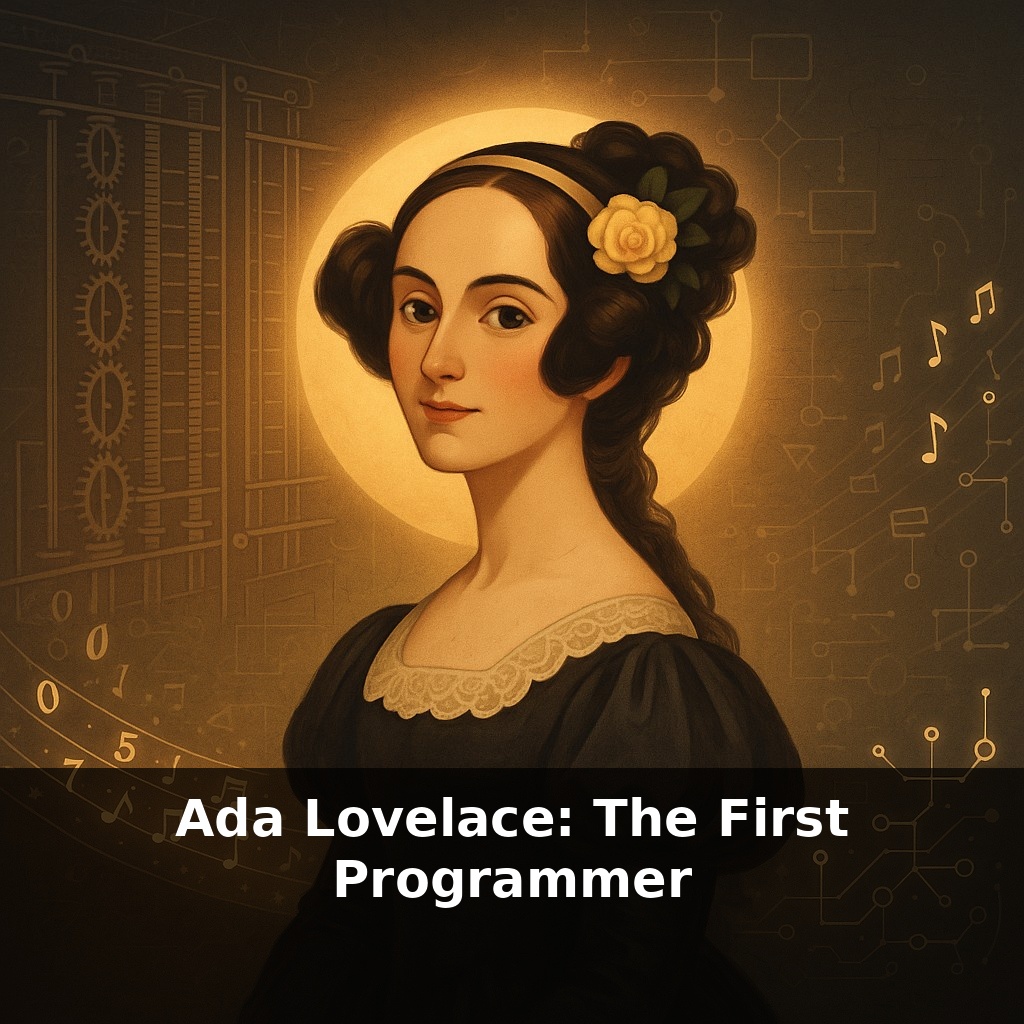
A century before the word “computer” meant a machine, a young woman wrote a step‑by‑step recipe for one that didn’t even exist. In her notes, numbers quietly turn into symbols, and a calculating engine starts to look less like a calculator and more like a mind.
In 1843, Ada Lovelace did something even Babbage hadn’t fully done for his own machine: she treated it as a blank, programmable space. Where others saw a clever way to crank through arithmetic, she saw a system that could be instructed, revised, and expanded—more like drafting blueprints for a building than pressing buttons on a tool. Translating Menabrea’s dense French paper, she didn’t just clarify his ideas; she quietly outgrew them. Her famous “Notes,” especially the sprawling Note G, became a kind of parallel universe to the original article: longer, deeper, and far more ambitious. Here, she began to tease apart a radical question—if this engine could follow any symbolic rules we gave it, what kinds of tasks, beyond numbers, might someday live inside such a machine?
To get there, Lovelace had to work in layers. First, she unpacked how the engine would store values, keep track of intermediate results, and move step by step through a procedure—not unlike an architect deciding where staircases, supports, and open spaces must go long before anyone decorates the rooms. Then she pushed further: what happens if the steps can loop back, branch, or reuse earlier work? In Note G, her Bernoulli-number table isn’t just math; it’s a proof-of-concept that such logical structures can be laid out, debugged on paper, and trusted to run without human correction.
Lovelace’s next move was to treat those abstract capabilities as something you could systematically plan, not just admire. Note G reads less like commentary and more like a working notebook from someone stress‑testing a system that hasn’t been built yet. She worries about consistency, about how to avoid ambiguity, about ensuring that a long chain of symbolic manipulations doesn’t silently drift off course. In modern terms, she’s already thinking about what it means to be precise enough that a mindless mechanism can’t misunderstand you.
That’s where her Bernoulli‑number table becomes more than a clever stunt. She lays out columns that track not just final outputs but transient states, carefully labeling how each part of the engine would be engaged at each moment. You see her anticipating failure modes: if a quantity isn’t ready when needed, if an operation is applied in the wrong order, the whole plan collapses. So she designs the description to guard against those slips, separating what the engine “knows” at each stage from what it will “know” next.
Crucially, she also distinguishes between the engine’s built‑in operations and the higher‑level patterns a designer might impose. Addition and multiplication are fixed; the larger arrangement of those actions is open‑ended. That gap—between primitive capabilities and creative combinations—is where she locates human ingenuity. The engine, she writes, can do “whatever we know how to order it to perform”; the constraint is not the hardware but our imagination and discipline in expressing a task.
This leads her to a bolder step: if the same mechanism can act on any symbols that obey rules, there’s no reason in principle to stay within mathematics. Musical notes, logical propositions, even linguistic structures could, in theory, be encoded and transformed. She doesn’t claim that such feats are imminent, only that the door is conceptually open. Her real achievement is to draw a sharp line between the physical device and the abstract processes it might someday carry—then invite future thinkers to cross it.
When modern engineers read Lovelace’s Note G, many recognize the bones of practices they still use. Her careful tabulation of each intermediate quantity prefigures techniques like “tracing” a program line by line to see where it might fail. Where today’s developers rely on debuggers and unit tests, she relied on meticulous hand‑checks of every transformation, treating each misalignment as a clue to tighten the description.
Her insistence on separating primitive operations from higher‑order plans echoes in how contemporary systems are layered: microinstructions, instruction sets, libraries, frameworks. A researcher at IBM or Google, sketching out how a new algorithm will sit atop existing hardware, is making the same kind of conceptual move—treating the machine as a stable base for increasingly abstract strategies.
In that sense, her work functions less as a relic and more as an early style guide for thinking with machines: be explicit, anticipate ambiguity, and design your descriptions so that even a rigid mechanism can’t lose the thread.
Lovelace’s view nudges us to ask not just what systems can do, but what kinds of questions we’re bold enough to encode. Today’s AI labs quietly echo her habits: interdisciplinary teams arguing over notation, edge cases, and hidden assumptions in training data. Your calendar app and a Mars rover both rely on that mindset. One emerging frontier follows her lead further, treating codebases like collaborative novels where each contributor must write clearly enough for future, unseen readers.
Lovelace’s questions still trail us. When we script a robot to explore ruins or orchestrate a city’s power grid, we’re extending that same urge to choreograph matter with thought. Your challenge this week: notice one place where a fixed routine could become a flexible “note,” then sketch how a more imaginative set of instructions might reshape it.