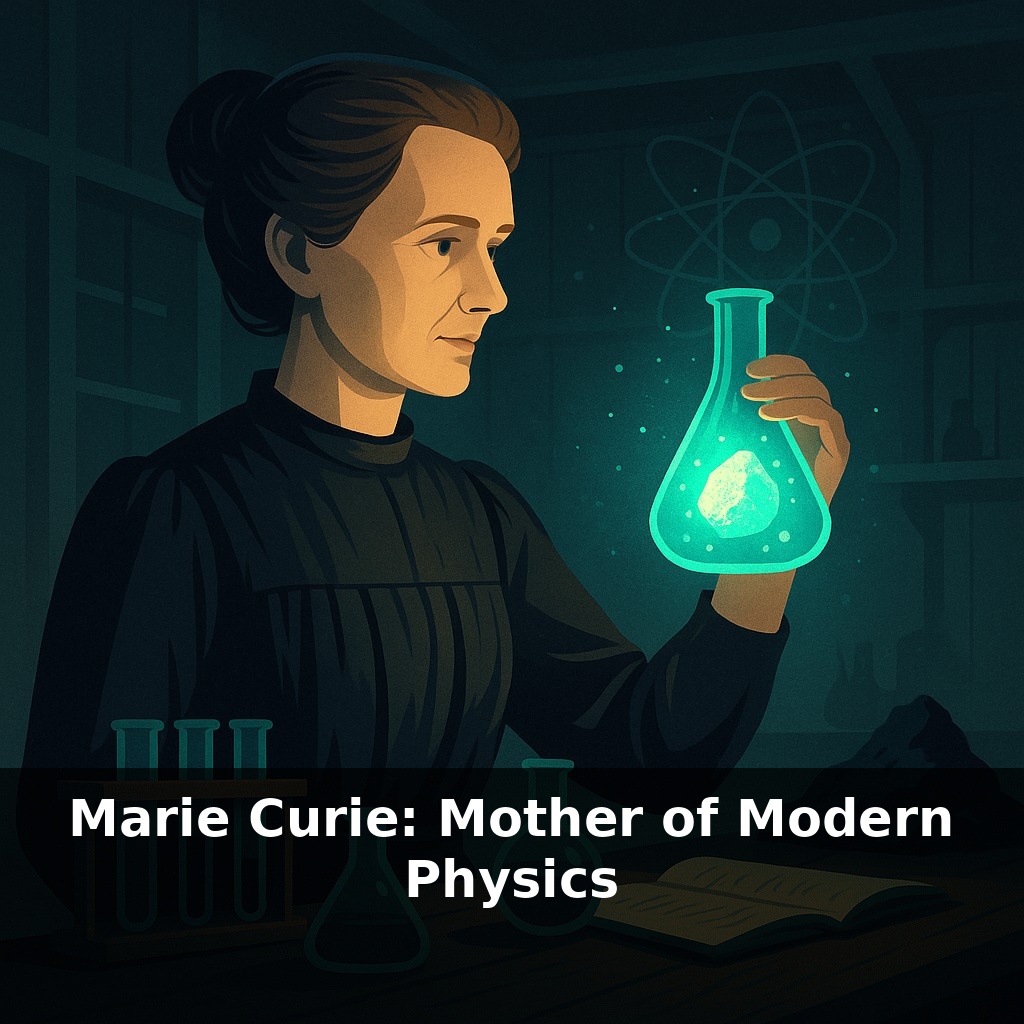
“Radioactivity is an atomic property,” Marie Curie wrote—and then spent years stirring boiling poison to prove it. In a cramped Paris shed, she turned piles of black rock into a glow so bright it lit the night, and in the process, rewrote what we thought matter itself could do.
Curie’s genius wasn’t just in what she discovered, but in *how* she decided to look. While most physicists were chasing grand theories on blackboards, she turned to the messiest, most stubborn evidence she could find: minerals no one wanted, instruments that barely existed, and measurements so faint they looked like errors. Where others saw noise, she suspected a hidden signal—so she built the tools to catch it.
Her approach was closer to a codebreaker than a traditional chemist. She compared, subtracted, and cross-checked endlessly: If this ore is more “active” than pure uranium, something else must be hiding inside. That relentless logic drove her from dusty lab benches to the birth of whole new fields. And by trusting numbers over reputation, she quietly overturned the authority of some of the most established scientists of her time.
Instead of chasing prestige projects, Curie hunted the problems no one else wanted. Pitchblende was a waste product, too stubborn and dirty for “serious” labs, yet she chose it the way a savvy programmer chooses the ugliest, most bug-ridden legacy code—because that’s where the system’s real secrets hide. Working with crude instruments and scarce funding, she treated every constraint as a clue. If her measurements refused to fit expectations, she didn’t discard them; she redesigned the experiment. That willingness to follow awkward data, not elegant theory, became her quiet superpower.
Curie’s next move was as radical as her questions: she decided that if existing instruments couldn’t fully track these strange emissions, she would *turn matter itself into the measuring device*. She pressed tiny samples against charged plates and watched how quickly they drained electricity, transforming simple electroscopes into quantitative detectors. The more vigorously a substance bled charge, the more “active” it was. It was crude by today’s standards, but it turned a yes/no gadget into a numerical gauge—and, crucially, into evidence that could not be hand‑waved away.
That shift—from “it glows” to “it discharges at this precise rate”—opened an entire toolkit. Once she could assign numbers, she could rank ores, compare salts, and track subtle changes over days or months. Patterns emerged: certain fractions of the ore were consistently more potent than pure uranium. That couldn’t be dismissed as impurity or experimental sloppiness; it pointed to *new* entities hiding in the mix. Step by step, she chased the trail into ever more concentrated residues, even as they became harder to handle and more hostile to glassware, skin, and patience.
Isolation became a physical ordeal. While others published on clean topics, she spent years in a shed, stirring vats of corrosive sludge, boiling off acids, and crystallizing residues that might or might not contain something unknown. Each failure still yielded data: a fraction slightly more active, a residue that refused to behave like known elements. She treated these stubborn leftovers as leads, not dead ends, and reorganized her workflow around them.
To keep from getting lost in the complexity, she worked like a meticulous software architect refactoring a gigantic, tangled system: break the ore into modules, test each systematically, recombine only what proves significant. Chemical separations were her “unit tests”; the electroscope, her continuous integration check. If a fraction passed both—chemically distinct *and* strongly active—it earned a place on her very short list of suspects.
Out of that grinding, iterative cycle emerged two new elements—polonium and radium—and, just as importantly, a reproducible method. Anyone with enough patience, ore, and glassware could follow her trail. In an era still dazzled by individual genius, she quietly built something more powerful: a procedure sturdy enough for other minds, other questions, and eventually, entirely new sciences to walk across.
Her real breakthrough was treating “activity” as something you could *engineer* into a workflow. In modern terms, her lab was closer to a startup R&D shop than a quiet academic corner: messy benches, improvised gear, and a single overriding metric that drove every decision—how strongly a sample discharged her instruments. That mindset foreshadowed how hospitals now calibrate radiation doses, how nuclear plants track fuel, and how space agencies monitor cosmic rays hitting satellites.
Think of her method like an early version of a performance dashboard in tech: instead of CPU load or latency, the key graph was rate of discharge. She learned to trust that graph over intuition. When a sample with no dramatic glow scored “off the charts,” she followed the number, not the spectacle.
This is why her lab evolved into the Radium Institute, a place where physicists, chemists, and physicians co‑worked long before “interdisciplinary” became a buzzword. Curie wasn’t just mapping a new phenomenon; she was quietly prototyping how future big‑science labs would run.
Her methods still echo in today’s lab culture. By proving that careful measurement could outvote prestige, she helped normalize peer review, replication, and open data as scientific “safety rails.” You can see her influence wherever invisible risks are tracked by numbers—dosimeters on hospital staff, environmental sensors near reactors, even wearables logging our exposure to the world. The deeper implication is ethical: once you can quantify harm and benefit, you’re responsible for how that knowledge is used.
Curie’s deepest legacy may be *how* she handled power she barely understood: by sharing methods, not hoarding secrets. It’s the scientific version of open‑source code—dangerous if abused, transformative when forked responsibly. The real question her life leaves us with isn’t what atoms can do, but what we choose to build once we know.
Here’s your challenge this week: set aside 30 focused minutes to do a “mini Curie project” by exploring one invisible force in your everyday life—radiation, magnetism, or radio waves—and actually measure or visualize it using a free tool (for example, a Geiger counter app, a phone magnetometer, or a Wi‑Fi analyzer). Then, in 5 sentences or less, explain—out loud to someone or in a voice memo—how Marie Curie’s persistence in isolating radium and polonium changed the way we understand that same kind of invisible force. Before the week ends, share one concrete modern impact of her work (like cancer radiotherapy, medical imaging, or radiation safety protocols) with a friend, class, or online community, and plainly connect it back to Curie by name.