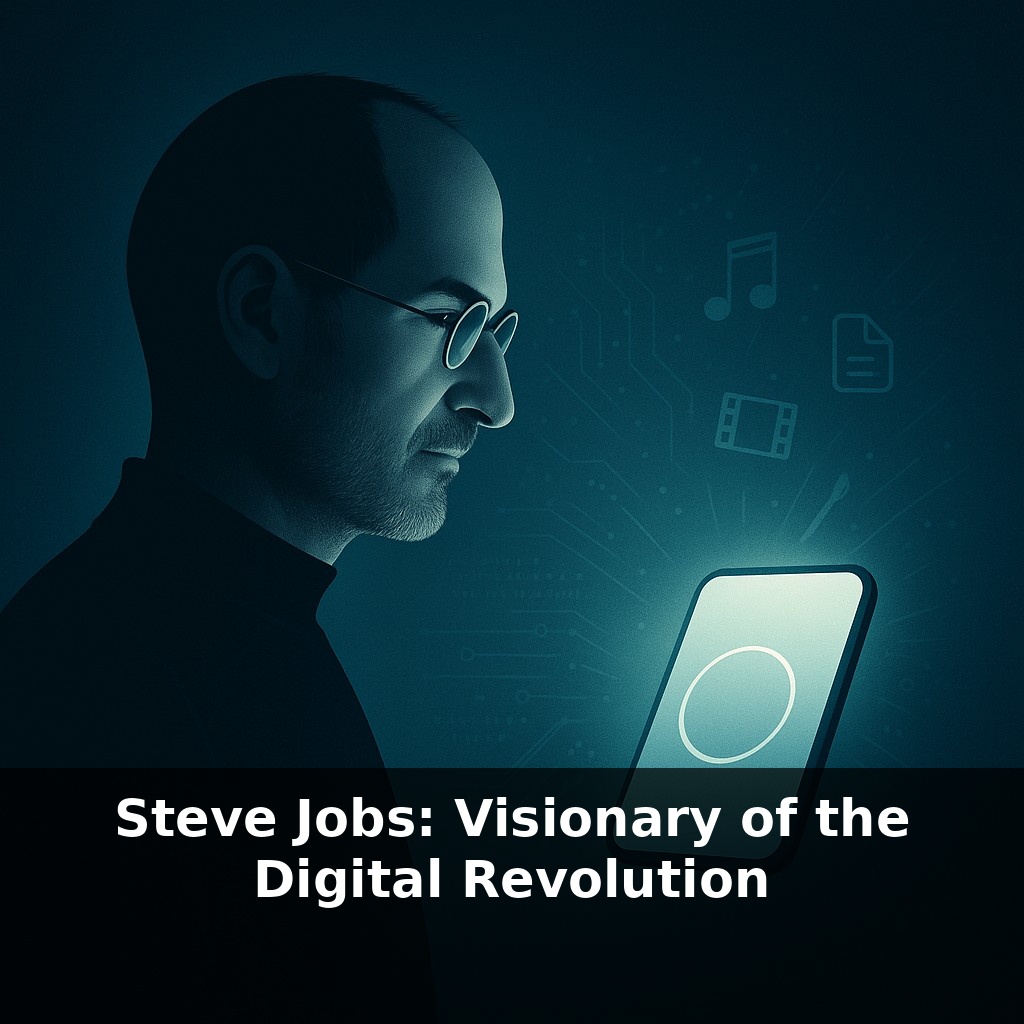
At a small product meeting, one man stops the demo over a single on‑screen button. Not its function—its feeling. Within a decade, that obsession helps sell over two billion devices and rewires daily life. How does arguing over tiny details reshape the entire digital world?
Jobs didn’t just refine products; he kept redefining the stage on which they existed. When most leaders saw computers as office tools, he pushed them toward creativity: music, movies, publishing, design. Later, when phones were about minutes and signal bars, he reframed them as pocket-sized hubs for life—maps, photos, payments, friendships. His real skill was spotting the moments when a whole category felt “good enough” to everyone else, then asking a sharper question: “What if this were delightful?” That question shaped everything from how screens responded to a fingertip to how songs flowed in your ears. Think of the way a well-planned city quietly guides you—paths, signs, and public spaces nudging you along. Jobs applied that kind of urban planning mindset to the digital spaces we now live in every day.
Jobs’s influence came from more than taste; it came from how he structured decision‑making around that taste. While competitors split responsibility—one team for hardware, another for software, another for retail—he pulled them under one roof, demanding they answer a single test: does this feel coherent? That coherence showed up in places most executives never visited: the circuit board layout, the box you unwrapped, the store table where you first tried the product. Think of it as editing a complex novel so every chapter, sentence, and even punctuation mark serves the same narrative arc.
Jobs’s real leverage came from where he chose to draw the boundary around “the product.” For most companies, the product was the device: metal, glass, maybe the software running on it. For Jobs, that boundary stretched outward: from the chip deep inside your phone to the contract you signed with your carrier to the 99‑cent song you bought at midnight. If any part of that chain felt clumsy, he treated it as a design problem, even if it technically belonged to another industry.
That’s why he fought music labels to unbundle albums into single tracks, pushed AT&T to rethink data plans for the first iPhone, and green‑lit Apple Stores when big-box retailers preferred discounting beige PCs. He was not just launching gadgets; he was quietly renegotiating how different industries fit together around the person holding the device.
Crucially, he did this after losing everything. When he was forced out of Apple in 1985, he didn’t retreat into nostalgia. At NeXT, he aimed high—workstations for universities and Wall Street—but the hardware flopped commercially. Yet the software stack they built, with its Unix foundations and object‑oriented frameworks, became the skeleton for Mac OS X and later iOS. His “failure” ended up as the operating system for hundreds of millions of pockets and desks.
The same pattern shows up in Pixar. Jobs bought a struggling graphics group from Lucasfilm, nearly ran out of money betting on digital animation, and spent years selling hardware just to stay alive. The payoff wasn’t only Toy Story; it was proving that computers could carry emotion at feature‑film scale. That success gave him something more valuable than another company: a sharper instinct for how stories and feelings drive technology adoption.
Inside Apple, he structured work to channel that instinct. Small, cross‑functional “directly responsible individual” teams owned critical pieces of a product, collapsing silos between engineering, design, and operations. He shielded these teams from the quarterly panic of Wall Street, then held them to an almost theatrical standard of reveal: the keynote was a forcing function that aligned schedules, marketing narratives, and technical tradeoffs around one launch moment, the way an architect aligns electricians, masons, and glassmakers to a single opening day for a new building.
By the time you saw a new Apple device on stage, dozens of quiet battles had already been fought: over screws you’d never see, license terms you’d never read, and interface decisions that felt “obvious” only because someone had argued them into existence years earlier.
Consider how this boundary‑stretching showed up in specific products. With the iPod, Jobs didn’t just ship a music player; he backed it with iTunes software and the iTunes Store so that finding, buying, and syncing songs felt like one continuous motion. With the iPhone, he paired multitouch hardware with a curated App Store, carrier deals, and visual voicemail, so “phone” quietly expanded to mean camera, GPS, game console, ticket, and wallet. Even with the iPad, early critics mocked it as a “big iPod touch” until magazines, schools, and airlines reshaped their own tools around its form.
His patent trail hints at how far his attention ranged: from glass staircases in Apple Stores to power adapters and device enclosures. That volume of protection signaled one thing to competitors and partners alike: the seams between industries—publishing, telecom, entertainment, retail—were now contested territory, and Apple planned to design those seams as carefully as the screens they framed.
Every new interface now competes to feel less like a tool and more like a quiet collaborator. As AI spreads from phones into cars, homes, and glasses, the real contest won’t just be raw intelligence, but who choreographs sensors, services, and context into a single, trustworthy “personality.” Think less spreadsheet and more seasoned coach: always nearby, knowing when to step in, and—true to Jobs’s standard—disappearing the moment it would get in your way.
Jobs’s deeper legacy is a question, not a product: where does the “edge” of your creation really end? In a world of AI copilots, smart homes, and streaming everything, the most powerful builders will treat each feature like a doorway into a wider world—and take responsibility for the hallway, the lighting, and what happens once people walk through.
Before next week, ask yourself: 1) “If I stripped my current project down to its ‘iPod moment’—the simplest, most elegant version that truly delights people—what features, meetings, or tasks would I boldly kill today?” 2) “Where am I letting fear of being wrong stop me from making a clear, Steve-Jobs-style product decision—and what’s one concrete call I’ll make in the next 24 hours, even without perfect data?” 3) “If I walked through my user’s ‘Apple Store’ experience of my product or service right now, what’s the one friction point that would make Steve say, ‘That’s ugly’—and how will I noticeably improve that single moment before the week is over?”