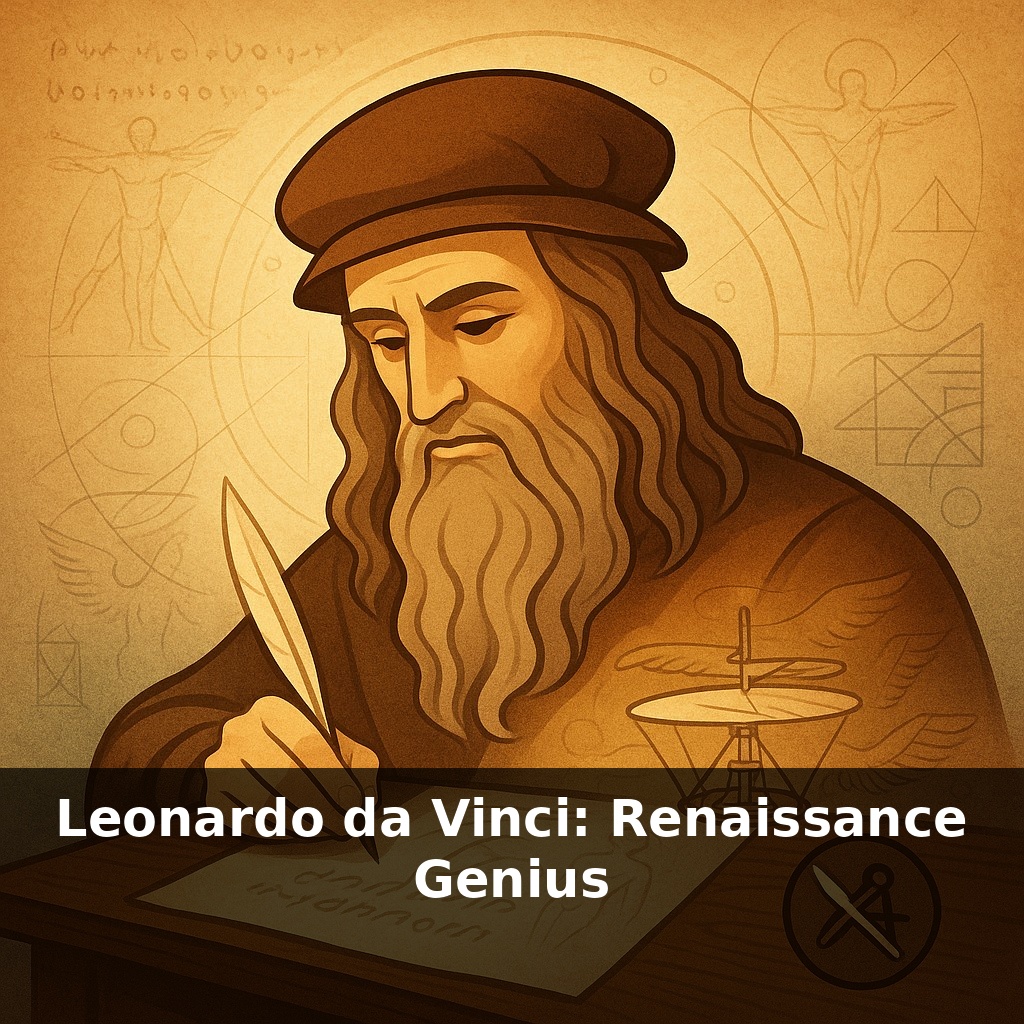
At a wooden desk in Renaissance Italy, a left‑handed artist writes backward so only a mirror can reveal his thoughts. Beside sketches of angels, there’s a blueprint for a flying machine. Is this a painter dreaming, or an engineer quietly reinventing how we study the world?
Leonardo didn’t just draw what he saw; he kept asking, “What is this *really* doing?” A curl of hair became a study of spirals in water. The shadow on a cheek turned into an experiment in how light scatters through air. His curiosity kept drilling downward, like an architect testing the strength of foundations before daring to build higher.
In this episode, we follow Leonardo not as a legend but as a working problem‑solver. We’ll step into his workshop as he dissects bodies, redirects rivers, and rethinks how bridges should carry weight. We’ll see how he used small, repeatable tests—on pigments, gears, and muscles—to refine ideas long before anyone spoke of “labs” or “data.”
Most of all, we’ll explore how his relentless note‑taking and sketching built a feedback loop between seeing, testing, and imagining that still underlies how we innovate today.
Leonardo’s world was not a tidy laboratory; it was a construction site of half‑finished ideas. War, politics, and patronage kept pulling him between courts, so his “research program” had to travel. He sketched siege engines for dukes, canal systems for city planners, and theatrical machines for court spectacles, treating each commission as a test bench. When a painting stalled, he diverted energy into anatomy; when a military job collapsed, he pivoted to civil engineering. His notebooks became the thread stitching these shifting projects into a single, evolving investigation of how nature builds and breaks.
Leonardo’s method starts looking less mystical once you follow him through a single problem. Take water. In Milan, he’s hired to advise on canals and flooding, so he goes beyond measurements for builders. He draws eddies curling around bridge piers, notes where banks collapse first, and sketches alternative pier shapes with arrows showing redirected flow. On the same page, you’ll find sketches of braided hair and billowing cloth: different subjects, same question—how does a moving medium twist and fold?
He carries that question into painting. In the background of his landscapes, rivers don’t just sit there; they carve valleys, deposit silt, and change course. The “realism” isn’t only in the surface look, but in how the scene behaves if you mentally press “play.” That’s a pattern in his thinking: instead of freezing nature, he’s constantly asking, “What happens next if I nudge this?”
You see the same approach with mechanics. For a patron worried about assault on city gates, Leonardo doesn’t just draw one reinforced door. He sketches multiple locking systems, then annotates where each might fail under stress. His notes describe staged tests: first with small wooden models, then heavier assemblies, then—ideally—full‑scale trials. It’s a staircase of risk: fail cheap and small before you dare to build big.
Collaboration quietly strengthens this approach. Working with mathematician Luca Pacioli, he illustrates complex polyhedra for a treatise on proportion. But those shapes reappear in his own studies of architecture and human bodies, as if the geometry seminar never ended—he just moved it into new materials. Stone, flesh, and flowing water become different “interfaces” for the same underlying rules.
And while many machines remain ink on paper, his habit of systematic variation—one gear ratio after another, one valve design beside its cousin—means later engineers can treat his pages almost like a dataset. Change this angle: the force path shortens. Add this brace: the load redistributes. He’s not merely drafting objects; he’s mapping option spaces.
In that sense, Leonardo behaves less like a lone painter and more like a one‑person R&D lab embedded inside the workshops, fortifications, and riverbanks of Renaissance Italy.
Leonardo’s notebooks feel strangely familiar if you’ve ever used version control in software. He rarely stops at a single solution; he “commits” dozens of tiny variations, each annotated with conditions: “for slow water,” “for heavy loads,” “for sudden impact.” A bridge sketch might sit beside notes on a musical instrument, both probing how tension stores and releases energy.
Take his studies of light. On one page he shades spheres with shifting light sources, not to make them prettier but to log how shadows sharpen or blur. Nearby, he diagrams the eye like a camera, exploring how lenses bend rays. He then carries those insights into stage effects for court festivals—controlling spotlights, colored filters, even smoke to choreograph what spectators notice first.
He also treats failure as data. When a plaster experiment for a mural decays, he doesn’t just abandon it; he dissects why, listing moisture, wall prep, and pigment choices like debugging logs. Each misstep seeds three new trials, so progress looks less like a straight line and more like a branching tree.
Future work on Leonardo points forward as much as back. Machine‑learning models can already scan his pages for overlooked patterns in gears, vortices or proportions—like a second mind quietly extending his sketches. Education reformers study his habits to design studios where maths, coding and drawing share the same table. Your challenge this week: pick one problem you care about and attack it from three fields—say physics, design and storytelling—just as stubbornly cross‑wired.
Leonardo’s real legacy may be a mindset: treating each sketch like a prototype and each question like a doorway to three more. Today, your phone’s camera, bridge designs, even medical scans quietly echo problems he first poked at with ink-stained fingers. Follow his lead: let one stubborn question pull you across skills you didn’t know you were allowed to mix.
To go deeper, here are 3 next steps: (1) Pull up a high‑res image of Leonardo’s notebooks (search “Codex Leicester scans” from the Gates collection) and spend 15 minutes zooming in on one page, noting how he mixes sketches, mirror‑writing, and questions—then try recreating that exact page layout in your own notebook using a current problem you’re curious about. (2) Borrow or download Walter Isaacson’s *Leonardo da Vinci* and read just the chapters on his anatomical studies, then open the free app “Complete Anatomy” (or a similar 3D anatomy tool) and imitate Leonardo by drawing what you see from two or three different angles. (3) Visit Google Arts & Culture, search “Leonardo da Vinci,” and pick one painting (like *The Last Supper* or *Virgin of the Rocks*); study the composition and light for 10 minutes, then use a simple drawing app like Procreate (or pencil and paper) to redesign that scene set in your own city, keeping his triangular composition and sfumato-style soft edges.