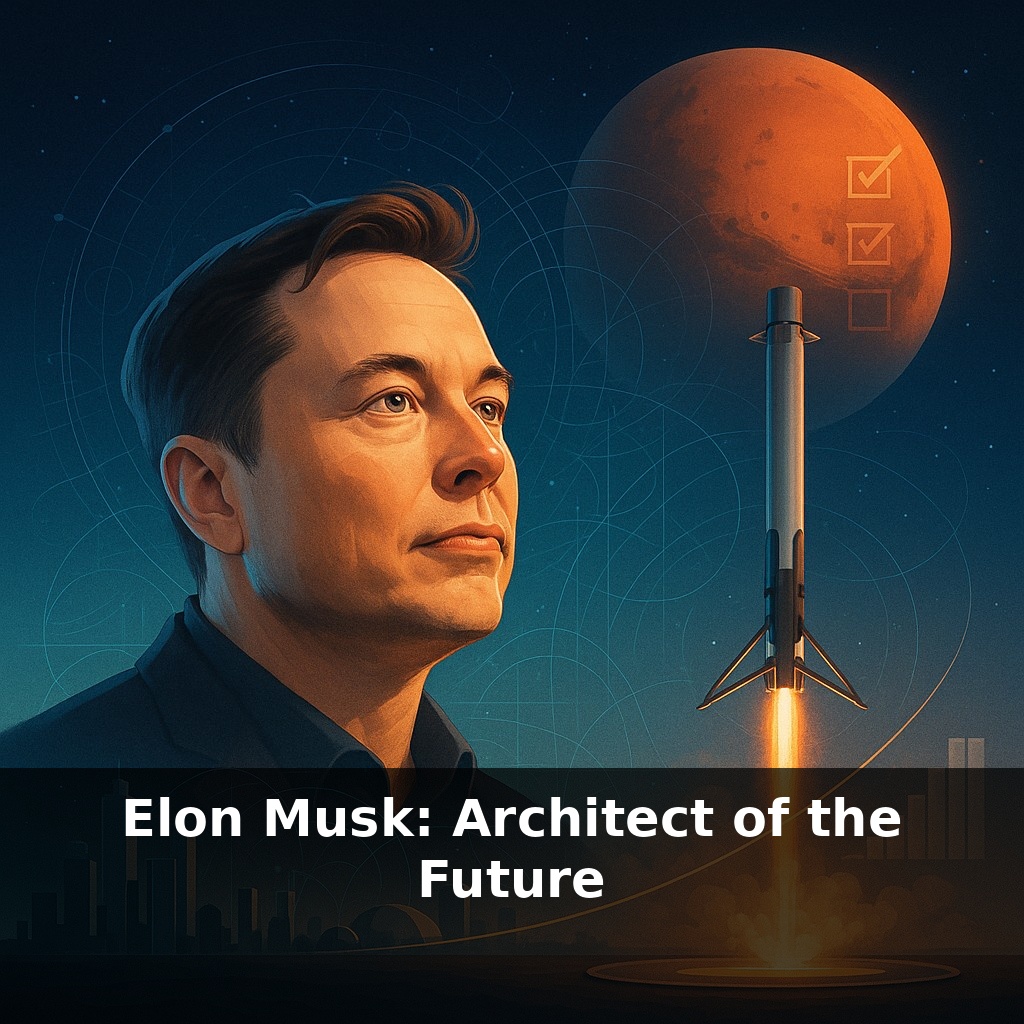
Elon Musk helped turn rockets from disposable fireworks into tools you can fly again and again. When most leaders are focused on quarterly profits, Elon Musk sketches timelines that stretch for centuries. Today, we step into the mind of a founder who treats Mars like a to-do list, not merely a science fiction dream.
Most founders pick a market and ask, “How can I win a slice of this?” Elon Musk starts further upstream: “What will humanity desperately need in 30 years—and why doesn’t it exist yet?” Then he works backward, stripping problems down to physics, supply chains, and spreadsheets until only the bare essentials remain. Instead of accepting the going price of a battery or a rocket engine as a fact of life, he treats it as a puzzle: what are the raw materials, who controls them, and which parts of the process can be rebuilt from scratch? That’s why his companies keep pulling more work in‑house—design, software, manufacturing, even the factories themselves—like a city that quietly absorbs its suburbs so it can coordinate the whole system instead of just one busy street.
Instead of asking “Which business model scales?” Musk tends to ask “Which constraint breaks progress for everyone?” For launch, it was cost to orbit; for cars, batteries and charging; for connectivity, remote regions left offline. That’s why you see him gravitate toward infrastructure layers—rockets, energy storage, satellite networks—where shaving a zero off the cost doesn’t just build a company, it unlocks new industries. Think of how cheaper chips enabled the personal‑computer era: he’s hunting for those leverage points in the physical world, where technology curves are still waiting to bend.
In practice, this shows up as a pattern: Musk picks a “boring” number, then refuses to accept it. For launch, it wasn’t “rockets are cool,” it was: why does it cost tens of thousands of dollars per kilogram to reach orbit? That question drove SpaceX to treat booster recovery as a core design goal, not a marketing stunt. As of early 2024, some Falcon 9 first stages have flown 19 times, driving the cost of getting mass to low Earth orbit under roughly US$2,700 per kilogram—cheap enough to make whole categories of missions economically viable that were previously science‑fiction on a spreadsheet.
You see the same move in how he treats timelines. Announced dates are often wildly optimistic, but their purpose is less about PR and more about forcing the organization to compress learning cycles. SpaceX’s rapid-fire launch cadence isn’t an accident; it’s an explicit trade: accept more visible failure in order to gather more data, earlier. Each explosion, abort, or anomaly becomes part of an engineering feedback loop that tightens with every iteration.
At Tesla, that loop runs through factories as much as products. Instead of treating the car as the finished story, Musk talks about “the machine that builds the machine”—the production line itself as a product to be designed, debugged, and upgraded. Battery packs that once cost over a thousand dollars per kilowatt-hour now come in under one-seventh of that, thanks in part to redesigning the cells, rethinking materials, and reorganizing how they’re produced and assembled at scale. That’s how Tesla reached 1.81 million deliveries in 2023 and roughly 18% of the global battery-electric market: not just by making desirable vehicles, but by relentlessly attacking the physics and logistics of building them.
Starlink extends this philosophy into orbit. Instead of a few giant satellites, SpaceX opted for thousands of small, mass-produced units and a launch system it controls end-to-end. By early 2024, that network connected about 2.6 million subscribers across more than 70 countries, including regions where traditional providers never found a profitable case to serve. Each launch doesn’t just sell capacity; it feeds data back into both the rockets that carry the satellites and the user hardware on the ground, tightening the entire ecosystem like an architect constantly redrawing the blueprints while the building is going up—because the scaffolding, tools, and materials are all under the same roof.
Musk’s approach shows up most clearly in what he’s willing to own end‑to‑end. At Tesla, he doesn’t just push for better EVs; he pushes for new cell formats, in‑house software, and even custom chips for autonomy. It’s closer to designing a skyscraper where you also specify the steel, invent a new kind of elevator, and write the building’s control software yourself so the whole structure can evolve as one unit. You see this in Tesla’s focus on over‑the‑air updates: cars improve after sale, so data from each drive trains the neural networks that guide the next software release.
Even his side projects echo this pattern. The Boring Company isn’t simply about tunnels; it’s about rethinking how fast and cheaply you can dig, then designing vehicles and stations around that new capability. Neuralink doesn’t just build implants; it builds robotics and custom chips to handle brain signals at scale. In each case, the bet is similar: if you control enough of the stack, you can keep rewriting the rules while everyone else is still negotiating interfaces.
A decade from now, the real impact may be less about any single company and more about expectations Musk resets. People may start asking why infrastrBuilding on Musk’s vision for the future, where infrastructure isn’t upgradable like software, and climate solutions move slower than smartphone cycles. Policy, too, could shift: regulators forced to respond to satellite megaconstellations, robotaxis, and brain‑machine trials may adopt a “sandbox first, ban later” stance, treating frontier tech like experimental city blocks rather than monuments cast in stone.
With the foundation of Musk’s achievements laid out, Musk’s deeper legacy may be cultural: treating “impossible” as a starting brief, not a stop sign. As more teams adopt that stance, stagnant sectors can feel like old city grids opened for renovation—layered, messy, full of cranes. The frontier shifts from lone visionaries to networks of builders, each asking: which “fixed” rule is secretly still negotiable?
Before next week, ask yourself: 1) “If I applied Musk’s ‘first principles’ approach to just one problem in my life or work today, what assumptions would I strip away, and what radically simpler/cheaper/faster solution might actually be possible?” 2) “Looking at how Musk stacks his time with brutal focus (e.g., 5-minute blocks and batching similar tasks), what’s one 60–90 minute block this week I’m willing to completely redesign around my most important project, with zero distractions?” 3) “If I treated a crazy, ‘too big’ idea of mine the way Musk treated reusable rockets—testing tiny versions, expecting failure, then iterating—what’s one small, slightly uncomfortable experiment I could run in the next 48 hours to move that idea out of my head and into reality?”