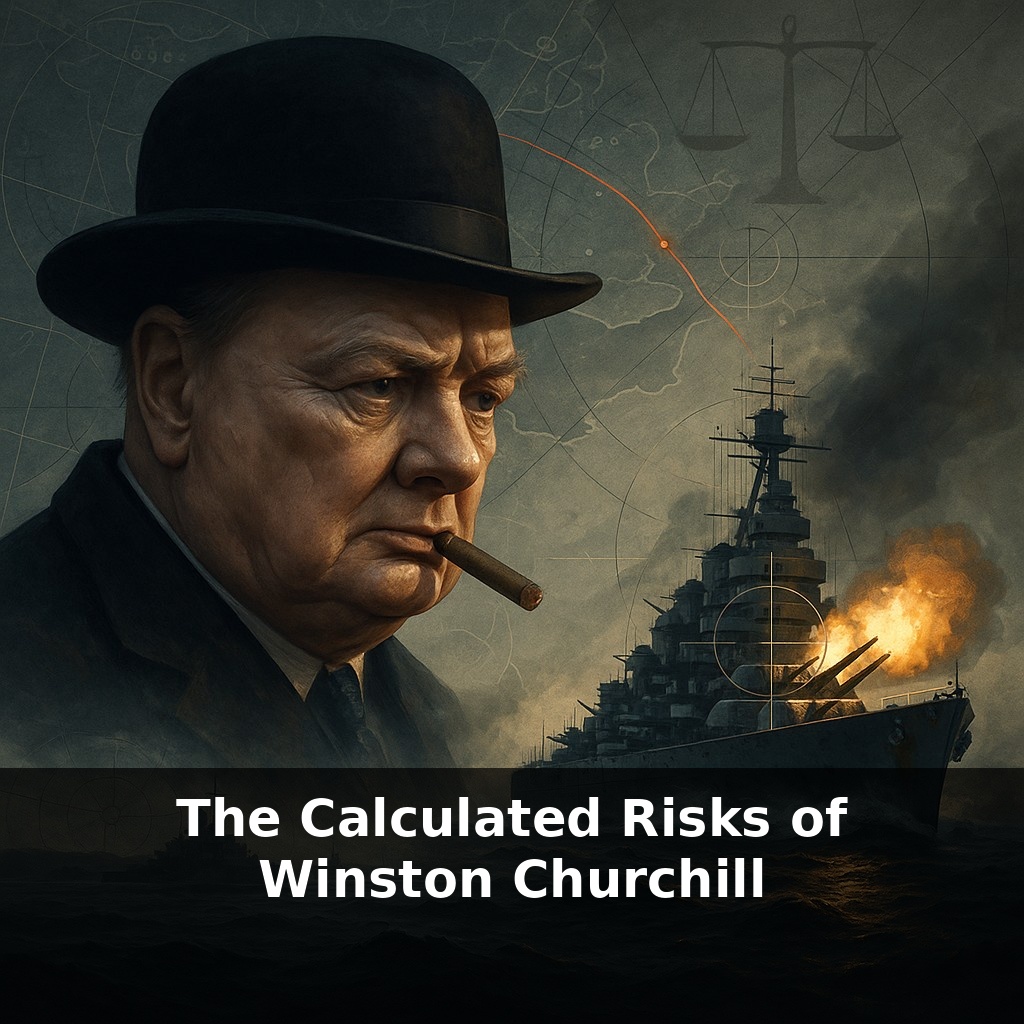
One summer morning in 1940, the British Navy opened fire on the ships of its *own* ally. Not by accident—by order. In this episode, we’ll step into the moment a leader chose catastrophe today to avoid something even worse tomorrow. And how he did that on purpose.
Churchill didn’t just *accept* risk; he structured it. Behind the dramatic orders were cold calculations built from numbers, maps, and history. In May 1940, he read reports showing German armoured thrusts advancing tens of kilometres per day and knew Britain could lose its army in weeks. Cabinet minutes, intelligence summaries, and Air Ministry tables became his decision tools. He demanded specifics: sortie rates, ship turnaround times, daily aircraft losses, U-boat sinkings. When RAF briefings projected fighter attrition curves, he used those forecasts to decide how long Britain could endure sustained attacks. He cross-checked military optimism against hard logistics: fuel stocks in days, replacement pilots in weeks, shipbuilding in months. This episode breaks down how he weighed outcomes not by what was popular or palatable, but by whether the numbers made survival—even victory—mathematically plausible.
Now add a second layer: time. Churchill didn’t just ask, “Can we win this battle?” but “What does this buy us in weeks, months, years?” Approving Operation Dynamo, he knew 338,226 troops saved were also 338,226 future trainers, officers, and cadres for a rebuilt army. Ordering the attack at Mers-el-Kébir, he gambled that 1,297 French sailors killed would harden U.S. perceptions of British resolve and shorten the road to American entry. With only 640 fighters against roughly 2,600 German aircraft, he calculated how many days of resistance were needed for radar, industry, and American aid to start compounding.
Risk, for Churchill, had tiers. At the top sat what he privately called “mortal risks” to the state: loss of the Royal Navy, collapse of home defence, or a political settlement that turned Britain into a German satellite. Everything else—cabinet rebellions, public outrage, even bloody setbacks—was negotiable if it moved those mortal risks down.
You can see this in the way he graded options. When planners proposed reinforcing the Middle East in 1941 with scarce tanks and aircraft, the numbers were bleak: only a few hundred modern British tanks existed; shipping lanes were under U-boat pressure; home defence still felt fragile. Yet Churchill approved major transfers. Why? Staff projections showed that if the Suez Canal, Egypt, and Iraqi oil were lost, Britain’s import capacity and global movement would shrink so much that, within roughly 12–18 months, the war’s economic balance could become irrecoverable. Sending, say, 200 tanks east was a visible weakening of the home front; losing the canal threatened the long-term viability of the entire war effort.
He thought similarly about bombing strategy. When Bomber Command argued for expanded night offensives in 1941–42, early sorties produced loss rates hovering around 4–5% per mission. At first glance, those percentages seemed manageable. But when multiplied across, for example, 1,000 aircraft over 20 raids, they translated into hundreds of crews—thousands of highly trained specialists—gone. Churchill pushed for better navigation aids, target marking, and concentration of force before authorising larger campaigns, because the raw percentages, scaled up, implied an unsustainable drain within a year.
His approach to coalition operations followed the same pattern. For Operation Torch he knew 107,000 troops would be committed with only limited amphibious experience and finite landing craft. Codenamed logistics tables showed that losing even a third of the shipping involved would delay any cross-Channel invasion by many months. Yet he judged the political and strategic upside—drawing Vichy forces, impressing Stalin with a second front, anchoring U.S. commitment—as worth that quantified downside, provided the naval risk was aggressively mitigated through routing, escorts, and deception.
Across these decisions, Churchill repeatedly forced his commanders to translate vague hopes into explicit odds, timeframes, and resource curves—and then chose the option that cut existential risk over cosmetic safety.
In practice, this meant turning vague fears into numeric thresholds. Churchill pressed for tables showing, for example, how many merchant ships could be lost each month before bread rations had to be cut. If imports fell below roughly 60% of pre-war levels for too many consecutive quarters, planners warned of compounding shortages; he treated that as a red line. During the U-boat “happy time,” he demanded weekly tonnage sunk, escorts available, and projected convoy coverage 30, 60, 90 days out, then backed escort carriers and longer-range aircraft when the curves clearly diverged.
He applied similar logic to morale. Those 21 Blitz visits were not symbolic alone; he asked Home Intelligence how many raids per week a city could endure before absenteeism, crime, and defeatism spiked. If reports suggested, say, three heavy raids in seven days doubled shock and strain indicators, he would schedule speeches, factory visits, and visible inspections to land inside that psychological window, using presence as a counterweight wherever the graphs bent downward.
Modern leaders can borrow the method without copying the means. Treat emerging threats—climate tipping points, AI misuse, grid failures—as Churchill treated invasion odds: demand numbers, not vibes. For example, press teams to specify: “At +1.5°C, how many coastal residents—100,000, 1,000,000—lose homes within 20 years?” or “If a hospital network suffers 3 days of outage, what’s the exact projected excess deaths?” Then insist every bold policy proposal states: risked lives, protected lives, and time gained.
Your challenge this week: take one high-impact decision and write its numbers on a single page—best case, worst case, and a “most likely” line. Add at least 3 metrics: people affected, money at stake, and time gained or lost (in weeks or months). Then ask: which option shrinks long-term damage by at least 30%, even if it hurts in the next 30 days?