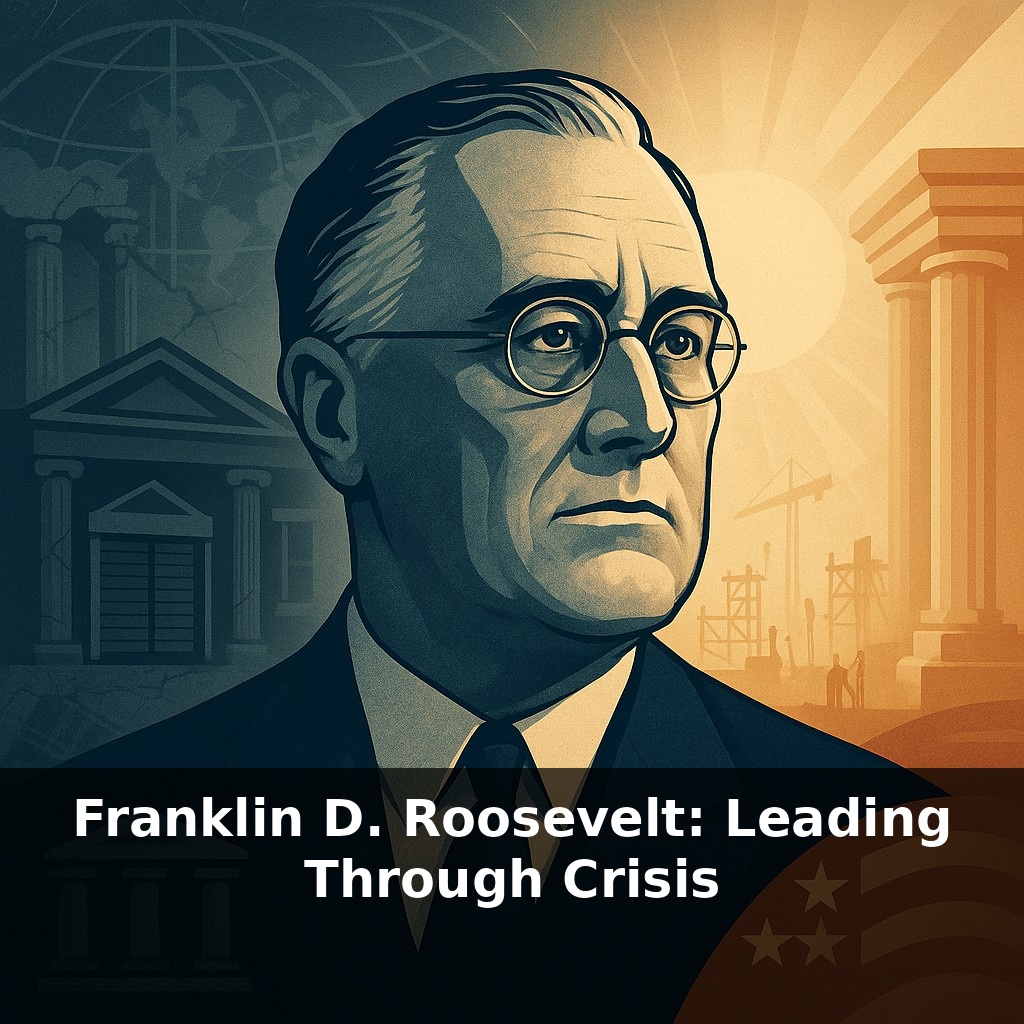
In the winter of 1933, banks were collapsing so fast that some towns woke up to find every branch locked. Four years later, those same streets hummed with new jobs and federal projects. How did one president move a nation from fear of ruin to preparing for global war?
Roosevelt didn’t inherit a clear playbook; he inherited overlapping emergencies. What made his leadership different wasn’t just big programs, but how he treated crisis as a moving target rather than a single problem to “solve.” He shifted tactics the way a sailor constantly trims the sails—adjusting course as the winds of politics, business resistance, and public opinion changed.
One week he was reassuring terrified citizens in Fireside Chats; the next he was pressuring Congress, or experimenting with agencies that might be temporary by design. He was willing to try, fail publicly, and then pivot, which unnerved critics who wanted predictability more than experimentation. At the same time, he began quietly aligning industry, finance, and labor for pressures that hadn’t fully arrived yet, sensing that the next storm would not be domestic at all, but global.
Instead of treating the Depression and the gathering storm in Europe as separate files on his desk, FDR read them as part of one long story: a fragile democracy under stress. He worried less about single policies “working” and more about whether citizens still believed the system could respond at all. That’s why he kept pulling in unlikely partners—Wall Street lawyers beside small-town reformers, Southern segregationists voting for programs that would later empower Black workers. His real project was rebuilding trust so that, when he asked for sacrifice in wartime, the country would actually say yes.
Roosevelt’s first moves went straight at the system’s broken wiring: who had power to act, and how fast. He didn’t just add new programs; he rewired authority. Agencies like the Agricultural Adjustment Administration and the National Recovery Administration tried to coordinate whole sectors—factories, farms, wages, prices—on timelines that business and Congress had never accepted before. When courts struck some of these experiments down, he didn’t retreat from the goal; he redesigned the tools, backing ideas like Social Security and unemployment insurance that were harder to unwind and more deeply rooted in everyday life.
That pattern—test, absorb resistance, then lock in a more durable version—shows up again in his path to war. Public opinion was wary of another overseas conflict, so he moved in increments that changed reality on the ground before rhetoric fully caught up. “Cash-and-carry” rules let the U.S. sell goods to countries that could pay and transport them, without saying “we’re in this war.” Then came Lend-Lease, sending vast quantities of matériel abroad while still technically staying out of combat. Each step normalized a deeper role, so when Pearl Harbor came, the industrial and legal scaffolding was already there.
Inside government, he played what advisers called “competitive administration.” Instead of one neat org chart, overlapping bodies like the War Production Board and the Office of Price Administration wrestled over how to allocate steel, fuel, and labor. The friction was intentional: by forcing arguments into the open, he surfaced information and options that a tidy hierarchy might have buried. It was messy, but it kept him from being trapped by a single bad bet.
Roosevelt also knew that numbers alone wouldn’t hold if people doubted fairness. The Fair Employment Practices Committee, while limited, signaled that wartime sacrifice had to be matched by at least some opening of opportunity, especially for Black workers migrating to defense plants. Measures like the G.I. Bill aimed beyond victory, tying service to long-term education and housing gains, so the state’s expanded role didn’t end when the shooting stopped.
Yet his record was scarred by stark contradictions. The internment of Japanese Americans exposed how fear and prejudice could override the very freedoms he claimed to defend. That tension—using emergency power to save democracy while sometimes violating its principles—remains one of the sharpest lessons of his tenure.
Roosevelt’s style becomes clearer when you zoom into specific choices. Take his handling of information. Rather than rely on a single inner circle, he cultivated overlapping channels: military briefings, labor leaders, business executives, and foreign envoys who often disagreed. He’d listen, let them argue, then quietly test the most promising ideas in limited arenas—like piloting new procurement methods in a few industries before scaling them.
Business leaders who once despised New Deal regulations later led war agencies, not because they converted overnight, but because he offered them influence in exchange for performance targets. Labor, in turn, got recognition of unions and wage protections, but also pressure to avoid strikes during critical production pushes.
One overlooked pattern is how he used time. Policies often came in “phases”: short-term relief, then structural change, then postwar planning. Like a conductor guiding a piece through distinct movements, he treated each phase as preparation for the next, not a self-contained fix.
FDR’s legacy is less a blueprint than a toolkit. His mix of expanded authority, coalition deals, and public reassurance can feel like stacking sandbags before a flood: necessary, but only if someone’s watching the waterline. In a world of rising seas, viruses, and bots instead of bombers, his record hints that the real test isn’t how fast leaders move, but how transparently they share tradeoffs when they do.
Your challenge this week: Pick one modern crisis—climate, AI, or pandemics. Trace how your country’s leaders have shifted powers, shared information, and built (or strained) alliances around it. Compare that pattern to FDR’s three-step habit: move early with provisional tools, adjust under pressure, then lock in longer-term rules. Where do you see similar moves today, and where are the guardrails missing or weaker than you’d want?
FDR’s record sits like a half-finished bridge: one side anchored in bold problem‑solving, the other in unresolved contradictions. Studying that span today isn’t hero worship; it’s a stress test. When you watch modern leaders face cascading shocks, you can ask: are they just stacking sandbags, or quietly reshaping the riverbed beneath our feet?
Start with this tiny habit: When you feel a twinge of worry about something (work, money, family—anything), pause and whisper to yourself one FDR-style “fireside” sentence that begins with, “Here’s what I *do* know right now…”. Then add just one next step you can take today, as simple as, “I’ll email Sam for an update,” or “I’ll check my bank balance before dinner.” This mirrors how FDR calmly reassured the public in his Fireside Chats while pointing to one concrete next move, and it trains your brain to shift from fear to focused action in under 30 seconds.