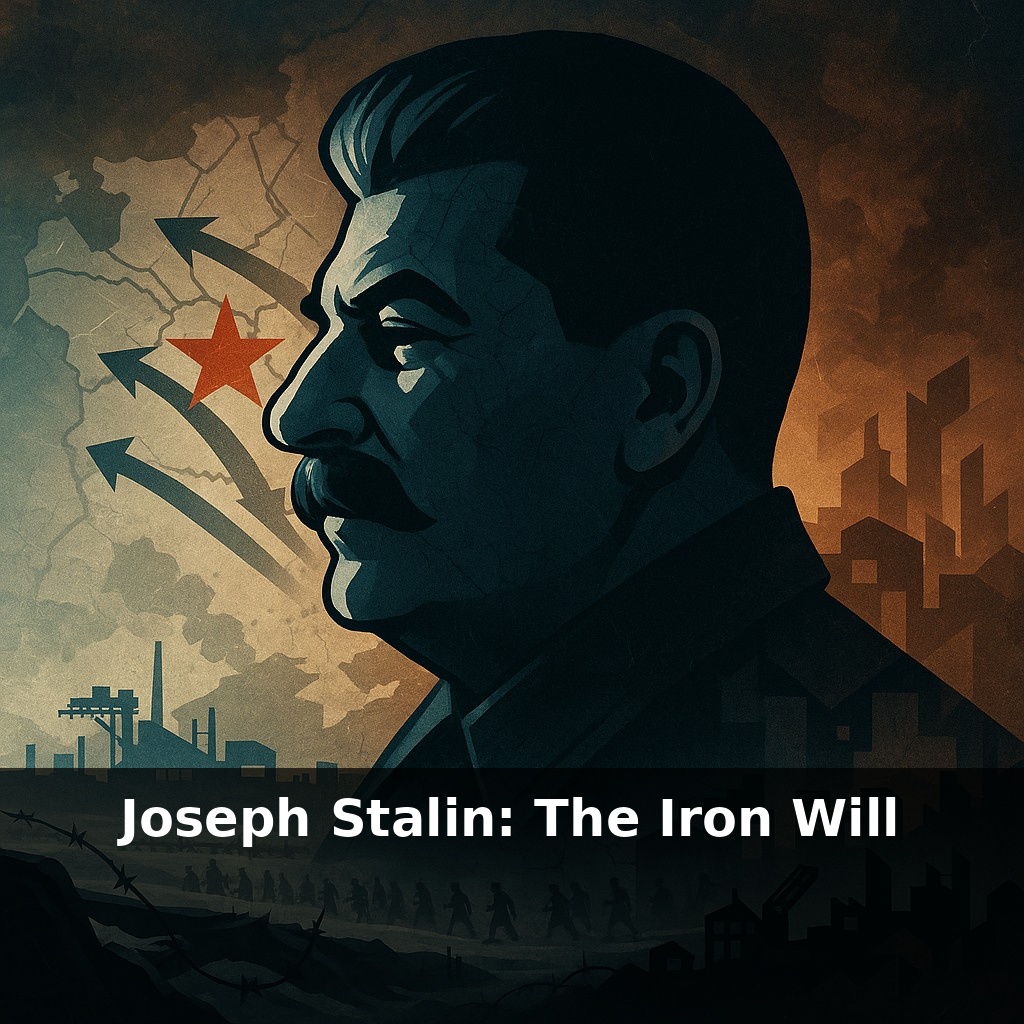
A single leader, who met his Western allies in person only twice, helped turn a battered country into the army that broke Hitler. In this episode, we step into war rooms, frozen trenches, and smoke-filled conferences to ask: what does an “iron will” really cost?
Stalin did not win the war by courage alone; he rebuilt the very skeleton of the Soviet state while under fire. When German armies surged east in 1941, entire cities seemed to lift off their foundations: machine tools unbolted overnight, rail lines jammed with equipment, families crammed into unheated cattle cars. In months, war industries were reborn beyond the Urals, as if the country had shifted its beating heart inland. From these new arteries came tanks, guns, and aircraft in numbers that steadily smothered German production. Yet the same hand that signed frantic evacuation orders also redrew post-war borders. As Soviet troops pushed west, they did more than liberate territory; they installed new regimes, rewrote constitutions, and locked Eastern Europe into a political winter that would define the Cold War’s front lines for decades.
On the eve of invasion, Stalin had already spent years remaking Soviet society into something harsh but mobilisable. Purges had decimated senior officers, yet they also left a command system where hesitation could be fatal to one’s career—or life. Collective farms, secret police, and a propaganda machine ensured that when orders came, they travelled fast, if not wisely. Wartime decrees tightened the screws further: deserters faced firing squads, “slackers” prison. At the same time, promises of glory, revenge, and a safer future tried to convince citizens that endurance now would purchase security later.
Stalin’s war leadership swung constantly between paralysis and ferocity. When German troops crossed the border in June 1941, he reportedly disappeared from public view for days, stunned that the pact with Hitler had shattered. Once he recovered, hesitation vanished. He took the title “Supreme Commander” and began issuing orders that pushed the Soviet system to its breaking point and beyond.
One of his earliest, brutal decisions was to seal the country in. Orders against retreat meant that officers who pulled back without permission could be shot. Whole units were labelled “cowardly” and disbanded; some survivors were marched into penal battalions and sent to assault minefields or fortified positions. The logic was stark: fear of your own side had to be at least as strong as fear of the enemy. Commanders like Zhukov learned to translate these ruthless directives into workable operations, but they never forgot that failure was as dangerous politically as it was militarily.
At the same time, Stalin centralised strategy while gradually—if grudgingly—trusting professionals to handle the details. In nightly sessions of the Stavka, the high command, he pored over maps, quizzed generals on railway capacities, and demanded fresh offensives even after catastrophic losses. Early disasters forced him to concede that micromanaging every regiment was impossible. From 1942 onward, he allowed broader operational freedom, provided the big goals—defend Stalingrad, encircle at Kursk, reach Berlin—were obeyed without question.
His management of resources was just as relentless. Lend-Lease supplies from the United States and Britain were never advertised domestically, but he relied on them: American trucks, British radar, canned food that kept Red Army divisions supplied as they moved west. Soviet industry prioritised sheer volume over refinement; a clumsy but robust T-34 that could be built quickly was worth more to him than a perfect but scarce machine.
Diplomatically, Stalin treated alliance conferences as extensions of the battlefield. In Tehran and Yalta, he pressed Churchill and Roosevelt for firm pledges: a second front in France, recognition of Soviet influence along its new western borders, reparations from Germany. Each concession he extracted abroad was paired with a tightening of control at home, ensuring that the Soviet Union would emerge from victory both exhausted and unyielding.
Stalin’s choices showed up most starkly in where he put pressure. Take manpower: instead of preserving elite units, he often drove them hardest, rotating fresh formations into the line like logs fed into a furnace to keep the flame of offensive momentum alive. Casualty figures in some rifle divisions ran so high that entire formations were rebuilt multiple times on paper while their banners and traditions stayed the same, a symbolic continuity masking human depletion.
In production, his priorities also revealed a hierarchy of value. He backed projects that promised scale over elegance: crude self-propelled guns to batter fortifications, rugged locomotives to sustain pushes across Poland, standardized artillery calibres so shells could be stamped out in fewer, larger runs. The same lens shaped occupation policy. As Soviet troops moved west, rail gauges, school curricula, and security services in “friendly” states were nudged toward Soviet patterns, as if tuning disparate instruments to a single, unyielding key so that, after the war, the whole region would play from Moscow’s score.
Crises today tempt leaders toward similar command‑style reflexes: central dashboards, emergency decrees, information “blackouts.” The lesson is not that discipline or coordination are dangerous, but that when every decision flows through a single will, short‑term gains can hide long‑term fractures. Like a river forced through a narrow dam, pressure builds behind the concrete; once the floodgates open, the release can redraw landscapes far beyond the original battlefield.
Stalin’s wartime choices still echo wherever security is traded for control: in emergency laws that never quite expire, in borders guarded like scar tissue, in archives that open only a crack. His story nudges us to ask, when storms hit our own institutions: are we building lighthouses for the future, or just taller prison walls?
Start with this tiny habit: When you finish any daily task (like brushing your teeth or closing your laptop), whisper one clear decision to yourself in a firm tone, the way Stalin delivered orders—for example, “I will read two pages of this history book tonight” or “I will send that difficult email before lunch.” Then take literally one step toward it: stand up and walk to the place where you’ll do it (your desk, your bookshelf, your laptop). This anchors a mini “iron will” moment into your day—without needing a revolution, a five-year plan, or a secret police force.