Gunfire dies down in the desert night—and the victors are the outnumbered ones. An Allied reporter coins a new name: “the Desert Fox.” How does a commander, short on fuel, men, and sleep, keep beating larger armies? That’s the puzzle we’re going to pull apart today.
Rommel’s genius didn’t start in North Africa—it was sharpened long before the sand and sun became his trademark battlefield. As a junior officer in World War I, he learned to move fast, hit hard, and keep decisions close to the front line. Those early campaigns taught him that hesitation kills momentum the way a sudden cold snap kills spring blossoms: silently, then all at once. By the time he reached Libya in 1941, he had already internalized a simple creed: see faster, decide faster, act faster. What made him dangerous wasn’t just boldness, but his habit of personally “feeling” the battlefield—driving forward, talking to tank crews, adjusting plans on the fly. In this episode, we’ll trace how that style in North Africa turned operational maneuver into something almost theatrical—high-risk, high-tempo, and, for a time, brutally effective.
By early 1942, Rommel stood at the center of a vast, brutal experiment in mobile war. The North African front stretched like a narrow, fragile bridge between Tripoli and Alexandria, with ports hundreds of kilometers behind the fighting and only a few thin roads and tracks tying everything together. Every advance meant longer lifelines for fuel, water, and ammunition—and more chances for the British to cut them. In this setting, Rommel’s talent wasn’t just attacking; it was turning a bare, exposed theater into something usable, the way a skilled climber reads a near-sheer cliff and still finds handholds.
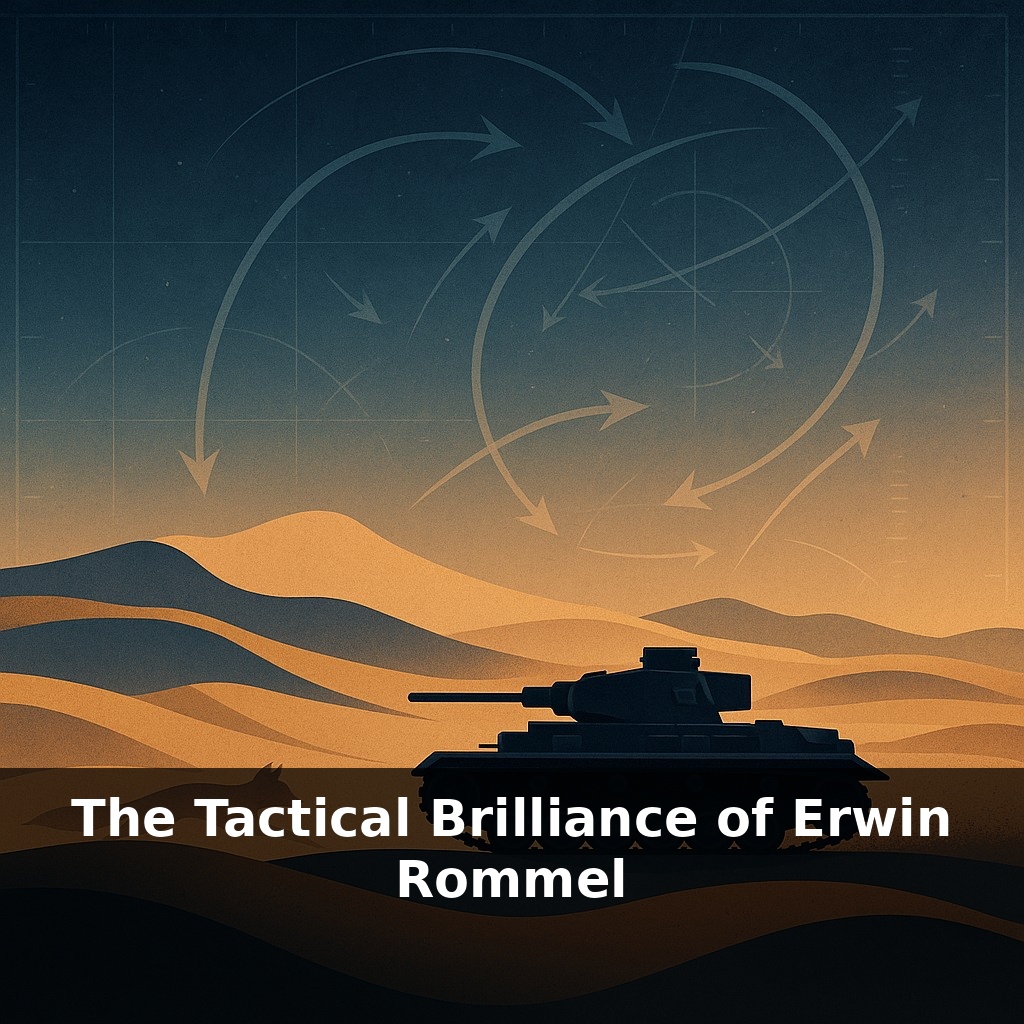
Rommel’s hallmark was how he stitched together tanks, infantry, artillery, and air support into a single, fast-moving instrument. At Gazala in May 1942, he didn’t simply charge the British line; he bent around it. While one force pinned the Commonwealth troops from the front, his mobile units swung wide through the desert “nothingness,” then slammed into the rear echelons—headquarters, fuel dumps, repair yards. The result: disoriented defenders, severed communications, and 35,000 prisoners taken in a matter of days.
This was pattern, not accident. Rommel treated time as his primary weapon. When Allied commanders wanted to pause, consolidate, and wait for orders, he accelerated. He would commit reserve units earlier than doctrine advised, betting that speed would generate shock before the enemy could coordinate a response. That aggressiveness often shattered carefully prepared British plans, built around methodical advance and firepower superiority.
His leadership style reinforced this tempo. Rommel refused to remain in a distant command post; he habitually moved close to the action, radio in hand, issuing direct corrections as situations shifted. This cut through layers of bureaucracy but also concentrated decision-making in his own person. Subordinates learned to exploit fleeting chances because they knew the commander would back bold moves, not punish them for deviating from a rigid script.
Logistics, usually the quiet, plodding side of war, turned into a high-stakes gamble for him. Operating up to 1,600 kilometers from main Axis ports, he regularly chose to advance even when fuel stocks were perilously thin. His staff scoured battlefields for captured British supplies, patched together convoys from whatever vehicles still ran, and rerouted transport at short notice when the Royal Navy threatened sea lanes. Success depended on improvisation: if a single link failed, his spearheads could stall in open desert with empty fuel tanks.
This approach yielded both impressive victories and brittle vulnerabilities. Every deep thrust stretched his forces thinner, magnifying the impact of any Allied counterstroke. When better-coordinated British armies finally combined superior supply, intelligence, and air power, Rommel’s style—so dazzling at its peak—struggled to recover from cumulative strain.
Rommel’s campaigns offer a series of sharp case studies in how bold operational choices can bend, but not erase, structural limits. At Tobruk in 1941, for example, he lunged forward so rapidly that Berlin grew nervous he’d outrun any hope of sustained support; German High Command urged restraint, yet he kept pressing local advantages, arguing that delay would only solidify British defenses. His diary shows a man constantly weighing “now” versus “later,” often choosing the former even when staff officers warned of future exposure.
Another telling episode: his reaction to Ultra-fed British counterattacks he didn’t know were intelligence-driven. When his columns were hit “too accurately,” he altered march timings, shifted routes into rougher terrain, and dispersed units more widely, treating the enemy’s uncanny anticipation as just another variable to outmaneuver. His reputation also shaped the battlefield: Allied units sometimes overreacted to feints simply because they believed “Rommel must be here,” handing him opportunities to exploit psychological pressure as much as physical force.
Your challenge this week: study how you handle being outnumbered—not in people, but in constraints. Pick one ongoing project where you feel short on time, resources, or authority. For seven days, do this:
Day 1–2: Map your “supply lines.” Where do delays, approvals, or bottlenecks actually live? Name them precisely.
Day 3–4: Identify one bold, time-focused move that trades security for tempo—a decision you could make faster, a prototype you could ship rough, a meeting you could replace with a short written order.
Day 5–6: Run a controlled “Rommel move”: push that one decision forward sooner than is comfortable, but not reckless. Document what friction appears and who gets rattled.
Day 7: Debrief yourself like a staff officer. Did acting earlier create confusion, or did it unlock options that waiting would have killed? Decide what version of “fast, but not fragile” you want to keep—and where you must not imitate Rommel’s overreach.
Rommel points toward a future where command feels less like pushing units on a map and more like conducting a fast-moving orchestra. Drones, autonomous vehicles, and AI tools will turn “seeing first” into a crowded race, not a rare gift. His real legacy, then, isn’t daring raids—it’s how he fused fragments of information into action before the picture was complete, like a storm forecaster acting on shifting pressure lines. Tomorrow’s best leaders may win not by knowing more, but by being braver with partial truths.
Rommel’s story nudges us toward a humbler question: how much “brilliance” is timing, and how much is terrain, luck, or opponents still learning the game? His arcs of success and failure trace like a fast-moving storm front—impressive, but shaped by larger currents. Study him not as a template to copy, but as a sharp lens on risk, tempo, and their hidden costs.
Start with this tiny habit: When you sit down at your desk (or open your laptop), quickly whisper to yourself, “Where’s my high ground?” and circle just ONE task on your to‑do list that would give you outsized advantage today—like Rommel seizing key terrain before the enemy. Then, before you check email or messages, spend just 3 focused minutes moving that one “high ground” task forward—draft the first sentence, open the key document, or make the single call that starts it. Over time, you’re training yourself to think like Rommel: secure the decisive point first, then worry about everything else.