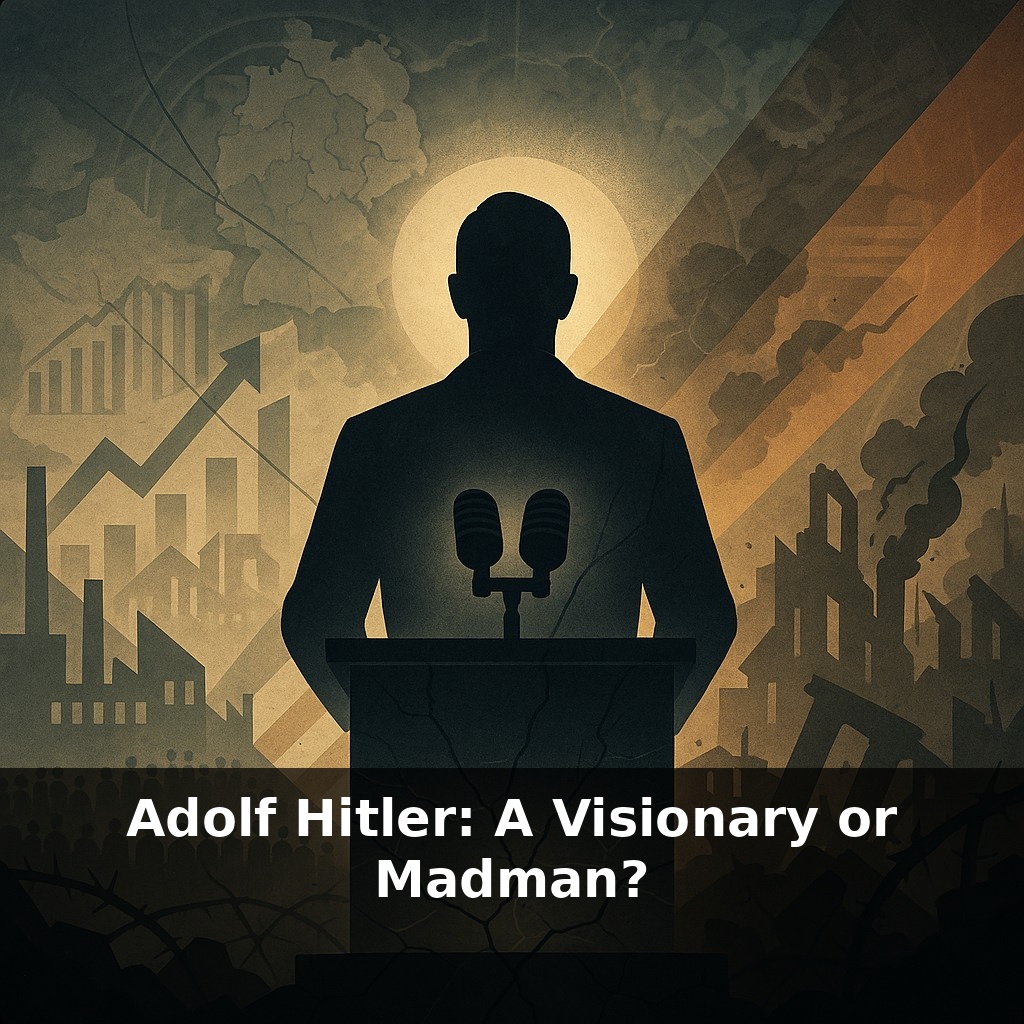
One man helped turn a broken nation into a powerhouse in just a few years—and then steered it straight into ruin. In this episode, we step into Adolf Hitler’s inner circle and ask a disturbing question: was this devastation driven by vision, or by madness dressed up as strategy?
Hitler’s rise didn’t begin with tanks or camps; it began with promises. To a society battered by hyperinflation, humiliation, and mass unemployment, he offered not just jobs, but purpose. New highways cut across the countryside, factories roared back to life, uniforms returned to the streets. Many Germans felt history’s tempo accelerate, as if the nation had shifted from a slow, broken waltz to a driving, triumphant march.
But beneath the spectacle was something more unsettling: a leader who treated reality as something to be bent by will and belief. Economic figures were massaged, dissent was crushed, and comforting myths replaced hard facts. In this episode, we’ll examine how ambitious projects, clever propaganda, and calculated gambles created the illusion of a master strategist—while laying the tracks for a disaster the world is still trying to understand.
To understand Hitler’s appeal and his ultimate failure, we have to hold two truths at once. On one side, there was real, visible change: concrete poured, factories expanded, military parades lengthened. On the other, there were the costs hidden offstage—crushed rivals, coerced labor, and an economy wired to permanent mobilization. We’ll trace how projects like the Autobahn and Volkswagen became symbols of renewal while masking structural dependence on conquest. Then we’ll follow his fateful turn east, where decisions stopped resembling strategy and started to look like a gambler chasing losses in a storm he created.
The foundations of Hitler’s “new Germany” were poured in concrete and steel. Motorways stretched across fields, factories tooled up, and uniforms appeared in ever-greater numbers—but the real engine was rearmament. Under the Versailles Treaty, Germany was limited to 100,000 troops. By 1939, that number had exploded into an armed force in the millions. Orders for weapons, uniforms, and vehicles soaked up unemployment, and firms that once built civilian goods found themselves feeding an insatiable military market.
On paper, this looked like a miracle. Yet much of it was financed by creative accounting and short-term borrowing, tied to future conquest. The regime wasn’t simply planning for war; it was planning to live off war. Territories to the east were already penciled in as sources of grain, oil, and slave labor long before the first shots of the Second World War. Domestic prosperity depended on the expectation that defeated neighbors would pay the bill.
This is where “vision” and “madness” start to blur. Hitler could read a crowd and sense when to accelerate or pause, but he showed far less interest in the limits of resources, logistics, or diplomacy. Specialists in these areas frequently raised alarms. Their memoranda piled up, but the leader preferred loyalists who confirmed his instincts over experts who challenged them.
The same pattern played out in foreign policy. Early moves—reoccupying the Rhineland, annexing Austria, dismantling Czechoslovakia—were daring, but each relied on opponents’ reluctance to risk war. Success reinforced his belief that boldness alone could bend events. Once he turned that mindset toward the Soviet Union, the scale of the gamble changed. The invasion sent millions of soldiers into a vast theater with fragile supply lines and underestimated resistance.
As the war dragged on, strategic choices narrowed. Resources were diverted into ideological projects and retaliatory weapons that impressed on paper but could not change the outcome. Like a symphony pushed to play faster and louder, the system produced noise and intensity even as it lost coherence—until the structure holding it together finally gave way.
Think of the early Third Reich like a carefully staged theater production. Front of house, the audience saw sleek cars at trade fairs, model stretches of road, and choreographed rallies filmed by Leni Riefenstahl to project order and dynamism. Backstage, however, stagehands scrambled: raw materials were tight, foreign currency was scarce, and planners juggled improvised financial instruments such as Mefo bills that pushed real costs into the future.
Concrete examples reveal the split. The Autobahn, heavily showcased in newsreels, carried relatively little freight compared to rail; its symbolic value far outweighed its economic payoff. Volkswagen collected savings from would‑be owners, but war priorities meant almost none received a car; factories shifted to military vehicles instead. Even rearmament successes hid fragility: synthetic fuel and rubber programs strained to keep up, leaving the regime vulnerable to blockades.
These choices weren’t random. They show a leadership willing to trade long-term resilience for spectacular, ideologically satisfying “wins” in the present.
Democracies today face leaders who promise renewal through speed, force, and purity. The danger isn’t only open brutality; it’s the slow normalising of emergency powers, loyalist courts, and “temporary” exceptions. Your challenge this week: each time a public figure calls complexity “weakness” and glorifies “decisive action,” note what freedoms or safeguards they suggest bending to make that action possible.
In the end, the “visionary or madman” question may miss the point. History shows that destructive leaders don’t need to be superhuman geniuses or raving lunatics; they just need a system willing to grant them unchecked power. Like a river with its banks removed, their impulses can suddenly flood far beyond what anyone first imagined.
Try this experiment: For one day, whenever you hear or read a bold political or social claim, pause and ask yourself, “Is this closer to visionary leadership or dangerous fanaticism—and why?” Then, deliberately restate that claim in two versions: one that emphasizes idealistic goals (like Hitler’s early “national rebirth” rhetoric) and one that exposes potential for abuse (like his calls for racial purity and absolute obedience). Notice which version feels more persuasive to you and which emotional buttons it pushes—hope, fear, pride, resentment. By tonight, briefly compare at least three claims you encountered and see how often persuasive “visionary” language could also mask extreme or harmful ideas.