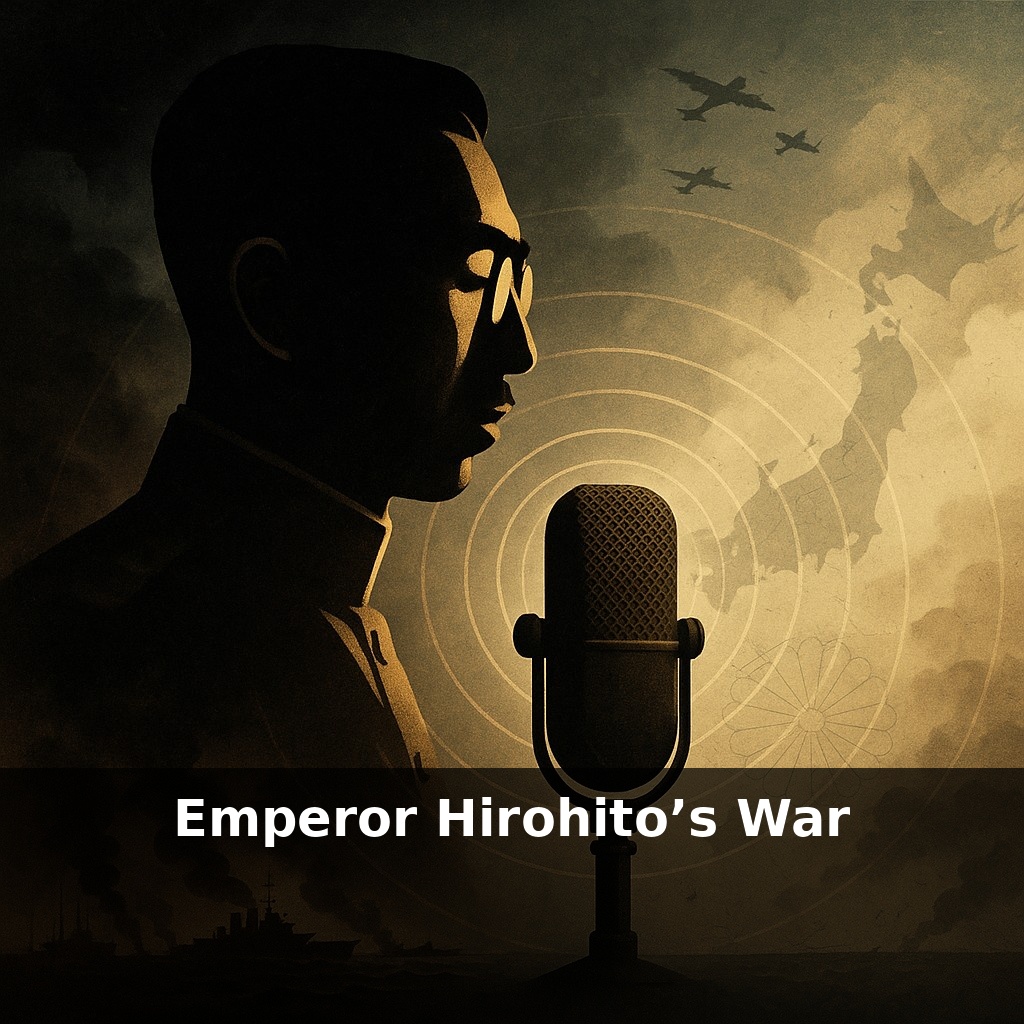
In August 1945, millions of Japanese heard their emperor’s voice—for the first time in their lives—and it was to admit defeat. How did the man who led a nation into total war also become the one voice that finally stopped it? Let’s step into that contradiction.
Hirohito did not sit above the storm—he sat inside it. By the late 1930s, his throne was surrounded by men who treated assassination, coup attempts, and cabinet collapse almost like routine weather changes in Tokyo’s political climate. Army radicals murdered prime ministers; navy leaders pushed rival plans; civilian politicians struggled to stay in office long enough to matter. Yet amid this turbulence, one thing remained constant: every truly decisive step still required the Emperor’s seal, spoken approval, or silent consent.
To understand his wartime role, we have to watch how he moved in this system: when he quietly pushed back, when he yielded, and when he finally broke precedent. Rather than a single moment of guilt or innocence, Hirohito’s war becomes a timeline of choices—some hesitant, some deliberate—made while the costs, in blood and ruin, kept rising.
Hirohito’s authority sat at a crossroads where law, ritual, and fear converged. On paper, the Meiji Constitution armed him with sweeping powers; in practice, generals and admirals treated those powers like a locked toolbox only they knew how to open. Key decisions passed through Imperial Conferences—highly choreographed meetings that wrapped hard strategy in layers of ceremony. Inside those rooms, his questions could stall momentum or nudge policy, but outside them the military’s autonomy grew like unchecked ivy, creeping into diplomacy, budgets, even school textbooks, binding society ever tighter to a path of escalation.
Hirohito’s war years are easiest to trace not in speeches—there were almost none—but in meetings, margins, and questions.
Take the road to December 1941. In the months before Pearl Harbor, service chiefs brought him thick binders of projections: oil reserves, ship counts, potential U.S. responses. Surviving diaries show him pressing them on logistics and timelines, asking what would happen if the war lasted longer than planned. He did not veto the march toward conflict, but he forced the planners to confront their own optimistic math. When the final decision for war moved through the 1 December Imperial Conference, it did so with his formal approval already signaled—an approval preceded by pointed, technical queries rather than moral objections.
Once hostilities began, his attention narrowed to operations. The Sugiyama Memorandum and staff notes record him quizzing generals about stalled campaigns in China or overextended lines in the Pacific, down to questions on aircraft ranges and replacement rates. He was not issuing detailed orders from a map room; instead, he circled weaknesses. Yet after setbacks like Midway or Guadalcanal, he accepted reassurances and allowed the basic strategy to continue, even as casualty lists lengthened.
Personnel choices reveal another layer. He could appoint and dismiss prime ministers, but only men acceptable to the services were viable. When he replaced Konoe with Tōjō in 1941, it was not a coup by a strong monarch; it was a decision inside a constrained menu, choosing a general who could both command the army and manage the cabinet. Later, as defeat loomed, he shifted toward figures more open to peace, culminating in the selection of Suzuki Kantarō in April 1945, a move that quietly aligned the throne with a negotiated end.
By summer 1945, American bombing and naval blockade had reduced Japan’s capacity to resist to a grim minimum. Here his pattern broke. Faced with deadlocked leaders arguing over conditions for surrender, he intervened directly in August—first to accept the Potsdam terms with one key reservation about the imperial institution, then to insist the war end even after the Allies’ clarifying response undercut that reservation. The “sacred decision” was less a sudden awakening than the endpoint of years of guarded engagement, finally tipping from questions and nudges to an unmistakable command.
Think of those years as a score that kept being rewritten mid‑performance. Early on, Hirohito’s marginal notes were small: questioning casualty estimates here, probing supply assumptions there. These didn’t overturn plans, but they did force officers to tighten their arguments, much as a conductor’s raised eyebrow can make a brass section soften without stopping the piece. For instance, when army leaders pushed for deeper advances on the Asian mainland, he pressed them on how they would hold overstretched lines. They adjusted timetables, trimmed ambitions on paper—yet the overall expansion continued.
His choices of advisers worked the same way. By bringing in staff officers with technical expertise or cautious temperaments, he could cool the temperature of discussions without announcing a change of course. Later, as bombing intensified, he listened more to figures who reported honestly on famine, fuel shortages, and civilian trauma. Those reports, echoing through palace briefings, slowly shifted the mood from perseverance to exhaustion, preparing the ground for the extraordinary step he would finally take in August.
Postwar, Hirohito’s muted presence still shapes how Japan remembers aggression and victimhood. Textbook debates, shrine visits, and apologies are like fault lines on a tectonic plate that never fully settled after 1945. As leaders reinterpret security laws or expand Self-Defense Force roles, unresolved questions about imperial responsibility quietly influence what feels “safe” to change—and what risks cracking the postwar consensus on peace and identity.
Hirohito’s legacy still drifts through Japan’s debates like coastal fog—never solid, never gone. Court records released decades later, and shifting biographies, keep revising his silhouette, much like new currents reshaping a shoreline overnight. Studying him is less about verdicts than learning how power hides, surfaces, and quietly redraws the map of memory.
Before next week, ask yourself: “When I hear how Hirohito navigated responsibility and denial after Japan’s surrender, where in my own life am I quietly avoiding ownership for the harm I’ve caused—and what is one specific apology or amends I could make this week?” “Thinking about how ordinary Japanese citizens were swept up in imperial propaganda, which news sources or social feeds in my daily life do I treat as unquestionable—and how could I deliberately challenge one of their core claims today by checking primary sources or opposing historians?” “After hearing how postwar narratives softened Hirohito’s role to protect the imperial institution, where in my family, workplace, or country do I see a ‘comforting myth’ replacing uncomfortable truth—and what concrete step can I take (like asking a hard question in conversation or revisiting a textbook or article) to nudge that story closer to reality?”