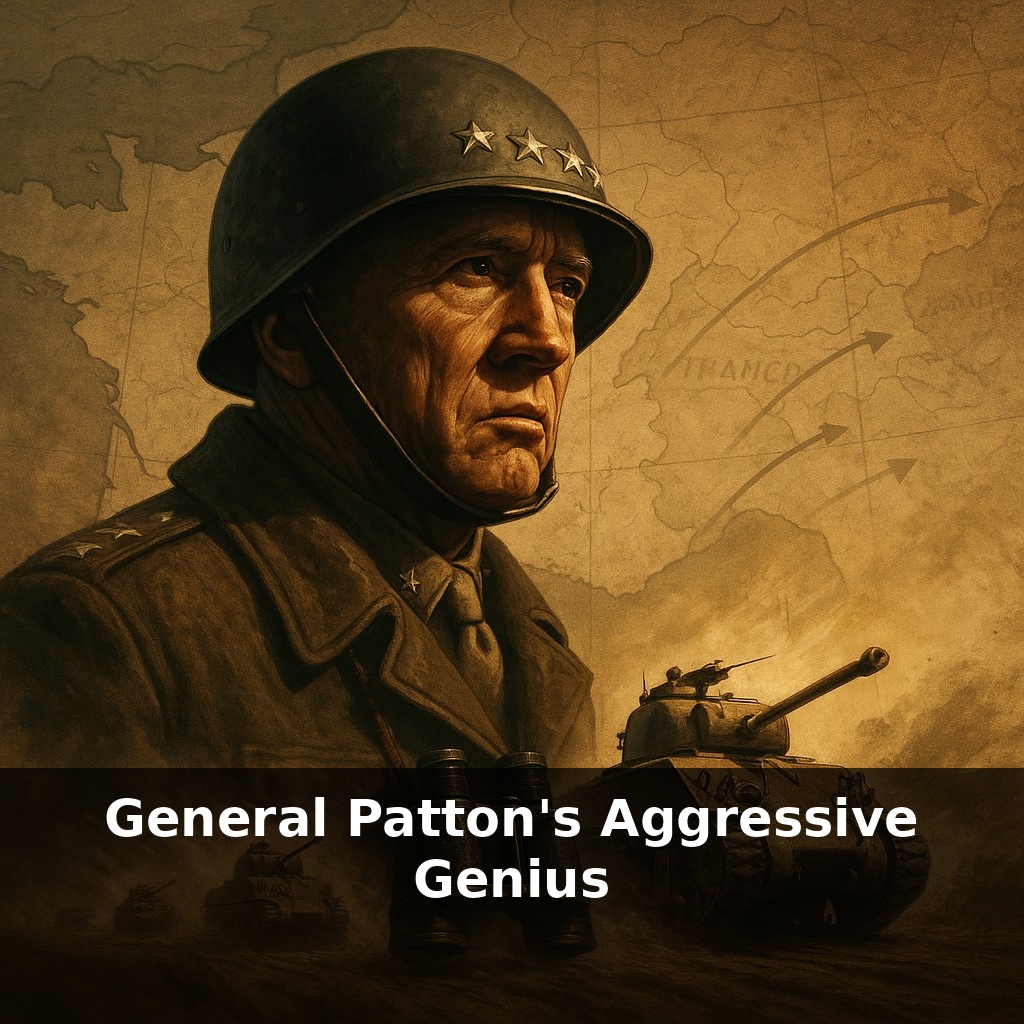
A general once drove his army so fast across France that German commanders thought they faced multiple Allied forces, not just one. In this episode, we drop into that whirlwind—where strict discipline, bold risk, and raw speed fused into Patton’s ruthless advantage.
By the time Patton took command of Third Army in August 1944, he’d turned his philosophy into a kind of moving factory of war: fuel, ammo, orders, and reconnaissance all flowing forward in sync. His nickname, “Old Blood and Guts,” wasn’t just about bravado—it signaled to friend and foe that this was an army designed to stay on offense. He obsessed over details that most generals left to staff officers, like the exact timing of bridge crossings or how quickly a refueling point could clear a column. Even his infamous 3-minute helmet inspections weren’t about appearances alone; they were micro-drills in responsiveness under pressure. The result? A force that could change direction almost as fast as a flock of birds, turning small openings in German lines into full-on collapses before the enemy quite understood what hit them.
Patton also treated information as a weapon. He pushed for constant reconnaissance, probing ahead like a hiker tapping the ground on a foggy ridge, never satisfied with yesterday’s map. He’d fire off orders, then revise them hours later when a patrol or aerial photo revealed a fresher gap in the German line. That restlessness extended to logistics: fuel dumps leapfrogged forward, repair teams rode with advancing columns, and traffic officers re-routed convoys in real time. To his staff, it felt less like managing a static battle plan and more like conducting a storm—always shifting, never allowed to settle into calm.
Patton’s real gift was turning that restless energy into systems that could scale beyond his own presence. He didn’t just bark orders from a jeep; he built a framework where hundreds of subordinate commanders could act fast without waiting for permission. One of his favorite tools was the “axis of advance” concept: he’d assign clear routes and objectives, then demand that corps and divisions exploit any weakness they found along that line. If a unit hit resistance, it fixed the enemy in place while a neighbor slid around the flank. The key was that everyone knew the larger direction of effort, so improvisation still served the overall design.
The August 1944 breakout in France showed how far this could go. Third Army surged through Brittany and across the Loire so quickly that German intelligence reports routinely overestimated its size. Patton leaned into that confusion. He encouraged feints, rapid redeployments, and sudden changes of direction that made his army’s footprint look bigger than it was. When fuel shortages threatened to slow him, he didn’t simply complain up the chain—he ruthlessly prioritized which units got gas, sometimes halting entire formations so others could keep punching forward where the payoff looked better.
Yet this wasn’t a solo act. Patton’s operations only made sense inside Eisenhower’s broader design, which balanced British, American, and Canadian advances with the political need to share risks and credit. Patton chafed at constraints, but he adapted, using every window of freedom to stage local offensives and rapid exploitation. You see this during the Battle of the Bulge: while other commands were reeling, his staff had already rehearsed contingency plans for a 90-degree turn north. When the order came, Third Army didn’t debate; it pivoted.
Underneath the legend of “Old Blood and Guts” was someone who understood that speed without structure burns out, and structure without drive ossifies. His particular genius was fusing both—creating an army that could move fast, think fast, and still hit hard in the exact place it would matter most.
Patton tested this whole system in moments that looked suicidal on paper. When he drove toward Metz and its ring of forts, he didn’t wait for a textbook siege; he pushed bridging units, engineers, and artillery forward in overlapping waves, probing for a soft spot rather than hammering the hardest point. During the relief of Bastogne, his staff mapped multiple routes north, then fed units along the ones that stayed viable as weather, ice, and German counterattacks shifted hour by hour. You can see the same mindset in how he handled air support: instead of treating aircraft as occasional help, he integrated them into daily rhythm—fighter-bombers hitting road junctions ahead of moving columns so German reserves arrived late, disorganized, or not at all. In a sense, he treated the battlefield like a fast-changing weather system: fronts moving, pressure building, sudden openings appearing where conditions briefly aligned—and he trained his army to move the moment those “breaks in the clouds” appeared, before they closed again.
Patton’s legacy quietly shapes how modern forces think about AI and autonomy. His instinct would be to treat algorithms like junior officers: useful, but constantly tested, challenged, and cross-checked by humans under pressure. As battlefield data streams thicken, leaders will face a Patton-style puzzle: how do you keep initiative at the edge without losing strategic control—like a conductor guiding virtuoso soloists who might, at any moment, improvise beyond the score? Your challenge this week: study one historic decision where speed magnified both risk and opportunity. How would you redesign that moment if AI systems had been in the loop—pushing for faster action, flagging hidden patterns, or even contradicting human instincts?
Patton’s deeper lesson isn’t just to move faster, but to prepare so thoroughly that rapid choice becomes almost instinctive—like a chess player who’s seen a pattern before the pieces settle. His papers show endless rewrites of plans, maps, and “what ifs.” The paradox: his “impulsive” decisions were often the final move in a long, invisible rehearsal.
To go deeper, here are 3 next steps: (1) Pick up *War As I Knew It* by George S. Patton and read his entries from the 1944 Lorraine and Battle of the Bulge campaigns, underlining every instance where he turns “aggression” into a concrete decision (timelines, orders, movements). (2) Open YouTube and watch at least one detailed breakdown of Patton’s dash across France—search for “Patton 3rd Army breakout from Normandy military history visualized”—and pause to note how he uses speed, logistics, and surprise together instead of just “boldness” in the abstract. (3) Grab a modern leadership lens by reading the chapter on “Decisiveness and Bias for Action” in *Extreme Ownership* by Jocko Willink and Leif Babin, then jot a side‑by‑side comparison of one Patton decision from the podcast with one combat decision from the book to see how “aggressive genius” shows up in different eras.