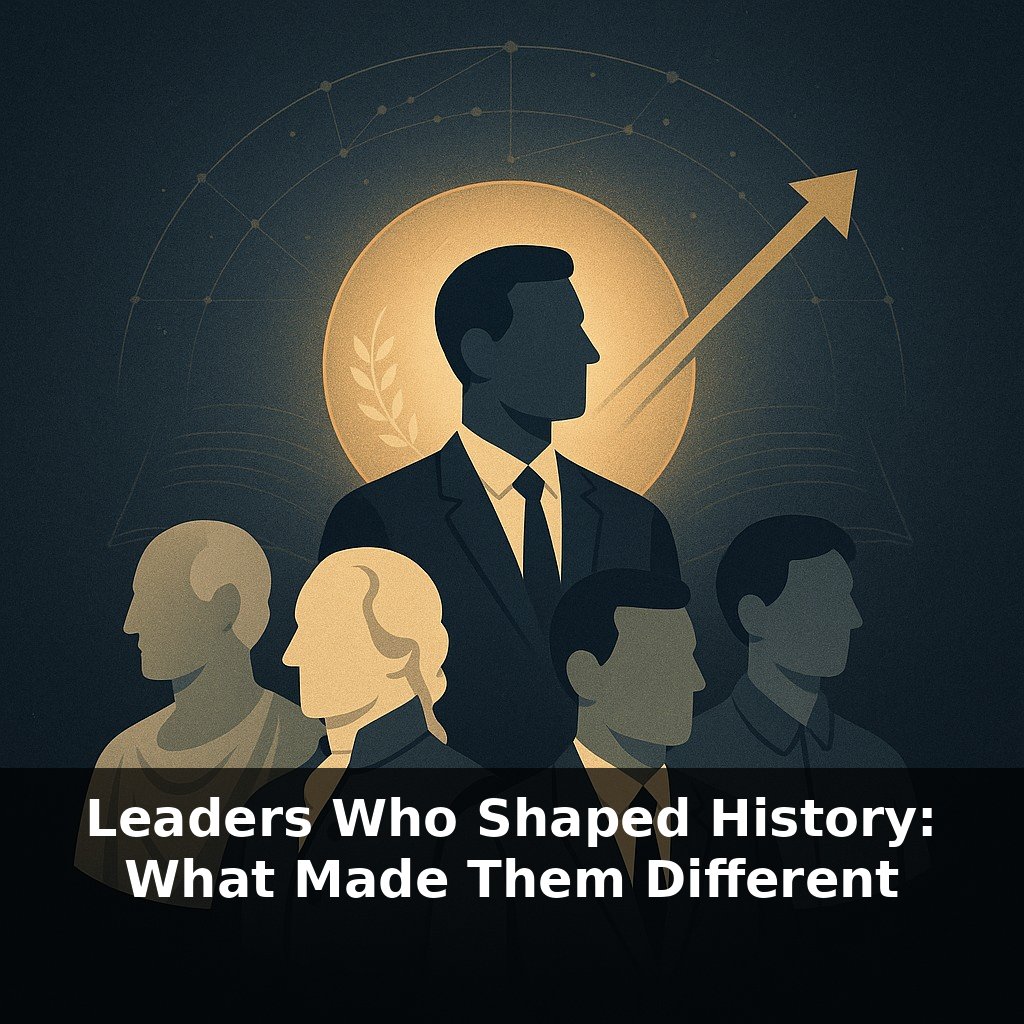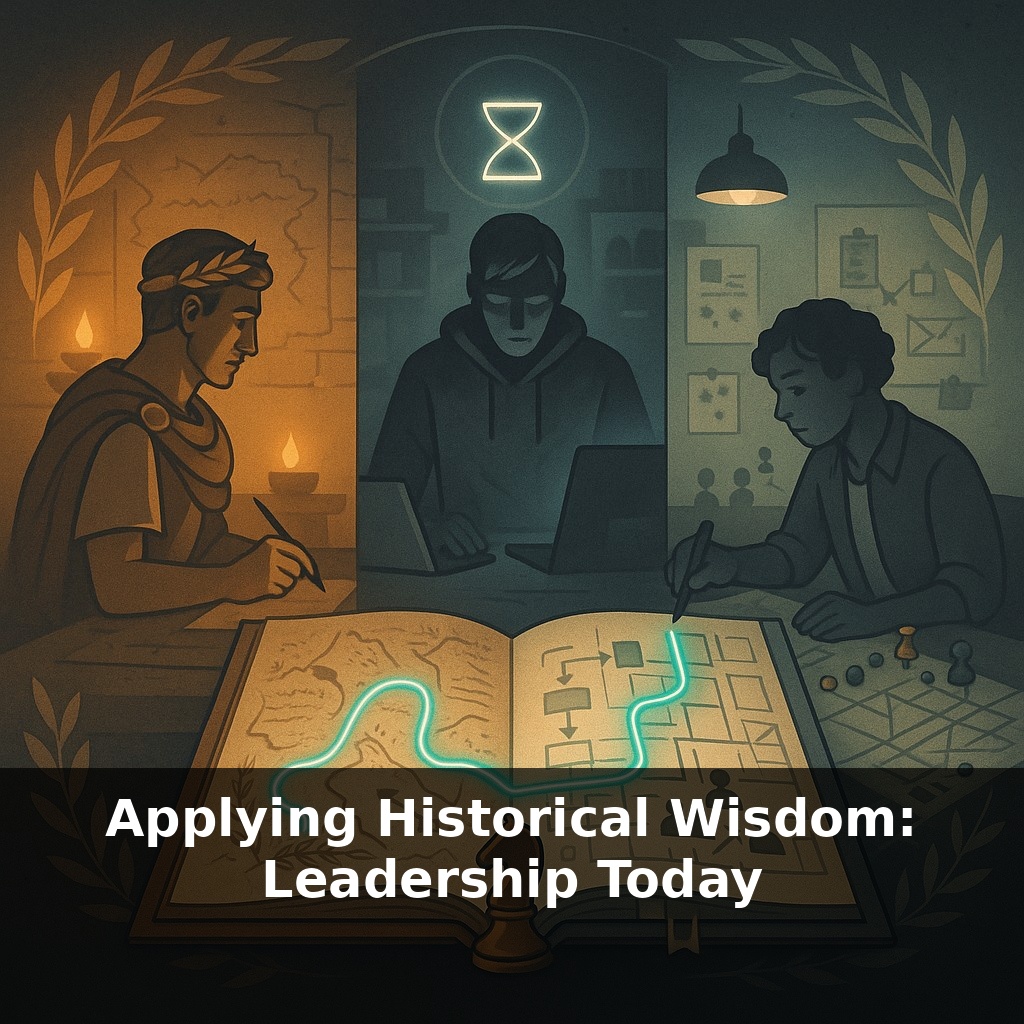
“Only about one in five employees strongly agree their leaders have a clear vision. Now jump to a war room, a startup garage, and a social movement meeting—three leaders, three crises. Each quietly reaching for the same playbook, written centuries before they were born.”
A Roman emperor journaling between battles. A tech CEO rewriting company values at 3 a.m. A community organiser redrawing protest routes on a napkin. Different worlds, same quiet discipline: turning chaos into choices.
In this episode, we’re not hunting for “great man” stories. We’re looking at how ordinary humans, under extraordinary pressure, used a handful of repeatable moves—clarifying what matters, reading the room, shifting tactics without losing their soul.
Think of it less as copying Lincoln or Sun Tzu, and more as borrowing their mental shortcuts. Like updating legacy software with a modern interface, we’ll explore how historical wisdom sits underneath agile sprints, inclusive town halls, and even your next difficult 1:1.
The goal isn’t nostalgia; it’s performance: better decisions, steadier teams, fewer self‑inflicted crises.
Leadership research backs up what history hints at: empathy isn’t “soft”—it’s a performance multiplier. Teams with empathetic leaders show up to 76% higher engagement, and companies like Microsoft don’t just stumble from $300B to over $2T by accident. Nadella didn’t copy Gandhi’s politics; he borrowed his lens on people and learning, then rewired a culture around it.
We’ll move through three arenas where this translation really matters today: - how you design strategy in uncertainty - how you build trust across difference - how you show up when everything breaks at once
Marcus Aurelius wrote nightly about staying steady under fire; today, leaders write OKRs and sprint goals. The medium changed, the underlying move didn’t: translate uncertainty into a few navigable commitments, then return to them when noise spikes.
Look at strategy first. Sun Tzu didn’t say “launch fast and pivot,” but he obsessed over shaping conditions before the battle. Modern version: product teams running small experiments that test assumptions before a big bet, or a nonprofit piloting a program in one city before scaling. The historical lesson isn’t “be sneaky”; it’s “win as early and as cheaply as you can—usually with information.” That’s why your most strategic act this quarter might be a brutally honest pre‑mortem: “If this fails, what will have killed it?”
Trust across difference has its own lineage. Lincoln’s “team of rivals” wasn’t a romantic gesture; it was risk management. By surrounding himself with opponents, he made blind spots argue with each other. Today, inclusive culture isn’t just about representation—it’s about intentionally engineering that same constructive friction. Think of how Pixar runs “Braintrust” sessions: directors invite peers to tear their stories apart, but keep authority to decide. The structure protects both candour and ownership.
Empathy, then, becomes less about being nice and more about reading constraints. Gandhi didn’t simply “care,” he understood what different groups feared and hoped for—and spoke to that mix. Nadella cites learning from this, then shifted Microsoft from “know‑it‑all” to “learn‑it‑all.” That’s not a slogan; it’s a hiring filter, a promotion criterion, a meeting norm (“What did we learn?” becoming as routine as “Did we ship?”).
Crises reveal whether these ideas are ornamental or operational. When COVID hit, some leaders defaulted to silence or spin. Others acted more like stoic generals: communicating frequently, admitting what they didn’t know, and setting short, renewable horizons—two weeks, 30 days, one quarter. History’s pattern is blunt: when fear is high, specificity and honesty beat grand promises every time.
A practical way to apply this is to treat historical figures like “guest mentors” in specific leadership moments. Stuck on a product decision with incomplete data? Borrow from explorers who sailed with rough maps: define your minimum safe test, send a small “ship,” and expand only if it returns with proof. Facing a tense cross‑functional conflict? Channel leaders who governed coalitions: start by mapping each group’s non‑negotiables and shared interests before you propose any fix.
In day‑to‑day management, you might use Lincoln‑style rival thinking by pairing two dissenting voices to co‑own a proposal, forcing synthesis instead of stalemate. Or, when a reorg is coming, you can take a page from postwar reconstruction: over‑invest early in clear roles, visible wins, and rituals that signal “the new normal,” so people have anchors while everything else shifts.
The key move is intentional translation: pick a historical pattern, name the modern constraint, then run a small, low‑risk experiment that connects the two.
Leaders who treat history as a lab, not a museum, will navigate AI turbulence faster. Expect boards to ask not just “What’s our strategy?” but “Whose playbook are we quietly running?” You might see leadership dashboards tracking ethical risks like a financial portfolio, balancing short‑term wins with “civic ROI.” Your challenge this week: in one tough decision, name a past leader who’d disagree with you—and write the best case for their view before you choose.
So the question isn’t “Who would Marcus or Lincoln hire?” but “What systems would they tweak tomorrow morning?” Maybe it’s re‑writing one stale meeting, or redesigning feedback like a chef tuning a recipe: small changes, tasted often. Keep treating biographies as prototypes, not monuments—and let your own leadership become one more experiment in that lineage.
Before next week, ask yourself: Where in my current role could I borrow Marcus Aurelius’s habit of “pausing before reacting” and experiment with a 10‑second silence before responding to criticism or bad news? Looking at one difficult relationship at work, how might Churchill’s blend of candor and encouragement change the next conversation you have—what exact sentence will you open with? If a historian wrote a chapter about how you handled this quarter at work, which decision would you be proud to see in print—and what specific choice can you make this week that would belong in that chapter?