
Why Mars? The scientific and historical reasons for the red planet
📝 Transcript
A rusty desert world, colder than Antarctica, might be the best second home our species has. Telescopes once turned Mars into a canvas for wild maps and canal myths; now silent robots trace dried riverbeds, hinting that this dead-looking planet once whispered with water.
Mars keeps pulling us back for reasons that go beyond its color in the night sky. Peel away the romance and you find a world that’s strangely familiar in its rhythms yet utterly alien in its conditions. Its day is just about as long as ours, its seasons tilt under a similar axial lean, and its polar caps grow and shrink, but the air is so thin you’d need a pressure shell just to take a walk.
When spacecraft first flew by in the 1960s, they didn’t find bustling canals, but they did glimpse something more profound: layered rocks, towering volcanoes, and canyons that dwarf anything on Earth. Each mission since has deepened a kind of scientific cliffhanger. Rovers grind into stones that formed in gentle lakes, orbiters map buried ice that could one day be tapped, and every new dataset sharpens a quiet, radical question: did life ever start here twice in one solar system?
But Mars isn’t just a scientific curiosity; it’s also a practical target. Its gravity is strong enough to keep you grounded but gentle enough to ease heavy engineering. The soil hides frozen water that could become air to breathe and fuel to burn, turning the planet into its own gas station. A trip there is long but not impossible with current rockets—months, not decades. And orbit after orbit, data keeps stacking up like tracks on a growing playlist, each mission adding a new clue about climate swings, buried ice, and chemical fingerprints that might point to ancient biology.
Mars matters because it is both scientifically strange and historically entangled with how we think about other worlds.
Scientifically, the planet offers something we can’t get from icy moons or distant exoplanets: direct access. We can land on the surface, drill into rocks, and fly tiny helicopters through the thin air. Seismometers on the InSight lander picked up marsquakes, revealing that the interior isn’t fully frozen—there’s still a warm, restless core driving slow geological change. Orbiters have mapped minerals that only form in specific environments, like clays that lock in records of long-vanished lakes, or sulfate deposits that point to evaporating seas. These are the kinds of rocks on Earth that geologists obsess over when they’re hunting for ancient microfossils.
There’s also the atmosphere, tenuous yet rich with clues. Trace gases like methane are being hunted with almost detective-level obsession. On Earth, most methane comes from biology, but volcanoes and chemical reactions can make it too. Spotting how Martian methane varies in space and time—if it truly does—could hint at processes we’ve never seen on a planet this small and cold. Combine that with buried ice, widespread dust, and global dust storms that can shroud the planet for months, and you get a climate experiment we can walk around inside, one that helps us sharpen models of Earth’s own climate shifts.
Historically, Mars has been a mirror for human hopes and fears. In the late 1800s and early 1900s, misread telescopic features were turned into straight-line “canals” by observers eager to find intelligence in the sky. That error fueled a wave of fiction—from H. G. Wells to Ray Bradbury—that embedded Mars in global culture as the archetypal “other world.” When the first close-up images revealed a cratered, silent landscape instead of cities, the disappointment helped push planetary science toward tougher, less romantic questions: not “Who lives there?” but “Could life ever have arisen there at all?”
Today, Mars threads those scientific and cultural strands into a tangible roadmap. NASA’s Perseverance rover is caching drilled cores for a future sample-return mission, ESA is preparing its Rosalind Franklin rover with a deep drill to search for preserved organics, China’s Zhurong has added a new vantage point from the northern lowlands, and SpaceX is testing heavy-lift rockets specifically with Martian landings in mind. Each of these efforts treats Mars not as a backdrop for stories but as a laboratory for testing how planets evolve, how fragile habitability is, and how far a technological civilization is willing to go to step beyond its home world.
A single core sample Perseverance is stashing could be as data-dense as a symphony score: each mineral grain a note, each chemical ratio a chord progression that tells you when the environment shifted key from neutral to acidic, from calm to violent. InSight’s marsquake catalog plays a different kind of music—low, slow rumbles that let scientists “hear” the thickness of the crust and the size of the core, constraints that feed straight into models of how rocky planets cool and crack over billions of years.
Look at history, and Mars acts like a recurring theme in human culture. The “canals” era nudged early radio experiments as people briefly considered beaming deliberate signals outward. The Viking landers, with their ambiguous life-detection results, hardened the standards for what counts as biological evidence everywhere else in the solar system. Even today, engineering teams stress-test entry, descent, and landing tech here precisely because the lessons—supersonic parachutes, retropropulsive landings, autonomous hazard avoidance—can be remixed for future worlds, from Titan’s haze to distant exoplanets.
Mars may also reshape how we organize ourselves. Treat it as a planetary-scale “startup incubator”: harsh constraints forcing lean engineering, circular economies, and ultra-resilient infrastructure that could loop back to Earth’s cities. As off-world crews learn to govern limited air, water, and energy, their charters and norms could become testbeds for post-national politics. The real experiment isn’t just survival on another world, but which ideas prove exportable across 225 million kilometers.
Your challenge this week: pick one Mars-driven technology—like ISRU propellant, radiation-hardened electronics, or bioregenerative life support—and trace its potential “return path” to your own life. How could it change how your city uses energy, handles waste, or builds housing? Sketch a concrete scenario and share it with someone who doesn’t follow space; use their questions to refine where the real terrestrial value might be.
Mars sits at the edge of our comfort zone—a place where robots already test-drive ideas our grandchildren might depend on. As we tune landers like instruments and treat each mission as a rehearsal, the red planet quietly shifts from distant backdrop to active collaborator, inviting us to learn, adapt, and eventually write a new chapter of “home.”
Before next week, ask yourself: “If I had a guaranteed ride to Mars orbit for one week, what *specific* question about Mars (its ancient oceans, possible microbial life, or climate history) would I be most obsessed with answering, and why does that matter to me personally?” “Looking at current Mars missions like Perseverance, Curiosity, or MAVEN, which instrument or experiment sparks my curiosity the most, and what’s one article, image set, or mission log I can explore today to really understand what it’s doing up there?” “Given what I now know about Mars’ history—its lost atmosphere, shifting climate, and potential habitability—how does that change the way I think about Earth’s future, and what’s one small choice I can make this week that reflects seeing Earth as a fragile, ‘only home we’ve got’ kind of planet?”
From this course
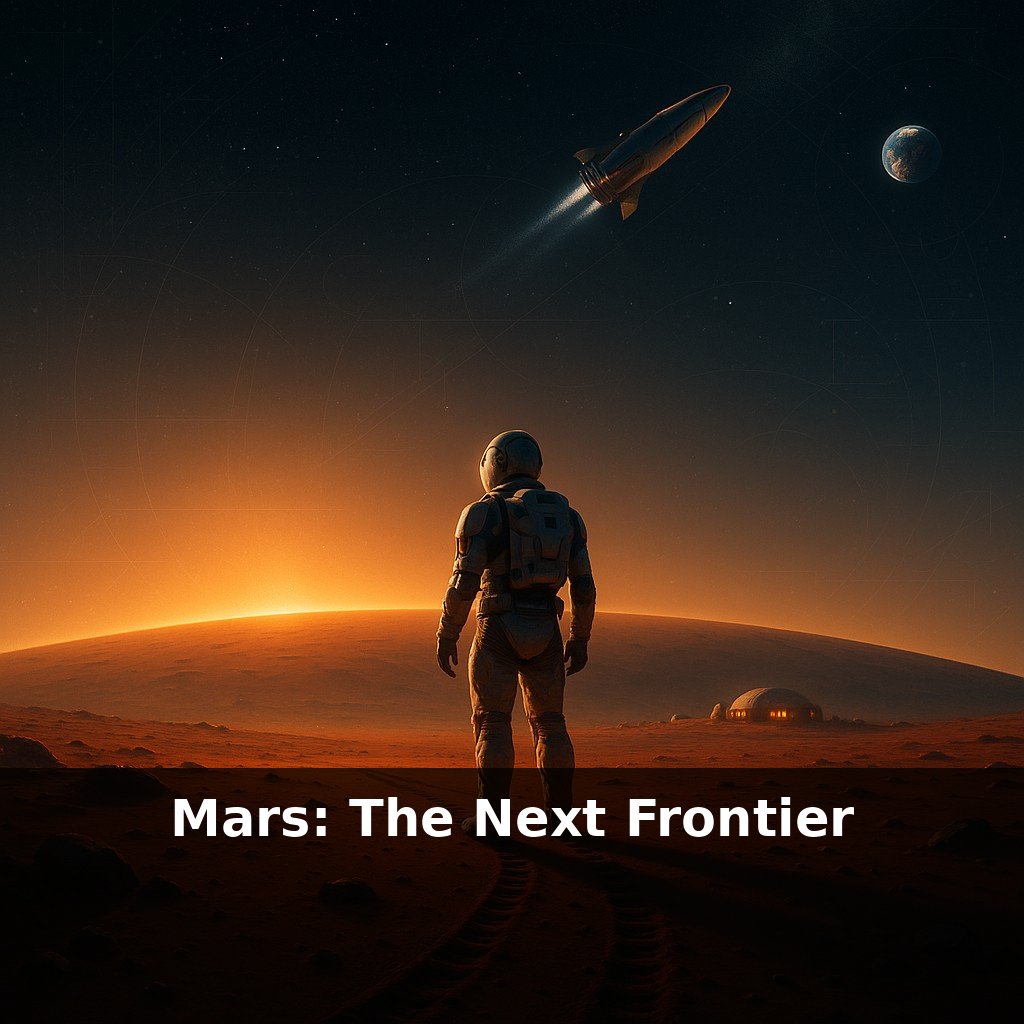
Mars: The Next Frontier
7 episodesUnlock all episodes
Full access to 7 episodes and everything on OwlUp.
Subscribe — $1.99/monthLess than a coffee ☕ · Cancel anytime

