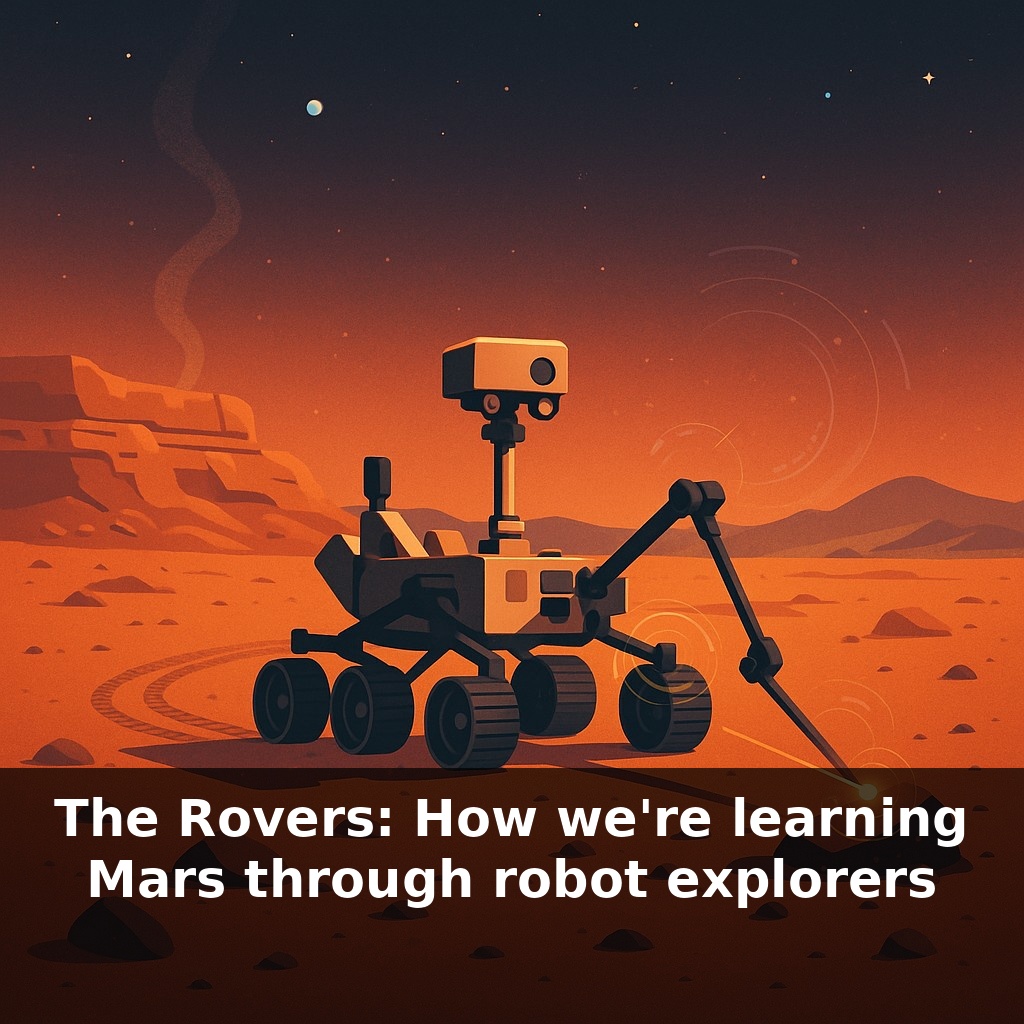
Right now, on a world you’ve never stood on, robots are drilling into ancient lakebeds and zapping rocks with lasers. They move, decide, and sample—mostly on their own—because any “turn left” command from Earth arrives long after the moment has passed.
Each rover carries a packed schedule, but Mars constantly edits the script. A dust devil crosses the path; a cliff wall exposes an unexpected stripe of minerals; winter shadows stretch longer than models predicted. The rover’s job isn’t just to follow orders—it's to notice these surprises and rank which ones are worth precious minutes of power, memory, and data. Think of a field photographer who must choose a single shot before the light fades: zoom in on that odd boulder, or pan wide to capture the landscape story? Curiosity and Perseverance do a version of this triage every Martian day, using onboard software to flag “interesting” textures and shapes long before scientists see the images. This quiet, systematic curiosity—encoded in lines of code—is how we’re slowly turning a distant desert into a readable history book, one prioritized snapshot at a time.
That quiet decision-making is layered on top of something even more demanding: just staying alive on Mars. The ground can swing from T‑shirt weather to Antarctic cold in a single day. Dust coats everything, thinning the sunlight that powers solar panels and sneaking into every crevice. Wheels sink into sand that looks solid but behaves like talcum powder. Electronics have to shrug off radiation that would wreck many Earthly circuits. Because every meter of travel and every drill hole risks damage, mission teams budget “wear and tear” like you might budget money on a long trip, always asking: is this detour worth the cost?
On top of that fight for survival, each rover also has to be a careful traveler and a patient chemist. Mars might look like open desert, but for a six‑wheeled lab the landscape is more like a city full of closed roads and fragile bridges. Sharp rocks can punch through aluminum wheels; fine sand can trap a rover for weeks. So instead of racing across the plains, missions plan cautious “hops” from safe patch to safe patch, sometimes spending several sols studying how the ground behaves before committing to a short drive.
This is why six missions have taken decades to rack up a distance you could drive on a weekend road trip. Most of the time isn’t spent rolling—it’s spent stopping to think, measure, and test. Above every movement sits a hierarchy of constraints: available power, memory, downlink bandwidth, mechanical risk, and, always, science value. A route that looks direct on a map might be rejected because it crosses slopes that could tip the rover just a few degrees too far, or because it would force the mast to stare into the Sun and risk blinding sensitive detectors.
Inside, the complexity grows. Curiosity and Perseverance carry instruments that turn rock powder into spectra, images into mineral maps, and gases into climate clues. Curiosity’s laser spectrometer, for instance, has pulsed hundreds of thousands of times at carefully chosen targets, turning pin‑sized craters into full chemical fingerprints. Perseverance raises the stakes by caching drilled cores in ultra‑clean tubes—treated almost like medical implants—because any future sample‑return mission must be certain that what comes back is Martian, not contamination from Earth.
All this has to work with a time delay that rules out “steer by sight.” Engineers on Earth sequence activities in bundles, then hand the rover freedom to react within guardrails. Over time, that autonomy has grown from simple obstacle avoidance to choosing which rock textures deserve a closer look. Each upgrade doesn’t just make driving safer; it changes the kind of questions we can ask, shifting Mars exploration from “what is there?” toward “how did it change, and could it ever have hosted life?”
Think of the way Mars rovers have changed over time as a bit like the evolution of a medical team. The early pathfinders were like paramedics: get there, stabilize the patient, send back vital signs—basic images and simple chemistry. Spirit and Opportunity stepped up to the role of general practitioners, staying for years in one “clinic,” comparing different terrains and spotting hints of long‑gone water in multiple neighborhoods. Curiosity arrived as a specialist, equipped to probe a single crater’s layered history in depth, ordering ever more complex “tests” on chosen targets. Perseverance adds the role of surgeon, removing carefully selected “tissue samples” and sealing them for a future procedure back on Earth. Meanwhile, Zhurong shows that another country can train its own team with different tools and techniques. Each mission doesn’t just add more data; it broadens the questions we dare to ask about climate cycles, buried ice, and even present‑day chemistry.
Future rovers may work in swarms, with small scouts racing ahead and sharing maps the way musicians trade motifs in a jazz ensemble, each improving the next solo. Their findings could steer where humans build habitats, grow food, and mine buried ice, turning “sites of interest” into future neighborhoods. As we refine these tools on Mars, we also sharpen methods for exploring icy moons, dark asteroids, and even hard‑to‑reach places here on Earth.
Each new rover is less a gadget and more a rehearsal for a distant landing party. Their maps, chemistry logs, and methane clues will sketch the first “safe routes” and “no‑go zones” for crews we haven’t launched yet. Your week‑long road trip has rest stops; Mars will, too—pre‑scouted oases of power, shelter, and science, pinned down by tire tracks no human has made.
To go deeper, here are 3 next steps: 1) Pull up NASA’s Mars 2020 Perseverance mission site and use the interactive rover model to click through each instrument (like SHERLOC and PIXL), then watch at least one raw-video clip from the Jezero Crater to see the terrain the episode described. 2) Open the web-based programming environment for NASA’s Open MCT or JPL’s Open Source Rover GitHub repo, and spend 30 minutes exploring how rover telemetry or rover-style robotics is actually structured in code and diagrams. 3) Grab a copy (or sample chapters) of “The Design and Engineering of Curiosity” by Emily Lakdawalla and, while you listen back to one rover segment from the episode, read the section on mobility or sampling hardware to connect what you heard with the real engineering tradeoffs.