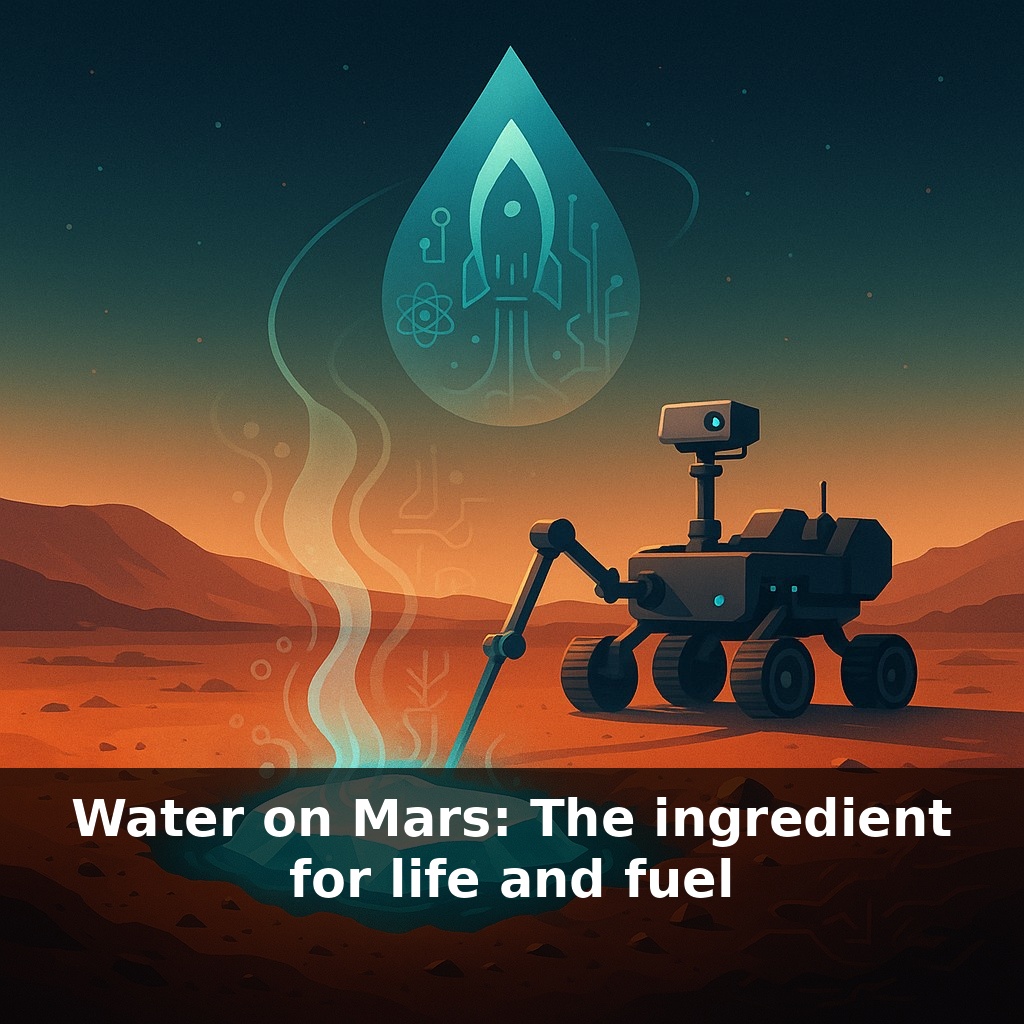
On Mars, water can start boiling while it’s still icy cold. A rover drills into the ground, chips of frost appear, and within seconds they vanish into thin air. Is this deadly problem, or the key to turning a frozen desert into a place humans can drink and even launch home?
On Earth, we treat water as background scenery—flowing from taps, hidden in pipes, pooled in oceans. On Mars, it becomes the main character. Not just because it hints at whether the planet once hosted microbes, but because almost every serious mission plan quietly depends on it. Future crews won’t ship all their water and fuel from Earth; the mass and cost are brutal. Instead, mission architects sketch bases near buried ice, sketch reactors that split water into oxygen for breathing and hydrogen for fuel, sketch drills that can reach frozen layers without losing everything to the thin air. Suddenly, “where is the ice?” isn’t a scientific curiosity; it’s a site-selection problem, an engineering problem, and a survival problem. In this episode, we’ll explore how that cold, reluctant Martian water could become the single most valuable resource in the solar system.
Orbital radars, neutron detectors, and landers have turned Mars into a kind of planetary treasure map, with “X” marks scattered across its poles and dusty mid‑latitudes. But not every cache is equally useful. Some ice hides under kilometers of frozen cap, others sit tantalizingly close to the surface yet mixed with rock, dust, and salts. Scientists now sift these layers the way geologists on Earth evaluate an ore body: How pure is it? How deep? How hard is it to extract without losing it to the air? Each answer reshapes where we’d dare build a base, how big it could be, and how often ships could depart.
On paper, Mars looks generous: estimates suggest enough frozen water to blanket the whole planet in a shallow global ocean. In practice, explorers care less about planetary totals and more about a simple question: “Can I dig here, in this spot, with this machine, and get what I need before I run out of power or patience?” That boils Martian water down to three linked puzzles: where it is, what form it’s in, and how fast you can turn it into something useful without watching it vanish.
The “where” is getting sharper. Radar sounders like SHARAD have revealed buried slabs tens to hundreds of meters thick in the mid‑latitudes, close to where engineers prefer to land—cool enough to preserve ice, but not so extreme that hardware or humans freeze. Add in ground‑ice detections from orbit and you get a shortlist of regions like Arcadia Planitia that keep surfacing in base‑location studies. These aren’t just blobs on a map; teams model how sunlight, seasons, and local terrain affect stability, trying to predict whether today’s promising deposit will still be there after years of operations.
Then comes the “what form.” Clean, nearly pure ice behaves very differently from ice that’s mixed with dust, salts, and rock fragments. Dirty ice might be mechanically stronger—easier to cut into blocks and stockpile—but chemically nastier for life support systems. Hydrated minerals hold water bound into their crystal structure; heating them releases vapor, but that costs energy and demands robust ovens instead of simple drills. The trade space starts to look less like a single “best” deposit and more like a menu: some options are close and low‑risk but resource‑poor; others are distant, rich, and technologically demanding.
Finally, “how fast” ties directly to mission architecture. ISRU studies routinely budget tens to hundreds of tons of propellant for a single return vehicle. That drives questions like: How many kilowatts of power must your base generate to melt, purify, and electrolyze enough water each Martian year? Do you build one big processing plant or a cluster of smaller, redundant units that can be serviced by robots during dust storms? NASA’s Mars Ice Mapper concept and commercial follow‑ons target exactly this: not just proving ice exists, but characterizing it well enough that a mission planner can plug numbers into a spreadsheet and commit to a launch window.
On Earth, companies already rehearse parts of this playbook in extreme places. Antarctic stations melt buried snow with heated loops and carefully track energy costs versus every liter produced. Lunar ISRU testbeds in deserts practice scooping, hauling, and processing simulant regolith, then logging how often hardware jams, clogs, or overheats. Mars planners watch these numbers the way a music producer studies sound levels—tuning power, throughput, and reliability until the whole system “mix” is stable.
The most aggressive concepts go further. Some studies propose robotic “water farms” dropped years ahead of crews: autonomous diggers carving trenches, conveyor belts feeding ice crushers, electrolysis units stockpiling oxygen and fuel into tanks long before the first human lands. Others explore mobile processors that crawl to fresh patches of ground ice as old ones deplete, leaving behind empty pits and full propellant depots. Each scenario turns frozen reserves into scheduled logistics: not just “Is there ice?” but “How many tons per month can we bank, with how much risk?”
Fuel depots, farms, and laboratories may all grow from the same icy roots. If robots can reliably “mine the frost line,” planners start treating Martian water like scheduled income, not a lucky strike. Policies will have to decide who’s allowed to tap which deposits and how to avoid contaminating any hidden habitats. Over decades, that could split Mars into zones: protected scientific “reserves,” industrial ice fields, and logistics hubs feeding deeper expeditions.
In the end, Martian water isn’t just a clue in the life hunt or a number in a propellant budget—it’s how we’ll learn to live off‑world without a constant lifeline from Earth. As we master drilling, melting, and splitting it, we’re also rehearsing for icy moons and deep‑space waypoints, treating each frozen deposit like a carefully tuned instrument in a growing interplanetary orchestra.
Try this experiment: Build a “Mars water factory in a jar.” Grab a clear glass jar, some red sand or soil (to mimic Martian regolith), a small rock “ice cap” made of a frozen cube of salty water, and a lamp as your “sun.” Pack the sand in the jar, place the ice cube on top, shine the lamp on it for 30–60 minutes, and watch how the meltwater trickles down, pools, and evaporates on the glass, just like transient brines and vapor cycles discussed for Mars. Then change one variable—saltier ice, weaker lamp, or cooler room—and see how it alters the amount and speed of “Mars water” movement.