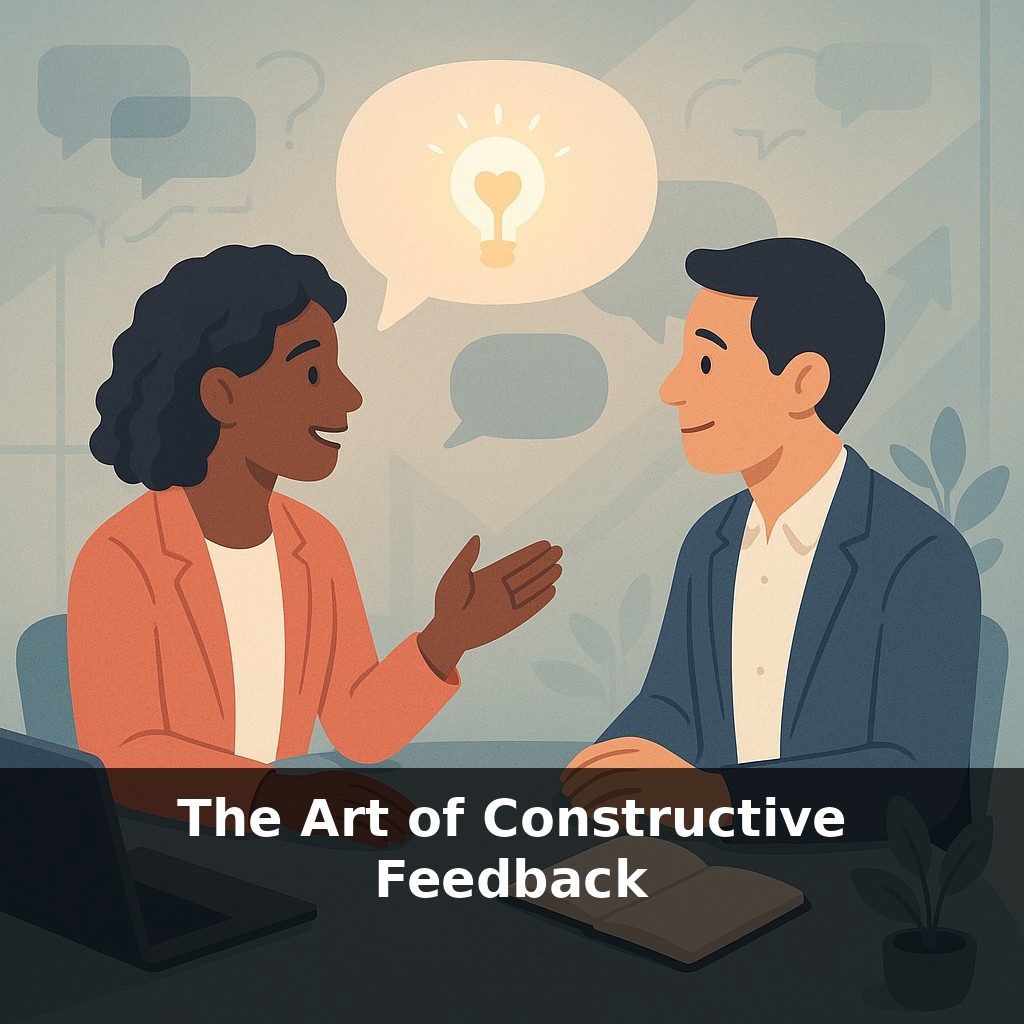
The Art of Constructive Feedback
📝 Transcript
Roughly two-thirds of employees say they want more feedback—yet most of us replay awkward conversations where we tried to “be honest” and watched the other person shut down. In this episode, we’ll explore why the way you give feedback matters more than how often you give it.
Most workplaces run on unspoken stories: “My manager doesn’t think I’m ready,” “My teammate doesn’t care,” “Leadership is out of touch.” What’s striking is how often those stories are born not from big conflicts, but from small, clumsy comments that land the wrong way. One offhand remark after a presentation, one rushed sentence in a 1:1, and suddenly trust drops a notch. Over time, those micro-moments compound into quiet disengagement or quiet resentment. This is where constructive feedback becomes less about “fixing performance” and more about editing the narrative between people—clarifying intent, shrinking guesswork, and replacing assumptions with shared reality. When you approach it that way, each conversation is less a verdict and more a design session for how you’ll work together next.
In most careers, your reputation isn’t shaped in performance reviews; it’s formed in the quick debrief after a client call, the Slack reply to a draft, the comment you leave in someone’s document at 11:37 p.m. These “micro-feedback” moments work like tiny design choices in a user interface: each one either makes future collaboration feel more intuitive, or slightly more confusing. Over weeks and months, people begin to predict how safe it is to take risks around you, how honest to be, how much effort to invest. That’s the real leverage of getting this skill right: it quietly rewires how work feels, long before it rewrites any metrics.
When researchers look at what makes feedback actually land, three elements show up again and again: what you focus on, when you say it, and how tightly it’s tied to a concrete next step.
First, the focus. Many conversations drift into labels: “You’re not proactive,” “You’re a natural presenter,” “You’re disorganized.” Labels feel efficient, but the brain treats them like identity statements, not data. That’s where defensiveness spikes. A more useful focus is the smallest observable unit of behavior: “You sent the client update three days after they asked for it,” or “You paused to ask two clarifying questions before proposing a solution.” You’re moving from judging the person to describing the tape of what happened.
Second, the timing. Annual reviews and long-delayed debriefs force people to reconstruct situations from fuzzy memory. By then, most of the emotional learning window has closed. The data from companies like Adobe isn’t just about frequency; it’s about proximity. The closer feedback is to the moment, the easier it is for the receiver to connect cause and effect: “When I did X, Y happened.” That connection is what allows the brain to update its internal model instead of filing the comment under “random opinion.”
Third, the link to the future. A lot of “feedback” stops at diagnosis: here’s what went wrong, here’s what bothered me. Useful conversations make an explicit bridge: “Next time, try…,” “For the next version, focus on…,” “Going forward, let’s agree that…” Think of it like refactoring code in a live system: you’re not just pointing out bugs; you’re proposing a cleaner pattern for the next release, while the context is still loaded in working memory.
This is also where positive feedback becomes more than generic praise. Saying, “Nice job on that report,” delivers a quick mood boost, but it doesn’t teach. Saying, “The way you summarized the risks in three bullet points made it easy for the client to decide,” signals exactly what to repeat. Over time, that specificity creates a personal library of “moves that work.”
Notice what’s missing in all of this: the need to be perfectly eloquent. The impact comes less from polished phrasing and more from disciplined attention to behaviors, timing, and next steps.
Think about the last time a colleague sent you a rushed email at 6:58 p.m. that created more questions than answers. A typical reaction is, “They’re so careless.” A constructive move is to zoom in on the sequence instead: *tight deadline, last-minute rush, missing context, confusion downstream*. When you walk back through that chain out loud—“When updates land with two minutes to spare, I end up guessing and we both scramble”—you’re not just reacting, you’re surfacing how small choices stack into outcomes neither of you actually want.
You can also flip this with strengths. Maybe a teammate consistently rescues chaotic meetings by asking, “What decision do we want by the end of this call?” Naming that pattern—“You keep us from spinning by pushing for a concrete decision”—turns an invisible contribution into a repeatable asset.
Over time, these pattern-spotting comments function less like verdicts and more like shared debugging sessions where you both get better at tracing how inputs lead to results.
Teams that practice this skill consistently start to behave more like learning systems than collections of individuals. Patterns don’t just “happen”; they’re noticed, discussed, and iterated. Over time, people begin to *request* this kind of input, because it feels like shared problem‑solving rather than judgment. That shift changes who speaks up, who experiments, and how quickly small insights spread—especially across remote and cross‑functional work where silent friction usually goes undetected.
Your challenge this week: treat feedback like a shared prototype. In your next three work conversations, pause once to say, “Here’s what I *think* I’m seeing—does that match your view?” Notice how often their version surprises you. Those tiny course-corrections are less courtroom, more whiteboard, and they slowly turn “my story vs. yours” into “our evolving draft.”
From this course
Mastering Feedback Delivery
5 episodesUnlock all episodes
Full access to 5 episodes and everything on OwlUp.
Subscribe — $1.99/monthLess than a coffee ☕ · Cancel anytime