“You’re not paid to keep people comfortable. You’re paid to keep them honest.”
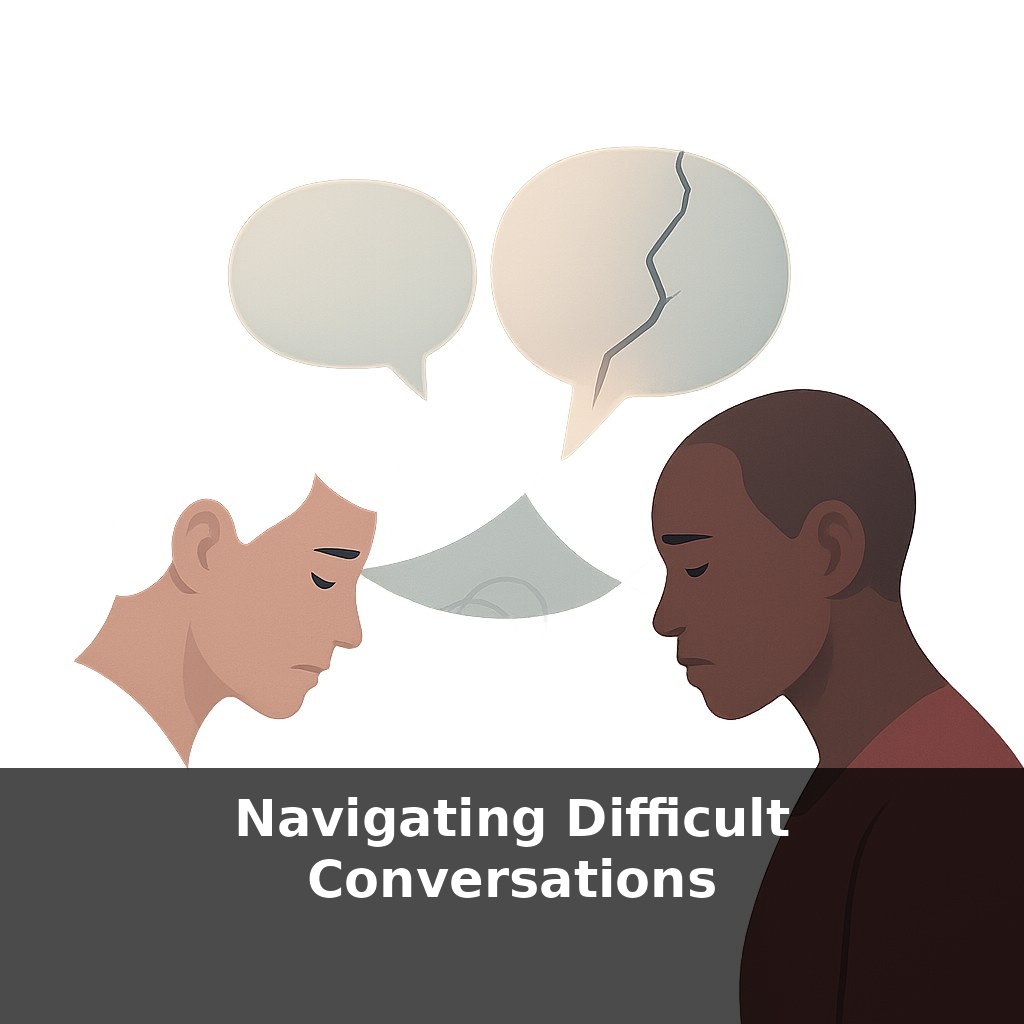
Now picture three moments: your boss shuts down after you speak, your partner goes quiet mid-argument, your teammate nods but never changes. Same problem, three settings: the conversation broke before the words did.
Here’s the twist: most “difficult” conversations become difficult long before anyone speaks. They’re shaped by unspoken stories: “If I’m honest, I’ll hurt them.” “If I admit this, I’ll look weak.” “If I push back, this relationship is over.” Those stories quietly set the rules, and you start editing yourself to stay safe instead of saying what’s true and useful.
Modern research on feedback and conflict says the real skill isn’t having the perfect script; it’s noticing and managing those stories in real time. The leaders who do this well don’t magically avoid tension—they navigate it without letting it turn into threat. They know when to pause, when to name the emotion in the room, and when to bring the focus back to shared goals instead of personal attacks.
That’s what this episode is about: learning to see, and then rewrite, those invisible rules before they hijack the conversation.
Most workplaces still treat tough conversations like fire alarms—loud, stressful, and only pulled in emergencies. Yet the data says the opposite of our reflex: structured, frequent feedback actually lowers defensiveness and raises trust. Tools like SBI or Non-Violent Communication look simple on paper, but under pressure your brain defaults to old habits: blaming, avoiding, sugarcoating. That’s why EQ matters so much here. It’s the buffer that lets you stay curious when someone bristles, and the discipline that keeps you specific when your instinct is to generalize or retreat. In other words, the method matters—but the mindset running it matters more.
Think about the last hard conversation you avoided. You probably didn’t skip it because the content was impossible; you skipped it because of how you *expected* it to feel. That gap—between what needs to be said and what you feel capable of saying—is where skill lives.
Three levers shift that gap: clarity, safety, and timing.
**1. Clarity: from vague discomfort to precise signal** Your brain hates ambiguity. When you go in with fuzzy intent (“I should say something about their attitude”), your nervous system reads “danger.” When you get precise (“I want to align on how we handle client pushback”), you give your brain a target. Clarity turns a looming confrontation into a solvable problem. Before you talk, write one sentence: *“After this conversation, I want us both to be clear on ______.”* That’s your anchor when emotions rise.
**2. Safety: lowering the perceived threat without diluting the truth** People rarely resist *information*; they resist feeling judged, cornered, or powerless. Leaders with strong EQ create conditions where honesty doesn’t equal humiliation. They do it by:
- Separating person from pattern: “You’re talented and committed. I’m concerned about a pattern around deadlines.” - Sharing impact, not verdicts: “When the report slips, I stay late and miss time with my kids.” - Offering agency: “Here are two paths I see. What might a third option be?”
Notice the shift: you’re not the prosecutor; you’re a partner in solving a specific problem.
**3. Timing: catching issues at “annoying” instead of “explosive”** Most conflicts arrive in your calendar as “emergencies” because they were ignored when they were just friction. The longer you wait, the more story-building happens on both sides, and the harder it is to stay grounded. High-performing teams normalize short, early course corrections. They don’t save everything for the annual review or the big blow-up.
Here’s where a simple tech analogy helps: think of these conversations like updating software. Frequent, small patches keep the system secure and stable; rare, massive updates are risky, stressful, and more likely to crash things. The communication models you’ve heard about are just ways of packaging those small patches so they’re easy to install.
Underneath all of this sits a choice: do you want comfort now, or trust later? Leaders who excel at “radical candor” consistently pick trust. They still feel the spike of dread before a hard talk—but they’ve practiced enough that the dread isn’t the driver anymore.
Think about three concrete situations:
- A senior engineer keeps interrupting juniors in sprint reviews. You don’t label it “disrespectful”; you pull up the last two meetings, note four interruptions, and ask, “In the next review, what would ‘hearing everyone out’ look like in practice?” You’re moving from opinion to observable patterns they can work with.
- A high performer turns cynical after a reorg. Instead of countering their negativity, you ask for a recent moment when they felt sidelined. You’re not fixing feelings; you’re surfacing data you can jointly design around—role clarity, decision rights, visibility.
- A peer in another department stonewalls your requests. Rather than escalating, you set a short sync with one goal: “Let’s map exactly where our processes collide.” You sketch the journey of a single customer request across both teams, then agree on one experiment to reduce friction next month.
Your challenge this week: pick one low-stakes tension and run a “micro-conversation” like these, within 48 hours of noticing it.
Trust will soon depend on how well humans and tools collaborate *in* the moment. As AI starts flagging loaded phrases and VR rehearsals become as normal as slide decks, your role shifts from “brave messenger” to “skilled editor” of your own reactions. Think of it like upgrading from driving stick to using advanced driver assist: you still steer, but sensors warn you before you drift. Leaders who practice now will treat these tools as amplifiers, not crutches, and their teams will feel the difference.
As you experiment, notice who you become in these moments: the critic, the fixer, or the collaborator. Each role shapes whether others brace or lean in. Over time, patterns emerge like footprints on a trail—showing where you default under pressure. Follow those tracks with curiosity, and your “hard talks” start to look more like shared design sessions.
Here’s your challenge this week: Choose one real conversation you’ve been avoiding (with your boss, partner, or friend) and schedule a specific time for it within the next 72 hours. Before the conversation, script exactly one “I” statement about how you feel and one clear request (for example, “I feel anxious when deadlines shift last-minute; can we agree on 24-hour notice for changes?”). During the conversation, commit to using the “curious first” rule: ask at least two genuine, open-ended questions before you respond with your own viewpoint. Afterward, rate the conversation from 1–10 on two things—how honest you were and how well you listened—and note one thing you’ll do differently next time.