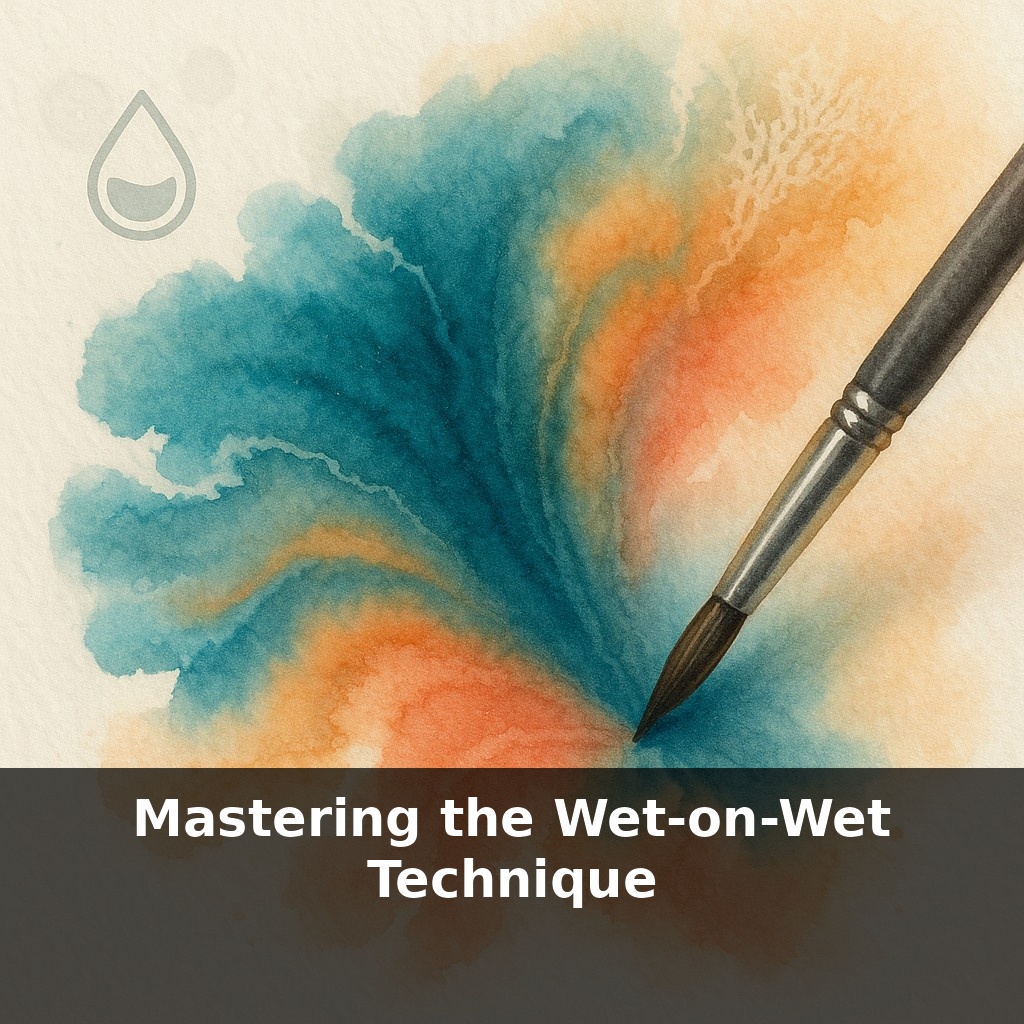
“Wet-on-wet is the closest thing watercolor has to jazz improvisation,” one illustrator told me. You prep the paper, touch the brush down, and suddenly the paint races away from you. In that brief window before it dries, are you steering the flow—or just watching it happen?
Forty to sixty percent. That’s the indoor humidity range where your wet-on-wet window can quietly *double*—without you changing a single brushstroke. Most painters obsess over color palettes and brushes, yet ignore the single biggest collaborator in this technique: time.
In this episode, we’re going to treat wet-on-wet less like a mysterious “flow state” and more like a system you can actually tune. Paper, air, and pigment are all running on their own clocks. Your job is to sync them.
Think of your surface like a well-timed sports play: the pass, the sprint, the catch all have to land in the same fleeting moment, or the move falls apart. In wet-on-wet, that moment is the narrow band between “too wet to control” and “too dry to move.”
We’ll explore how to recognize that sweet spot on sight, how to stretch it, and how to use it deliberately instead of chasing it in panic.
Most artists first meet wet-on-wet in a chaos phase: puddles, blooms, and “why did it do *that*?” moments. The turning point is when you stop reacting to accidents and start reading the surface like a live dashboard. Every part of the sheet is at a slightly different setting—some zones glossy, some satin, some already tightening. At the same time, your brush isn’t neutral; it’s either adding water, matching what’s there, or quietly stealing it. That mix of paper state and brush state is where control really lives, and where subtle choices matter more than dramatic moves.
The first variable to train your eye on is *paper moisture*, but do it in sections, not as an abstract idea. Break your sheet into three zones and give each its own job.
Zone A stays very glossy. Load a large, soft brush with clear water and flood that area until you see full mirror-like shine and soft pooling at the edges. This is your “drift” zone. Drop in mid-strength color and simply watch: pigments with heavier bodies will crawl more slowly, and staining colors will shoot ahead. Don’t correct; just notice which hues outrun the others and how far they travel before they stall.
Zone B is your “control” zone. Blot your brush once on a towel, then wet this section so it looks shiny but not mirror-like—no standing beads, just an even sheen. When you touch in color here, aim for specific shapes: a soft-edged oval, a gentle diagonal band, a cloud that stays where you put it. If the color explodes outward, your brush carried too much water. If it digs a hard trench, your paper was already edging toward dry.
Zone C is the negotiator between the two. Tilt your board slightly so a bit of water from A slowly creeps toward C. Now wet C with a drier brush, so it lands in a satin, almost matte sheen. As the shine dulls, start painting forms that *just* hold: tree silhouettes, distant hills, abstract blocks. This is where many artists quietly place their most convincing soft-focus details.
Now bring in the second variable: *brush moisture*. With the same pigment mix, try three passes in each zone—one with a dripping brush, one with a well-loaded but non-dripping brush, and one with a brush you’ve kissed twice on a towel. You’ll see quickly that you’re not just painting *on* water; you’re constantly reprogramming the surface with every touch.
The third variable, *pigment strength*, finishes the triangle. Mix a tea, milk, and cream version of one color. On identical sheens, lay the tea first, then charge milk into it, then a narrow stroke of cream. Where they meet, you’ll see that thickness can carve edges even on quite wet paper, letting you nudge form into what would otherwise be pure atmosphere.
Think of each stroke like a software update to your surface: every tap, drag, or lift silently patches the “behavior” of the wet area. A heavily loaded brush doesn’t just add color—it pushes the existing film outward, creating currents that can redirect earlier washes. A nearly dry brush, skimming lightly, can act like a precision eraser, pulling out soft highlights without announcing a hard correction.
To explore this, run a series of “micro-interventions.” Lay a pale wash, then intervene with only one variable at a time: a slightly wetter brush, a denser mix, or a thirsty brush touch. Watch how each adjustment rewrites the way later marks spread or stall.
Your edge quality becomes a record of these small negotiations. Fuzzy tree lines in the distance? They often come from painting *just* after the shine fades. Sharper but still gentle forms—like reflections—emerge when you nudge thicker paint into an already-settling area, letting density, not linework, do the describing.
Studios are quietly turning into labs: some artists test hydrogel-sized papers that slow evaporation so much that a single wash can last an entire study session. Others clip sensors to boards, logging temperature and drafts the way athletes track heart data. As AI apps begin overlaying live “moisture maps” on your phone, the act of judging shine and dampness starts to look like co‑piloting: you read the paper’s cues while the tool flags thresholds you’d normally miss.
Over time, you’ll start to feel tiny shifts—a brush that suddenly glides less, a shine that dulls faster under a desk lamp than near a window. Treat each session like tuning an instrument: adjust water, angle, and pace until the response “sounds” right. Your challenge this week: chart one page a day of controlled blooms, then alter only one variable each sheet.