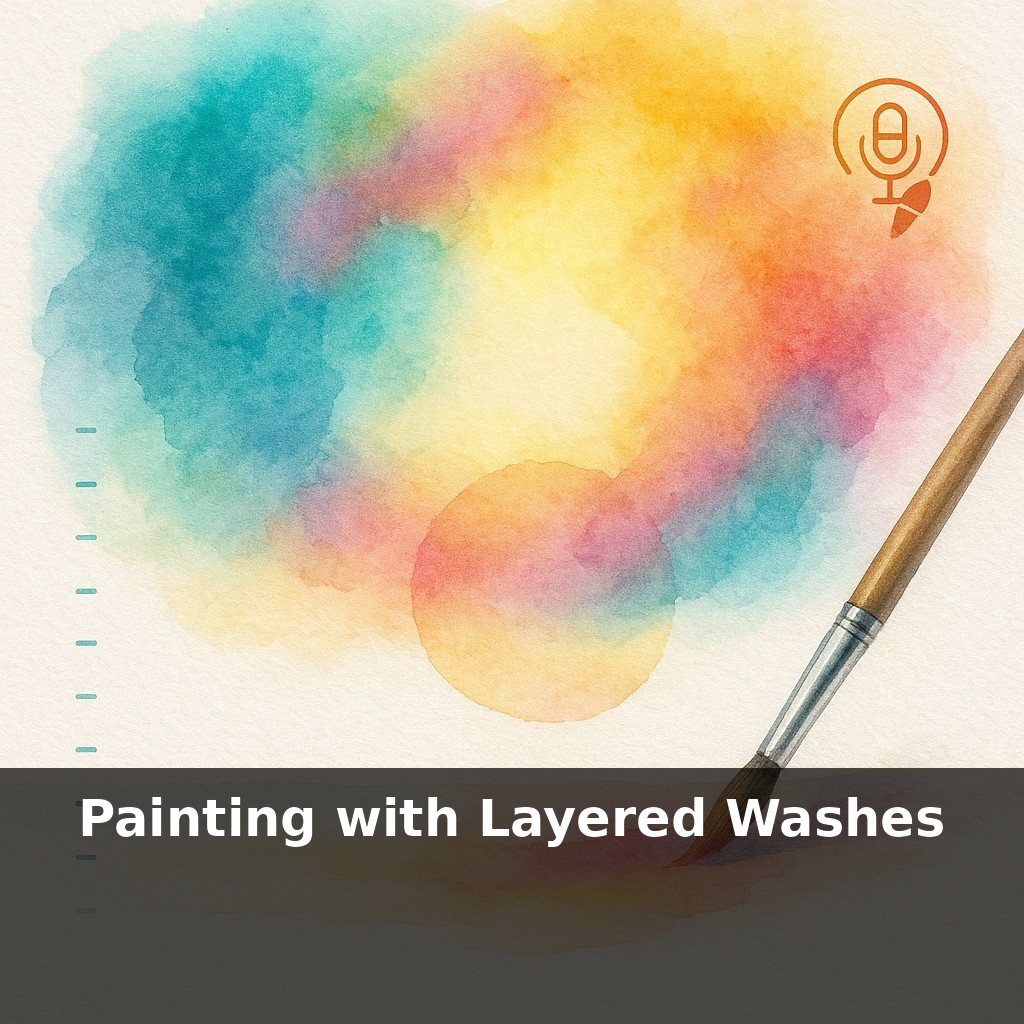
A single watercolor wash can look flat and lifeless—yet artists like Turner stacked dozens of transparent layers and ended up with skies that seem to glow from within. Today, we’ll step right into that moment when your first wash dries… and decide what happens next.
A single fact changes how you see that pale first layer on your paper: each new transparent pass only steals about 3–7% of its brightness. That means most of the glow you loved in the first pass is still there after the second, third, even fifth layer—you’re not “covering up” light, you’re shaping it.
So now the question isn’t “Will I ruin this?” but “How far can I push it?”
This is where timing, water control, and pigment strength stop being abstract tips and start feeling like dials on a console. Nudge the timing and you soften an edge; shift the dilution and the whole mood changes from misty dawn to electric storm. Instead of chasing a perfect wash in one go, you’ll learn to think in stages: setting the overall atmosphere, then gradually dialing in depth, contrast, and subtle color shifts until the surface begins to hum.
Now we’ll zoom in on what actually happens between those passes. That pale first layer isn’t just a background; it’s a test strip that tells you how your specific paper, brush, and pigment behave together today. On one sheet, ultramarine might sink and blur softly; on another, it might granulate into a speckled sky. The same mix can dry faster under a warm desk lamp than in a cool studio corner. Treat each layer as feedback: edges, blooms, and subtle streaks are clues you can read, then answer with your next decision—do you shift hue, reinforce a value, or simply let a passage stay quiet and untouched?
Forget chasing a perfect second layer. Instead, think in passes with specific jobs.
Start with intent: before you touch the page again, name the role of this next wash in one clear phrase—“soften distance,” “intensify focal area,” or “shift everything warmer.” That single choice will decide where you load your brush, how wet the paper should be, and how far you carry the stroke.
For a “unifying” pass, mix a very dilute, slightly warmer or cooler version of your existing color and float it across large areas, skipping highlights and anything you want to keep crisp. This doesn’t scream “new color”; it whispers over edges so shapes belong to the same world. Watch how midtones gently tuck under this veil while your lightest lights stay almost untouched.
For “sculpting” passes, narrow your target. Turn the sheet so gravity works for you, then lay strokes that deepen only the planes turning away from the light. Instead of outlining forms, think in bands: one band for the top of a cloud, another for its underside, another for the cast shadow it throws. Let those bands slightly overlap so you don’t get striping.
Edges now become your main tool. On still-damp zones, you can lay in a darker mix at the top of a shape and tilt the board so it melts downward; on bone-dry areas, you’ll need to pre-wet just the path you want that new color to travel. If you see a harsh line forming where you don’t want one, pause and decide: either soften immediately with a clean, damp brush, or deliberately echo that edge elsewhere so it feels intentional.
Color relationships also evolve layer by layer. You can steer a dull blue toward turquoise with a whisper of transparent green, or let a neutral sky glow by glazing a cool, sheer violet into the upper corners only. Rather than correcting “wrong” hues, treat each pass as an adjustment to the overall temperature map: cooler where you want airiness, warmer where you want weight.
Like refactoring a piece of code, every new pass should improve clarity somewhere—if it doesn’t have a clear job, it probably isn’t needed.
A simple way to feel this is to treat a small postcard as your “lab.” Divide it into three vertical bands. In the first, build a sky with only one hue—say, ultramarine—adding a new pass each time the last one dries. In the second, do the same but quietly shift the hue each layer: a touch of phthalo blue in the top third next round, a hint of rose near the horizon after that. In the third, keep value changes subtle but swing temperature—slightly cooler layers high up, warmer nearer the ground. At the end, compare: same basic subject, three very different moods.
Or zoom even smaller: paint five overlapping circles, all starting from the same pale base. On circle one, every new pass darkens just the bottom edge; on two, deepen only the side opposite an imagined light source; on three, reinforce the center; on four, push color, not value; on five, glaze a contrasting hue over half the shape. You’ll see how tiny, specific decisions per layer redesign form and drama.
Layer planning will only grow more strategic. Think of sketching not just thumbnails, but “layer maps” that plot when and where each pass lands, like a music producer planning tracks before recording. As AR tools mature, you’ll be able to preview those maps hovering over your page, then follow them in real paint, adjusting on the fly. Meanwhile, conservation research will quietly update our habits—subtle shifts in pigment choice or drying intervals that future‑proof today’s experiments.
In time, you’ll read your paintings like weather maps: subtle fronts of moisture, pressure, and color drifting across the surface. Instead of fearing “too many layers,” you’ll notice where a calm zone needs a gust of drama or a stormy corner needs clearing. Your challenge this week: paint one piece where you deliberately stop *one* layer earlier than you want.