Right now, many of us spend more time worrying about dinner than actually cooking it. You're standing in front of the fridge, tired, scrolling delivery apps, knowing you’ll regret the cost and the grease—but ordering anyway. Why does a simple meal feel like such a mental marathon?
Here’s the twist: the real problem usually isn’t recipes, cooking skills, or even time. It’s that most of us are running our kitchen like a pop‑up shop that has to be reinvented from scratch every single night. New ideas, new decisions, new scramble. No wonder dinner feels heavy.
What actually works—according to behavior research—is treating your eating like a system, not a series of one-off events. That means fewer “What should I make?” moments and more “This is just what happens on Mondays” autopilot.
In this episode, we’re going to zoom out from individual meals and zoom in on the patterns behind them: how food moves through your week, where your energy reliably crashes, and how a few small, front-loaded moves can quietly run the show later. Instead of hunting for motivation at 6 p.m., you’ll be learning how to build rails that guide you toward better choices with almost no extra willpower.
Think about what actually clogs your brain each day: it’s rarely the chopping or stirring, it’s the dozens of tiny forks in the road before you ever touch a pan. Scroll the recipes? Check the fridge? Ask everyone what they “feel like”? Research shows those micro‑decisions add up to more than an hour of food thinking—on top of the 37 minutes we spend cooking. In this episode, we’re going to treat your meals less like one‑off events and more like a simple weekly schedule, the way a commute follows the same route even when traffic changes.
Most people try to “get better at cooking.” Behavior scientists would say the smarter move is to get better at *designing defaults*.
Right now, your default might be: walk in the door, open the fridge, negotiate with your future self. A meal prep mindset flips this. You decide once, in a calm moment, how food will flow through the next few days—and then you mostly just follow the script you already wrote.
The research term for this is implementation intentions: “If it’s Sunday afternoon, then I batch‑cook X and Y.” “If it’s a weekday lunch, then I grab something from this shelf.” These tiny pre‑decisions matter because your brain loves patterns. When the cue is clear and the action is simple, repetition does the heavy lifting until it starts to feel weird *not* to prep.
That’s where batching comes in. Instead of scattering food tasks randomly—washing herbs here, cooking rice there—you cluster similar actions. All the chopping together. All the roasting together. All the grain‑cooking together. You’re not just saving minutes; you’re teaching your brain, “This is the block of time when we set up the week.”
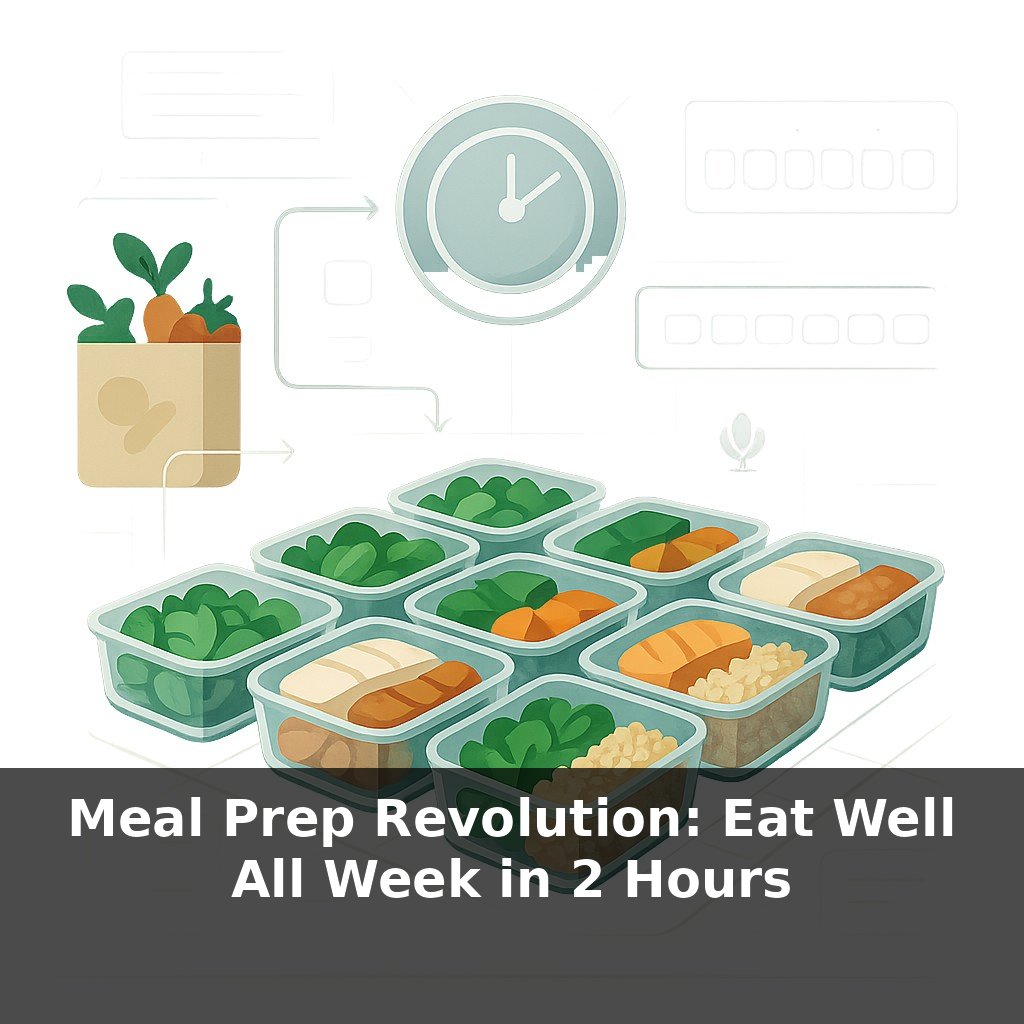
A basic structure might look like this: - One grain: a pot of quinoa, rice, or farro. - One or two proteins: tofu, lentils, chicken, or eggs. - Two pans of vegetables: maybe a tray of roasted roots and a sheet of broccoli or peppers. - Two flavor “engines”: a sauce and a seasoning mix that can swing dishes in different directions.
From there, the game is assembly, not invention: grain + protein + veg + one flavor. Taco‑ish on Monday, Mediterranean‑ish on Tuesday, bowl‑ish on Wednesday—different plate, same backbone. You’re building a small “inventory” that your tired self can combine in seconds.
Environmental cues quietly support this. A specific shelf becomes the “ready‑to‑eat” zone. Pre‑cut veg live in clear containers at eye level. Your rice cooker or Instant Pot stays on the counter instead of buried in a cabinet. Each of these is a silent nudge that makes the prepared option the *easiest* option.
Over time, that’s the mindset shift: away from heroic 6 p.m. decisions, toward a simple, repeatable food system you set in motion once, then mostly just keep on the rails.
Think of this like designing a tiny “food infrastructure” rather than chasing perfect recipes. A busy accountant I worked with picked three moves that repeat every week: Wednesday night, she cooks a tray of chicken thighs *while* answering emails; Saturday, she runs the dishwasher and resets containers; Sunday, she cooks one grain and one veg while calling her mom. No elaborate menu—just recurring blocks that quietly support everything else.
Another client, a teacher, uses her commute as an environmental cue. As she pulls into her street, she calls her own “reset hotline”: a 30‑second voice memo where she states what’s already prepped and chooses one combo for dinner. By the time she reaches the driveway, the decision is done.
Families often overestimate variety. One household rotated three base “builds”: tacos, bowls, and pasta. The twist came from toppings and sauces, not whole new meals—enough novelty to stay interesting, stable enough to feel effortless.
In a few years, your “meal prep system” might sync with tools you barely notice. A smart fridge could thaw tofu because it sees your calendar blocking a prep window. Wearables might flag, “You sleep better after carb‑heavy lunches,” then nudge your batch‑cooking toward grains. Shared prep spaces may work like coworking kitchens: you book a two‑hour slot, batch with commercial ovens, leave with a week of meals and a smaller carbon tab.
Your challenge this week: treat your kitchen like a tiny lab. Once, just once, time how long it takes from “I’m hungry” to “I’m eating” on a non‑prepped day. Then, on a different day, set a 45‑minute timer and batch‑cook *only* three things: one grain, one protein, one veg. Across the next three meals, measure the gap from hunger to plate again. By Sunday, decide: what’s the smallest repeatable prep block that clearly changes that number?
You’re not aiming for perfection; you’re training a habit loop. Each small win—opening the fridge to find lunch half-done, gliding past delivery apps—reinforces the pattern. Over time, the question shifts from “Can I keep this up?” to “Why would I go back?” Like automatic bill‑pay for your body, the system hums quietly while you live the rest of your life.
Before next week, ask yourself: 1) “Looking at my usual week, which *two* specific moments (like after work on Tuesday or Sunday afternoon) could I reliably turn into ‘non-negotiable’ meal prep time, and what would I need to change or say no to so that time is truly protected?” 2) “If I picked just *one* go-to breakfast, lunch, and dinner from the episode’s examples (like overnight oats, sheet-pan chicken and veggies, or quinoa bowls), which ones fit my real schedule, and what exact ingredients could I buy today so they’re ready to go?” 3) “When I usually abandon meal prep, what actually happens in that moment—am I too tired, bored with the food, or missing tools—and what’s one super-specific tweak I can make this week (like chopping veggies while watching TV, using pre-cut produce, or doubling a favorite recipe) to make that moment easier instead of a stopping point?”