The Information Crisis: Why Critical Thinking Matters Now
📝 Transcript
About one in four Americans can reliably spot a fake headline. Now, think about your last scroll through the news: bold claims, confident voices, polished videos. Some true, some twisted. In a world this loud, the real question is: who, or what, is actually doing your thinking?
A 2020 study estimated that the average person now takes in around 34 gigabytes of information a day. That’s more than most of us will consciously remember in a year. But here’s the uncomfortable part: volume isn’t the real problem—sorting is. Your brain is constantly forced to make snap decisions about what to trust, what to ignore, and what to share, often in seconds and usually on autopilot.
This is where critical thinking stops being a school buzzword and becomes survival gear. It’s the skill that lets you pause before forwarding that alarming post, question why a story feels “obvious,” or notice when a confident voice is light on evidence.
In this episode, we’ll unpack how today’s information systems quietly shape what you see—and how you can start taking back control of your own judgment, one small decision at a time.
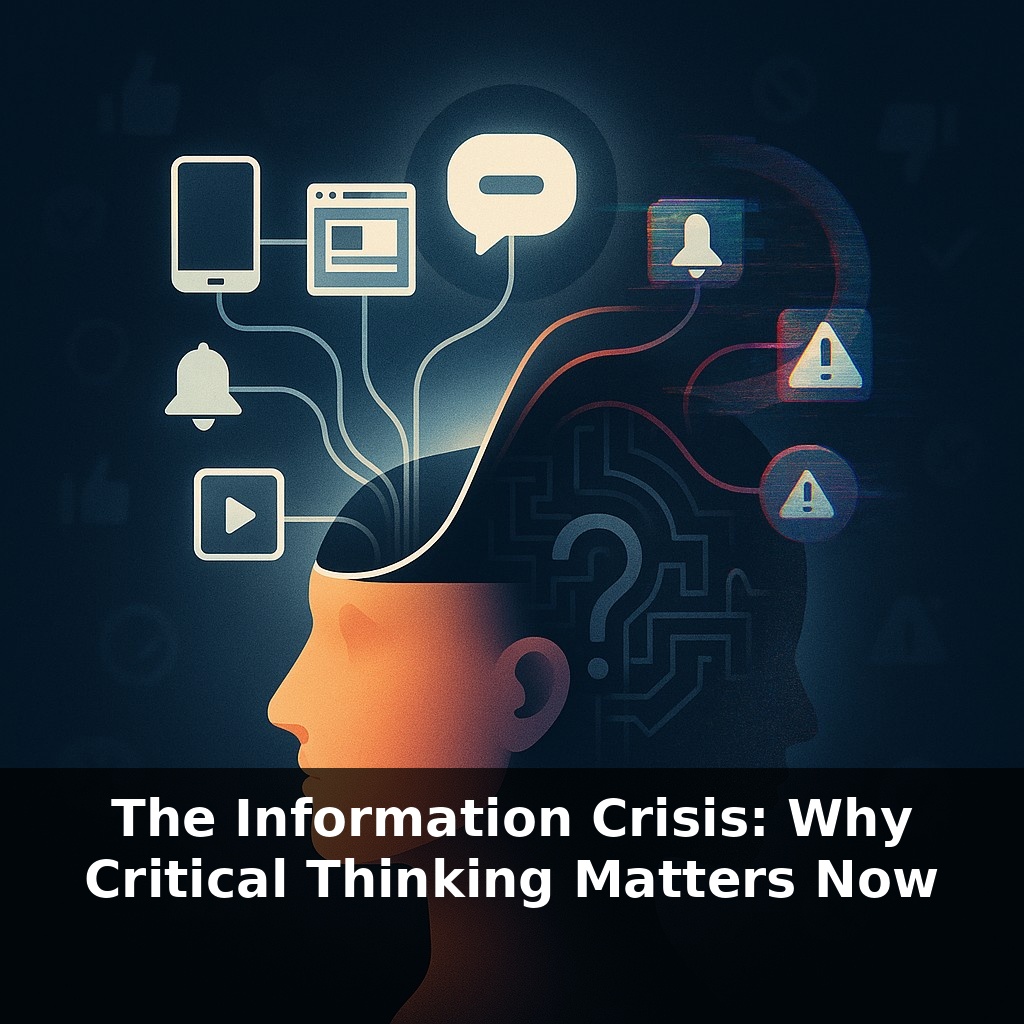
Open your phone and you’re not just seeing “what’s out there”—you’re seeing what powerful filters have decided is worth your attention. Recommendation engines, trending tabs, and engagement metrics silently organize your world, nudging some stories forward and burying others. It’s less like browsing a library and more like being handed a preselected menu, tailored to what keeps you looking. Add in polished misinformation, bots that mimic real users, and AI-generated content that feels convincing, and the line between signal and noise blurs in ways that are hard to detect on the fly.
Only 26% of Americans could correctly identify a false headline in a recent survey—and these weren’t wild conspiracy posts, but plausible, well-written snippets. That tells us the problem isn’t just “dumb people falling for obvious fakes.” The real issue is that modern information is engineered to feel right before we’ve had a chance to think.
A lot of what steers your reactions happens under the surface. Three forces matter here:
First, emotion. Content that makes you angry, afraid, or triumphant doesn’t just grab attention—it shortcuts analysis. When you feel something strongly, your brain tends to ask, “Who’s with me?” instead of, “Is this true?” Disinformation campaigns lean hard on this: moral outrage, identity threats, humiliation of “the other side.”
Second, repetition. Your mind uses familiarity as a trust signal. See a claim enough times—from headlines, memes, influencers, chats—and it starts to feel like common sense, even if you never saw solid evidence. Researchers call this the “illusory truth effect”: repetition doesn’t just remind you; it reshapes your sense of what’s plausible.
Third, identity. We’re social animals. If a story lines up with your group—political tribe, profession, fandom—you’re more likely to treat it as “obviously true” and interrogate anything that conflicts with it. This is motivated reasoning: your brain works harder to defend what fits your team than to evaluate what best fits the facts.
These forces don’t vanish with intelligence or education. Highly educated people can be even better at rationalizing what they already want to believe. More data doesn’t automatically fix this; past a point, extra links, charts, and threads just give you more material to cherry-pick.
That’s why fact-checking, while essential, isn’t a full cure. By the time a correction appears, the first version has already lodged in memory and social networks. Experiments show that even when people accept a correction, traces of the original claim still influence their later judgments.
So the practical question shifts from “Is this true?” to “How is this trying to move me—emotionally, socially, and quickly—before I can think?” The moment you notice that push, you’ve created a tiny gap where deliberate analysis can slip back in.
Your challenge this week: pick one online space you use a lot—TikTok, YouTube, Instagram, Reddit, X, anywhere. For seven days, don’t change what you read or watch; instead, change how you watch yourself.
Every time a post makes you feel a strong jolt—anger, fear, pride, disgust, or instant agreement—pause for just 10 seconds and ask three questions:
1. What emotion is this aiming for? 2. Who benefits if I react quickly to this? 3. What’s one piece of evidence I *haven’t* seen yet?
You don’t need to answer perfectly. The experiment is simply to notice how often your strongest reactions arrive *before* your clearest thinking—and how different your choices look when you wait those 10 seconds.
Open a cooking app and search “chicken.” You don’t get every recipe; you get a curated shortlist: “30-minute,” “viral,” “one-pan.” The list feels neutral, but it’s quietly shaping what you think chicken *is for*—fast dinners, meal prep, high protein. Online information works similarly: not just telling you what’s “true,” but narrowing the set of options you even consider.
Concrete example: during breaking events, platforms often push short, emotional clips from accounts that post constantly. Slower, methodical explainers exist, but they arrive late and low in the feed. Over a few hours, your sense of “what happened” is built from fragments optimized for speed, not completeness.
Or take comment sections: a few early, confident replies can steer the whole tone of a discussion. Later readers don’t just absorb the original post; they absorb “what people like me seem to think about this,” then adjust their own view to match.
In a few years, you may routinely “scan” information like an airport checks luggage—quick filters for origin, tampering, and hidden payloads. Labels showing when, where, and how content was created could matter as much as the message itself, especially as AI output blends seamlessly with human voices. Societies that normalize asking, “How do we know this?” before “Whose side is this on?” will likely navigate conflicts with fewer panics, slower mobs, and more reversible mistakes.
Treat today’s feeds like a shared kitchen: you’re not just eating what’s handed to you, you’re helping set the menu for everyone else. Each post you like, share, or ignore quietly votes for what becomes “normal.” Staying curious—asking one more how or why—turns you from passive consumer into careful co‑cook of our shared reality.
Before next week, ask yourself: 1) “The next time I feel a spike of outrage from a headline or clip, what’s the *second* source I’ll intentionally check before reacting or sharing—and how will I quickly compare what’s different in the framing, numbers, or language?” 2) “When I scroll today, which specific ‘information shortcut’ do I rely on most—trusting a favorite commentator, a familiar logo, or a viral post—and what’s one concrete way I can interrupt that habit (for example, by purposely seeking an opposing analysis of the same story)?” 3) “Looking at my current news routine, what’s one recurring topic—like elections, health data, or tech regulation—where I’m mostly consuming hot takes, and what’s one deeper source (a long-form article, primary report, or transcript) I’ll commit to reading this week instead of another opinion thread?”
Unlock all episodes
Full access to 7 episodes and everything on OwlUp.
Subscribe — $1.99/monthLess than a coffee ☕ · Cancel anytime