Trade Routes and Cultural Exchange
📝 Transcript
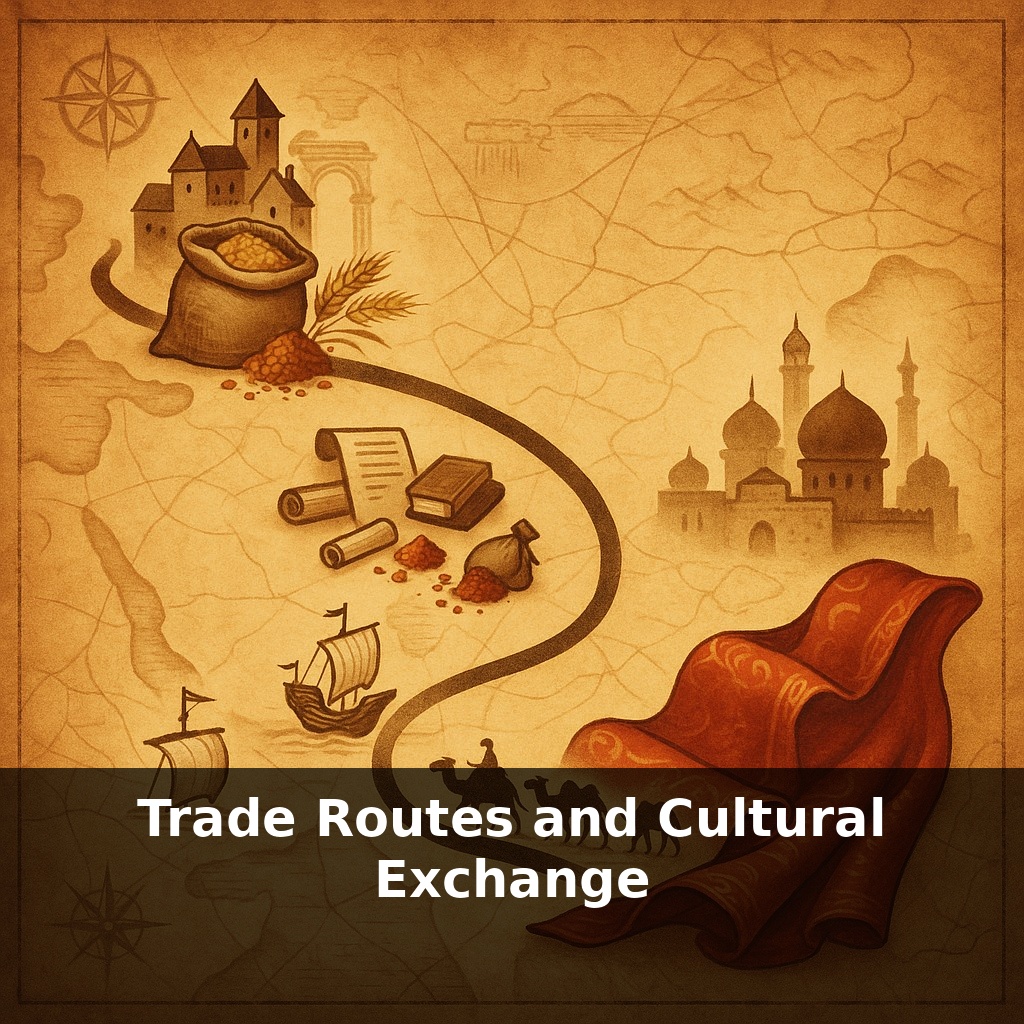
A bolt of silk leaves China and, many handoffs later, quietly helps spark the Italian Renaissance. A sack of Baltic grain arrives in London and changes what bread costs—and what stories sailors tell in taverns. This episode follows the cargo that secretly rewired medieval Europe.
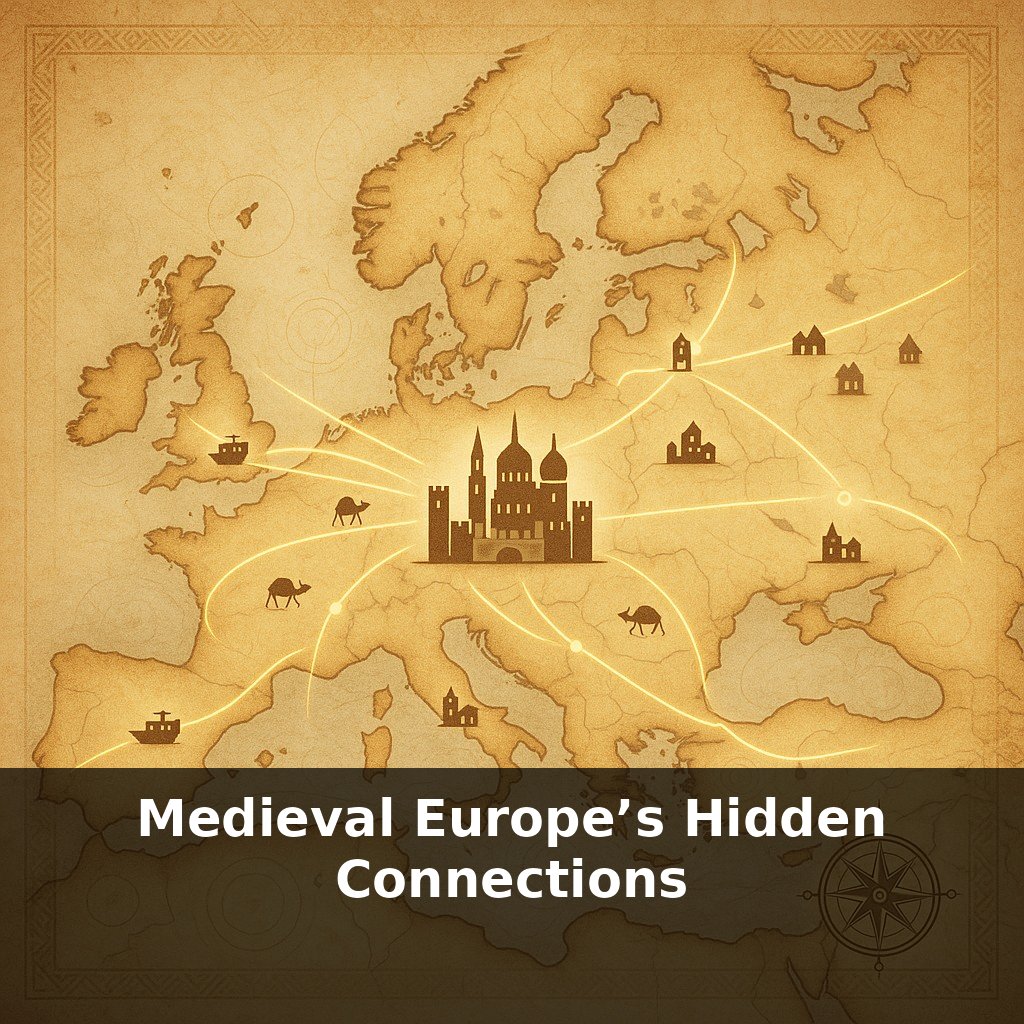
Merchants in the Middle Ages didn’t just chase profit; they stitched together worlds that had never met. Follow one caravan west from Central Asia and you’d find not only spices and dyes, but Buddhist sutras, Persian tales, and new ways of doing math. Follow a ship north from Iberia and you’d see Arabic astronomy manuals tucked beside barrels of olive oil. Ports and market towns became experimental kitchens where ideas were constantly being “re-cooked”: Italian bankers blended Arabic numerals with local bookkeeping, cathedral builders sampled engineering tricks that had traveled from older empires, and storytellers folded foreign monsters into local legends. Even languages started to absorb loanwords the way a stew takes on new flavors. By the time a cargo reached its final buyer, its most enduring contents were often the invisible ones: fresh beliefs, habits, and techniques that quietly rewrote daily life.
Cities along these routes began to specialize the way friends do in a group project: one handled credit, another storage, another security. Lübeck guarded sea lanes; Bruges curated luxury cloth; Italian ports fine‑tuned contracts that could move money faster than any ship. Technologies hitched rides in the background—magnetic compasses slipped from Asian workshops into European hulls, better maps quietly shortened voyages, and paper forms spread through counting houses like a new habit. Religious minorities often ran key links in this chain, turning marginal status into expertise that rulers suddenly couldn’t live without.
Stand on a medieval quayside and follow the money, not the cargo. A bale unloaded in Bruges might be paid for with a bill of exchange drafted in Barcelona, guaranteed in Genoa, and finally settled in a counting house hundreds of kilometers away. Deals like this turned merchants into early experts in risk management, currency conversion, and long‑distance trust. Families such as the Bardi and Peruzzi learned to spread investments across regions so a poor harvest in one zone didn’t ruin them everywhere at once.
Those financial tricks rested on a dense layer of human go‑betweens. Translators in port cities juggled Arabic, Latin, German, and half a dozen dialects. Local “fixers” guided foreigners through tax customs, guild rules, and neighborhood feuds. Jewish, Armenian, and Greek diasporas connected far‑flung markets because cousins in different cities could vouch for each other when no court would. Crusade veterans, suddenly familiar with eastern ports, repurposed wartime routes into commercial corridors, swapping swords for cargo manifests.
The goods themselves mapped out surprising alliances. Northern forests supplied ship timber to Mediterranean yards; in return, southern salt preserved northern fish that fed inland peasants. Flanders’ textile towns depended on English wool, giving kings a reason to keep sea lanes open even when they were at war on land. Pilgrimage shrines doubled as trade fairs: crowds coming to venerate relics also bought imported pigments for altarpieces and spices for elite kitchens.
Step back and the pattern looks less like straight lines and more like a layered codebase in technology: each generation added new “modules” of routes and practices, sometimes clashing with older “versions” but rarely erasing them. Mongol rule across much of Eurasia briefly bundled overland paths into a safer corridor; when that fractured, Mediterranean sea routes and northern leagues absorbed more of the traffic. Shocks—plagues, invasions, bankruptcies—didn’t end the system; they re‑routed it, teaching merchants which connections were fragile and which were resilient enough to rebuild again and again.
In port records you glimpse how deep this web ran. A ship manifest from Gdańsk might list furs from Novgorod, wax from Livonia, and copper from Falun all headed to a single fair in Bruges, where Italian agents snapped them up to finance ventures as far as Alexandria. In Barcelona, notaries began copying Arabic‑style contracts for partnerships that dissolved after one voyage, letting a cautious investor try distant markets without betting the family estate. Art followed these paths: cobalt from Persian mines ended up as the intense blue in French stained glass, while pigments from Afghan lapis gave Italian painters skies that seemed almost supernatural. Musical styles traveled in the wake of sailors’ songs; coastal towns borrowed unfamiliar instruments, adjusting local festivals to fit new rhythms. Even cuisine shifted: northern cooks experimented with dried fruits and sugar from Mediterranean warehouses, while coastal Iberian kitchens folded North African citrus into sauces and sweets that gradually redefined what “local” flavor meant.
Modern routes carry code, patents, and pop culture the way caravans once carried dyes and tales. As shipping lanes shift with melting ice and new canals, entire regions may become “junctions” or cul‑de‑sacs of innovation. Your challenge this week: pick one everyday object—your phone, coffee, or T‑shirt—and trace at least three countries and two historical eras linked to it. Notice how old alliances, conflicts, and routes still shape what feels ordinary today.
Follow this thread forward and today’s cargo looks different—code in a server farm, beans in a barista’s hopper, dyes in a fast‑fashion hoodie—but it moves through the same layered maze of middlemen and weak links. Like tracing the faint rings in a tree stump, every global product quietly reveals storms, grafts, and seasons that shaped its hidden route.
Here’s your challenge this week: Pick one historical trade route mentioned in the episode (like the Silk Road, Indian Ocean trade network, or Trans-Saharan route) and cook a single dish that features at least three ingredients that actually traveled along that route (for example: black pepper, cinnamon, silk-road-era wheat noodles, citrus, or dates). As you cook, keep a map (digital or paper) open and trace the path each ingredient would have taken historically from its origin to your kitchen. Then share the finished dish—and a one-paragraph story connecting your ingredients to that trade route’s cultural exchange—with one other person (in person, text, or social media) before the end of the week.
From this course
Medieval Europe’s Hidden Connections
7 episodesUnlock all episodes
Full access to 7 episodes and everything on OwlUp.
Subscribe — $1.99/monthLess than a coffee ☕ · Cancel anytime