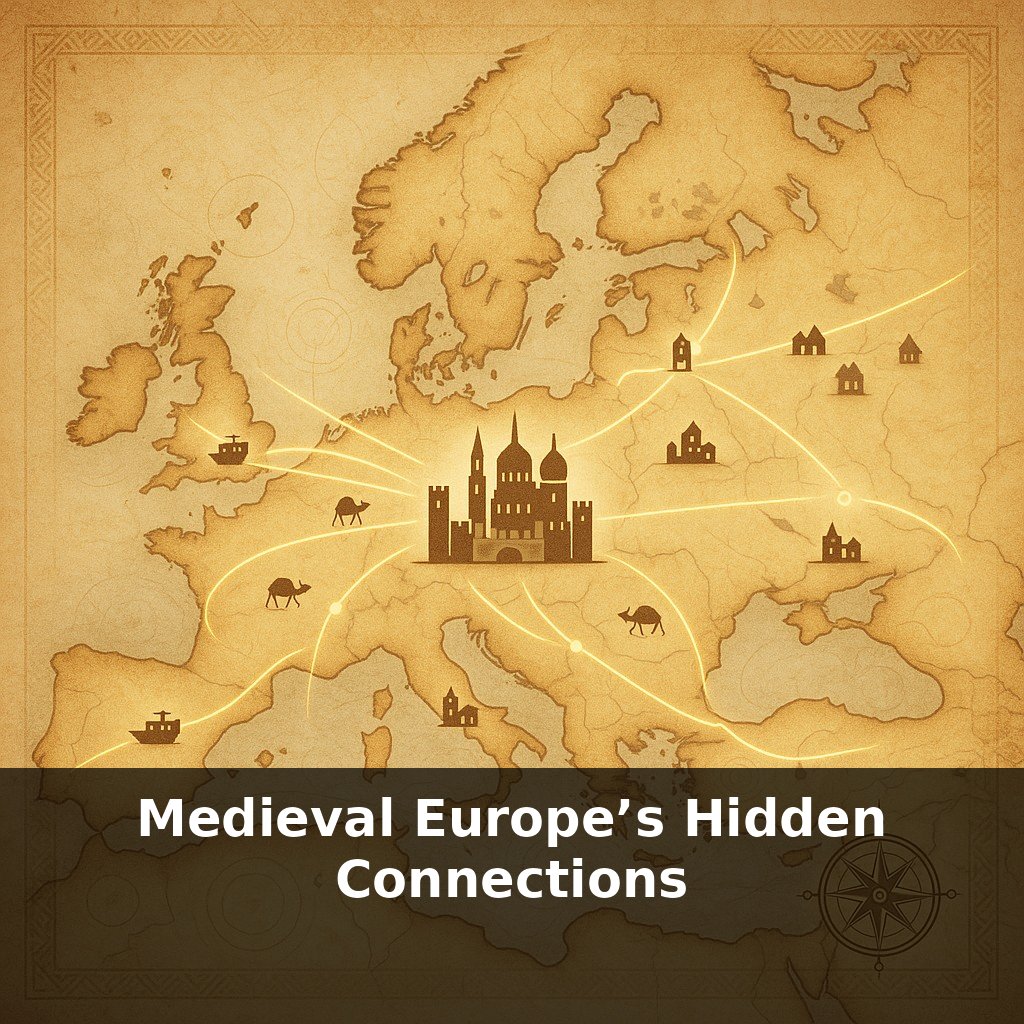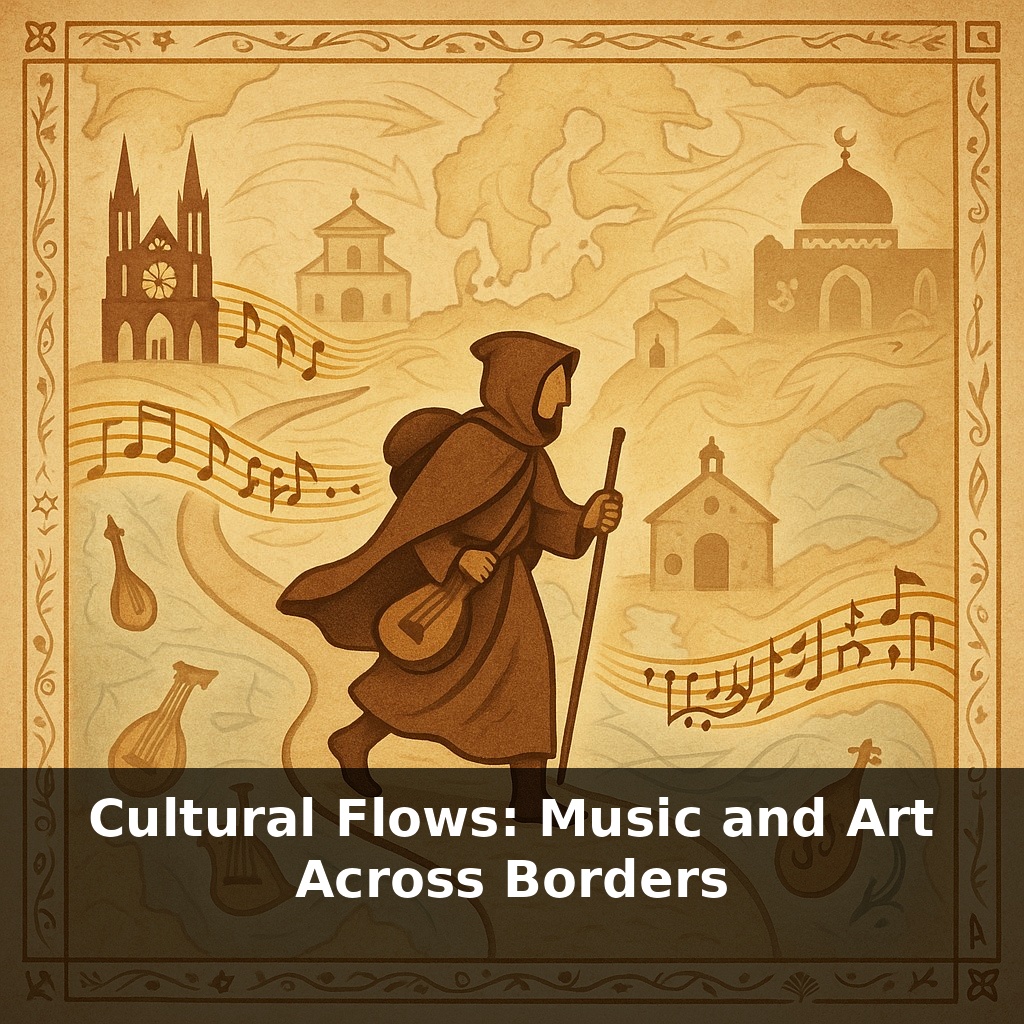
A medieval pilgrim sets out for Spain with a song from home and returns humming a melody from Paris. Along the road, colors from Afghanistan, instruments with Arabic names, and French stone styles collide. How did such a fragmented world create such shared music and art?
Follow those same pilgrimage roads a little further and you run into a puzzle: composers in England notating rhythms invented in Paris, Italian chapels filled with music written by northerners, and church walls in Spain painted with colors mined in Afghanistan. None of this makes sense if we picture culture as staying “in its lane.”
Instead, think about how a modern playlist works: artists from different countries, mixed into one listening session, yet you can still hear where each track comes from. Medieval Europe did something similar with its arts. Royal marriages re-routed choirs, crusades re-routed merchants, and universities re-routed ambitious students, all carrying styles, techniques, and instruments with them.
To see just how interconnected this world was, we need to zoom in on the people and objects actually on the move.
Step off those busy roads and into a cathedral town or a small workshop and the picture sharpens. Choirmasters swapped not just melodies but entire techniques, like sending “source code” for how to build new sounds. Goldsmiths in Bruges copied enamel tricks learned from visitors out of Limoges. A Florentine banker might fund an altarpiece, but the painter’s blue arrived via merchants who never saw the finished work. These crossings weren’t accidents; guild rules, court fashions, and church reforms all nudged artists to borrow, adapt, and quietly smuggle in foreign ideas.
Start with sound. In the 12th and 13th centuries, Paris became a laboratory for a new way of organizing voices: polyphony. Within decades, its methods show up in English monasteries and Iberian cathedrals, often in slightly “bent” form. English composers favored sweeter intervals; Spanish copyists tucked Parisian techniques into local devotional songs. When scholars tally 15th‑century Italian music books and find a striking share in the hands of northern scribes, they’re catching this process mid‑flow: expertise traveling with people, then embedding itself in local habits.
Visual culture moved just as restlessly. The style we label “International Gothic” wasn’t invented in one city; it coalesced as painters and illuminators followed courts from Prague to Paris to Naples, adjusting to new audiences as they went. A Bohemian artist might learn French ways of drawing drapery, then apply them to saints that local viewers expected to recognize instantly. The result feels coherent across Europe, but small details—facial types, patterns, favorite colors—give away where a work was made.
Materials themselves enforced long‑distance connections. Ultramarine, ground from lapis lazuli mined in today’s Afghanistan, had to pass through layers of traders before landing on a panel in Florence or Cologne. Its expense meant patrons often specified exactly where that blue would appear: the Virgin’s cloak, a crucial sky, a heraldic shield. A painter in Siena, deciding whether to spend on ultramarine or a cheaper blue, was making a choice shaped by mining, caravan routes, and Mediterranean shipping.
Instruments tell a similar story in miniature. The lute, whose very name preserves Arabic al‑ʿūd, entered Christian Europe through contact zones in Iberia and Sicily. Once there, it was refitted to local tastes: new tunings, new repertories, eventually new shapes. By the 15th century, a court in Burgundy might prize “Italian” lutenists playing pieces whose distant ancestry ran through Muslim Spain.
If you trace enough of these trajectories—of styles, hands, pigments, and sounds—you start to see that “French,” “Italian,” or “English” art in this period often meant a distinctive blend, not a sealed tradition.
Consider a single 15th‑century choirbook in a Florentine chapel. On one page, you might find a Mass by a Franco‑Flemish composer, copied by a German‑trained scribe, bound by a local artisan, and paid for by a banker whose income depended on loans to courts in France. None of these people needed to meet. The book itself is the meeting point. The same goes for an altarpiece in Aragon whose gold leaf techniques echo Venice, while its halo patterns recall patterns seen in North Africa. Follow the details—letter shapes in the notation, border doodles in the margins, the way a nose is drawn—and you can often tell where the maker learned their craft, which city they last worked in, or which workshop they were quietly imitating. Like a software project incorporating open‑source libraries from different developers, a single medieval artwork can bundle together solutions devised hundreds of miles, and decades, apart, yet present them as one seamless whole.
Roughly mapping these old routes with AI and digital archives doesn’t just satisfy curiosity; it can reshape policy and creativity now. If algorithms can cluster works by hidden kinships of line or rhythm, they might reveal forgotten border zones of collaboration. Your favorite “global” playlist or fusion art show could then be curated less like novelty, more like a continuation of deep patterns—closer to re‑opening an old port than inventing a new world.
Seen this way, “national style” starts to look more like a marketing label than a hard boundary. Borders shifted, dynasties fell, but habits of line, color, and rhythm kept flowing, like a shared codebase that outlived its original team. Next time you hear a “fusion” track or see “world music” on a shelf, ask: which older currents are quietly resurfacing here?
To go deeper, here are 3 next steps: (1) Pick one cross-border collaboration platform like SoundCloud or Bandcamp and spend 20 minutes today exploring artists tagged with two different regions you heard mentioned in the episode (for example, “Afrobeats” + “UK” or “K-pop” + “Latin”), then follow at least three new artists whose sound clearly mixes those cultures. (2) Watch one Tiny Desk or COLORS Show performance today that features a hybrid-genre artist (e.g., Sudan Archives, Lido Pimienta, or Omar Apollo), and while you listen, pull up the lyrics on Genius to see how language, place, and references travel across borders in that song. (3) Before the week’s over, stream one documentary that zooms in on cultural flows—like “Buena Vista Social Club,” “Ryuichi Sakamoto: Coda,” or “Breakin’ Convention: Hip Hop Dance Theatre”—and keep Shazam open on your phone to capture tracks you don’t recognize, then build a new “Cultural Flows” playlist from what you discover.