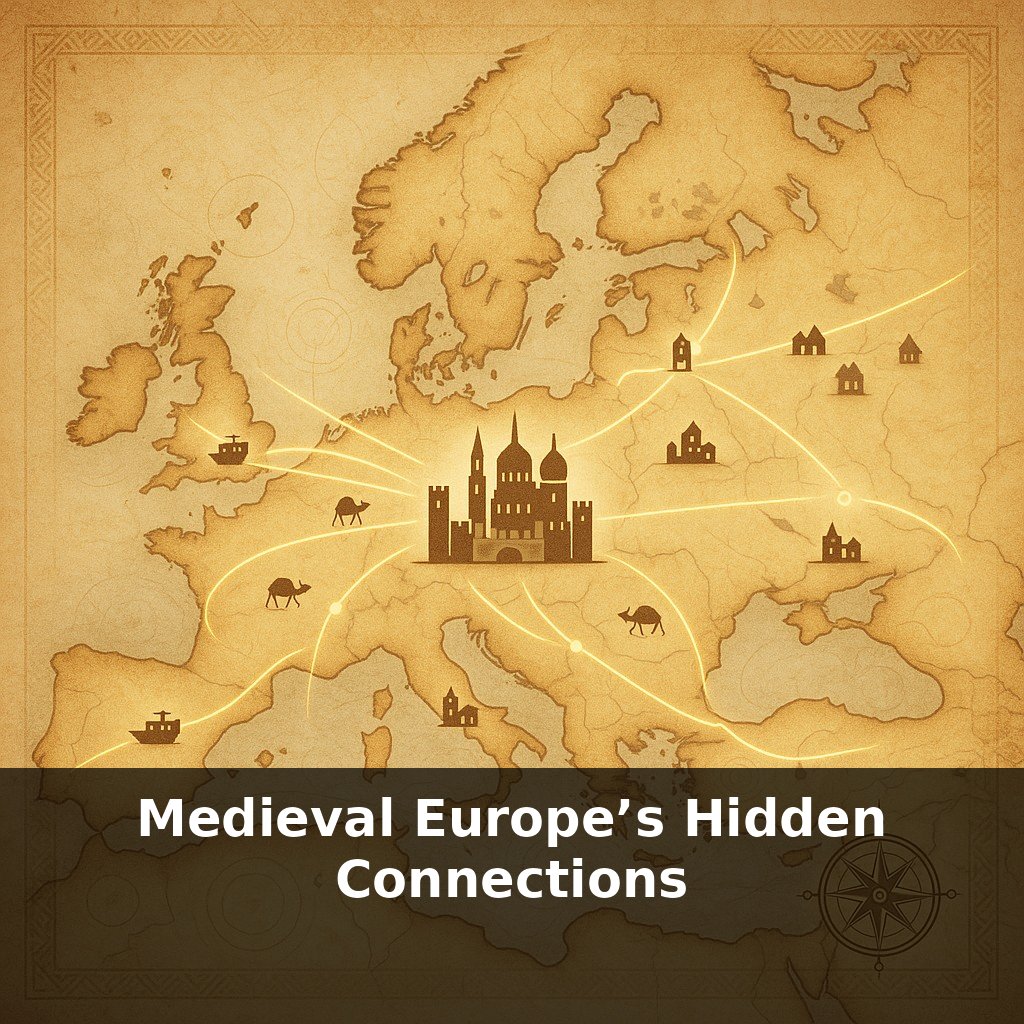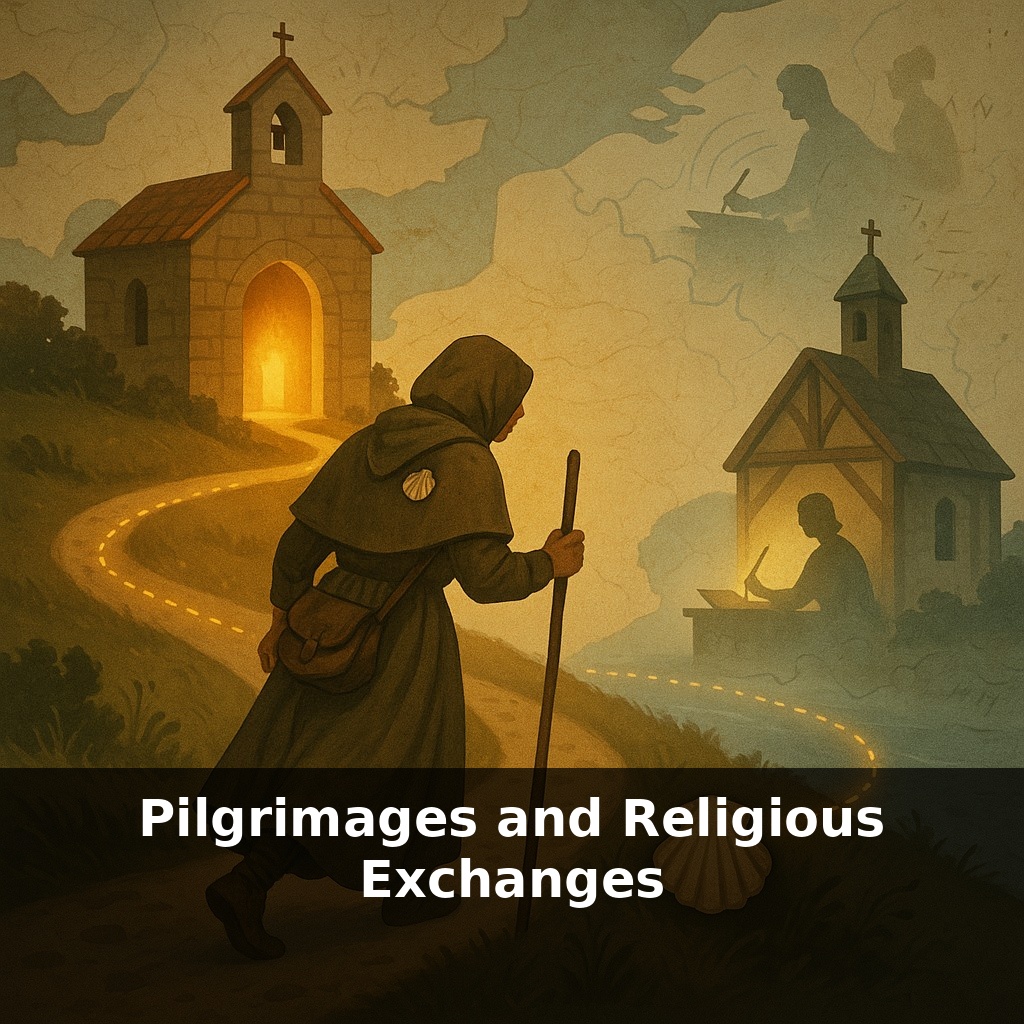
A woman limps into a roadside chapel in France, praying for her foot to heal. Months later, a storyteller in England repeats her tale—though he’s never left home. How did her private pain become shared European gossip, without printing presses or podcasts?
By 1300, as many as a quarter of the adults in some regions of Europe would go on at least one long-distance pilgrimage in their lifetimes. That doesn’t just mean crowded roads; it means whole villages temporarily hollowed out, contracts delayed, harvest plans rearranged, and family roles shuffled so someone could walk hundreds of kilometers toward a shrine.
Those journeys stitched together people who otherwise would never have met. A stonemason from Burgundy might share a bench with a Welsh shepherd, both squinting at the same painted altar. A Venetian shipmaster could swap news with a German nun while they waited for a favorable wind to sail east.
Along the routes, multilingual priests, innkeepers, money changers, and guides became experts in translating not only words but expectations. They learned to convert one region’s customs, currencies, and anxieties into terms a stranger could actually use.
By the 12th century, certain routes had become so busy that whole micro-economies grew up around them. Bakers timed fresh bread for the dawn departure, blacksmiths adjusted iron shoes for both horses and people, and money changers juggled coins from half a dozen kingdoms in a single purse. Markets near major shrines quietly stretched local tastes: an English farmer might try figs for the first time; a Catalan trader might pick up wool-cloth styles from Flanders. As on a crowded trading floor, proximity forced experimentation—new deals, new diets, new ways of praying—into everyday life.
By the late Middle Ages, those roads had become thick with layers of meaning you could literally wear on your chest. Pilgrim badges—cheap pewter tokens in the shape of scallop shells, saints, or tiny flasks—worked like portable résumés. A stranger at a riverside fire didn’t need to ask where you’d been; a quick glance at your cloak announced “Compostela,” “Canterbury,” or “Rome.” In ports and fairs, clusters of the same badges helped strangers sort themselves into ad‑hoc communities: Castilian speakers here, English there, veterans of Jerusalem over by the fire who knew which shipmasters to trust.
Authorities understood the power of these flows and tried to steer them. Kings and city councils issued safe‑conducts, toll exemptions, or special market charters that turned feast days into economic windfalls. Compostela’s privileges for merchants didn’t just make the road busier; they nudged trade routes ever so slightly westward, so that wool, wine, and metal goods followed in the wake of prayers. A pious journey could double as an informal trade mission, especially for artisans who carried sample wares in their packs.
Hospitals and hospices along the way quietly became data banks of human bodies. Staff saw wounds, fevers, and childbirth complications from half the continent pass through their doors. Treatments that seemed promising in one valley could be tried, tweaked, and carried onward by healed patients who remembered which herbs or procedures had helped. Over decades, that turned some shrines into hubs for circulating practical medical know‑how, even when no one involved would have called it “research.”
Not all traffic moved smoothly. Seasonal waves of travelers strained bridges, forests, and grain supplies. Local lords worried about vagrancy or heresy piggybacking on the crowds. Yet attempts to clamp down—curfews, licensing of guides, tighter control of relics—often produced more paperwork than order, and the records of those frictions now give historians some of their best evidence for how dense the movement really was.
Theologically, too, the road worked in both directions. Central authorities promoted a standardized Latin Christianity, but regional shrines smuggled local saints, songs, and miracle stories into the shared repertoire. Over time, a pilgrim from Poland and one from Portugal might not share a language, but they could recognize each other’s badge, chant the same refrain at mass, and navigate a broadly familiar ritual script.
In practice, those routes functioned a bit like an open‑source code repository: thousands of “users” continually uploaded small tweaks, which others then forked, patched, or discarded. Take music. A choirboy from Lübeck might hear a catchy refrain at Chartres, hum it all the way home, and fold it into a local hymn with slightly altered words. Over decades, scholars can trace melodic “families” radiating out from major shrines, their variants revealing which paths were most trafficked. Visual styles traveled just as quietly. A mason pausing at a Burgundian church might sketch an unfamiliar arch profile on a wax tablet, then experiment with it in stone hundreds of kilometers away. Even legal habits migrated: notaries comparing contracts at busy feast‑day courts picked up phrasing and clause structures, so a clause first coined in northern Italy could surface, thinly disguised, in a charter from the Low Countries a generation later. The road made imitation respectable, even pious—if it worked elsewhere, why not here?
A London–Jerusalem pilgrim might cross more borders than most modern tourists. Today, researchers mine that movement with tools the travelers never imagined: isotope tests on pewter, network models built from charters, even scrape marks on cooking pots. The picture that’s emerging hints at blueprints for low‑carbon tourism corridors and interfaith routes. Think of planners “forking” medieval pathways, then patching them for visas, Wi‑Fi, and climate resilience instead of river fords and bandits.
The puzzle is how many quiet experiments never left a trace. A healer’s new poultice, a delayed feud settled on the road, a song mashed up from three languages—most vanished like chalk in the rain. Yet enough stuck that, centuries later, we can still see their outlines and ask: if shared walking once rewired a continent, what might shared routes change for us now?
Here’s your challenge this week: choose one pilgrimage tradition you heard about in the episode (like the Hajj, the Camino de Santiago, or the Kumbh Mela) and spend 30 focused minutes today retracing one of its routes using maps, photos, and at least one first‑person account from an actual pilgrim. As you “walk” the route digitally, pause three times to note a specific exchange that happens there—such as a shared meal, a multi-faith encounter, or a marketplace interaction—and then deliberately recreate just one of those exchanges in your own context before the week ends (for example, inviting someone of a different background for tea and framing it as a mini-pilgrimage meeting point). By next weekend, briefly explain the tradition, the route, and the exchange you recreated to one other person, so the chain of religious exchange continues through you.